ATV Rodeos and Poker Runs at Syracuse
ATV rodeos and poker runs can turn a day at Syracuse Sand Dunes into a social event, but the details matter: routes, machine rules, sign-up procedures, and what your entry covers may vary by organizer. This guide explains how these gatherings typically work, how to prepare for the dunes, and what to confirm before towing your ATV or UTV to Hamilton County.
What to expect at a Syracuse ATV rodeo or poker run
How a poker run usually works
A poker run is generally a ride with several designated checkpoints. At each stop, participants collect a playing card or another marker; the goal is to assemble the best hand, or sometimes simply complete the route and turn in the required cards. The organizer sets the rules, so don’t assume every ride uses the same scoring method, route, or finish-line process.
At a large riding area, checkpoints may be spread across sections of terrain or organized around a route that keeps riders moving through the event. You might travel with friends, join a group, or ride at your own pace within the event’s rules. Ask whether the route is marked, whether a map is provided, and what to do if you miss a checkpoint or need help.
Poker runs are often fundraisers or community gatherings, but the cause and format can differ. Check the event notice for the organizer, registration instructions, start and finish locations, and any deadlines. If you’re interested in how these rides fit into the broader Kansas scene, [Kansas Poker Runs and Charity Rides] offers related context.
What an ATV rodeo can include
“Rodeo” can mean different things from one event to another. It may involve informal games, a skills challenge, a parade-style ride, friendly competitions, or activities for different age groups. The name alone doesn’t tell you whether the event is designed for experienced riders, families, or a mix of both.
Before entering a challenge, look closely at the machine requirements and participation rules. A timed obstacle or maneuver may suit a small ATV but not a longer, heavier side-by-side. If passengers are allowed, confirm whether the activity is safe for them and whether the organizer has special age or equipment requirements. Don’t feel pressured to take part in an activity that exceeds your comfort level.
The most useful question to ask is, “What will participants actually do?” An organizer can explain whether there are skill stations, a group ride, a prize drawing, or a course with specific riding expectations. That small check can prevent a family from arriving with one idea of the day and finding a very different event at the gate.
Events are separate from everyday riding
A scheduled event may add registration, group-riding procedures, designated gathering areas, or temporary route instructions. Those arrangements don’t automatically apply on an ordinary riding day, and everyday park access doesn’t necessarily include event participation. Read the event notice and the riding area’s rules as two related but separate sets of information.
The location’s standard rules still matter. Check where machines may ride, what equipment is required, how passengers are handled, and whether any areas are temporarily restricted. If an event organizer gives a route briefing, follow it even if you’ve visited Syracuse before. Familiarity with the dunes doesn’t mean you know the day’s event layout.
For a broader look at the riding area itself, see [Syracuse Sand Dunes in Kansas]. It’s a useful starting point for separating general destination planning from event-specific instructions.
Plan for the terrain at Syracuse Sand Dunes
Expect sand to change how your machine behaves
Syracuse Sand Dunes is in Hamilton County in western Kansas, where the terrain and weather can make the ride feel different from a wooded trail or hard-packed gravel road. Sand can shift under tires, hide ruts, and make a familiar-looking slope more demanding than it first appears. A route that seems straightforward on foot may require more throttle control and space when you’re riding.
Ride at a pace that leaves room to react. Avoid following another machine so closely that you can’t see the ground ahead, especially near a crest or turn. When visibility is poor because of dust, slow down and give other riders more room. A passenger can make an abrupt maneuver more consequential, so talk through basic signals and expectations before you set out.
Tire setup is a common question for sand riding, but there isn’t one adjustment that suits every machine, rider, and condition. Follow your manufacturer’s guidance, consider your experience, and ask the park or event organizer about any applicable restrictions. For more background on the local riding conditions, [Kansas Dune Riding in Hamilton County] explores the setting and what sand riding can involve.
Choose routes that fit your group
A group event can bring together riders with very different machines and experience levels. A confident adult on a familiar ATV may be comfortable with terrain that feels intimidating to a new rider or a child. Agree on a pace and regrouping plan before you leave the staging area, rather than trying to negotiate it while everyone is moving.
A simple plan helps: decide who will lead, who will ride at the back, and where the group will stop if someone gets separated. Make sure every rider knows the event’s meeting point and what to do if a machine has a problem. If your group includes young riders, keep the route and pace appropriate for the least experienced person—not just the most capable machine.
Do not assume a poker-run route is suitable for every vehicle simply because it is part of an organized event. Ask whether side-by-sides and ATVs follow the same route, whether any sections have width or skill restrictions, and whether there is an easier option. If your machine or rider isn’t a good fit for a challenge, skipping that portion is a sensible choice.
Use maps as planning support, not permission
A map can help you understand the broader area, plan your drive, and keep track of a group’s intended route. Tools such as onX Offroad may be useful for organizing a ride and saving map information for areas where cell service is unreliable. Before relying on any digital map, check what it actually shows and whether you can access the information offline.
A map is not a substitute for current property rules or event instructions. A line on a screen does not establish that a route is open, that you have permission to ride there, or that it is part of the poker-run course. Confirm riding boundaries and closures with the park or event organizer, and follow posted signs even if your device suggests another path.
The same caution applies when riders share downloaded routes with friends. One person’s saved track might reflect a past visit or a personal ride rather than the official event route. Treat it as a planning aid, not a promise about access. For more preparation ideas, [Kansas ATV Trail Map Downloads] and [Kansas Trail Conditions Before You Tow] are useful related reads.
Prepare your machine and riding group
Inspect the machine before the drive
A problem that might be manageable in your garage becomes more frustrating after a long tow to western Kansas. Before leaving, inspect tires, wheels, brakes, steering, lights, controls, and visible fluid leaks. Check the fuel situation and any machine-specific maintenance items your owner’s manual recommends. If your machine has been sitting, don’t wait until the staging area to find out that the battery is weak or a tire is losing air.
For a side-by-side, check seat belts, doors or nets, and any protective equipment fitted to the machine. For an ATV, confirm that the rider can control the machine confidently and that the controls are working as expected. Carry basic tools and items appropriate to your machine, but don’t attempt a repair beyond your ability in a crowded or unsafe area.
Riders often focus on the vehicle and forget the trailer. Check tie-downs, ramps, trailer lights, tires, hitch connections, and the way the machine is secured. On the drive to Syracuse, a loose strap or an unbalanced load can turn the trip into a roadside problem before the riding day even starts.
Pack for a full day outdoors
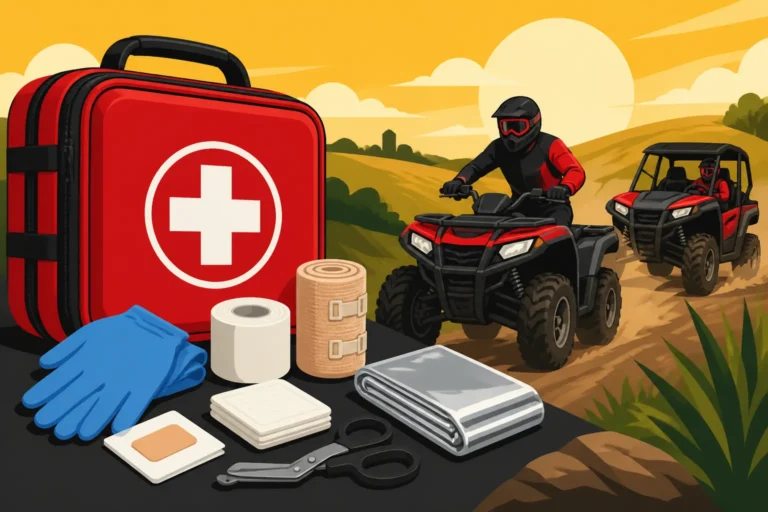
Bring water, weather-appropriate clothing, eye protection, gloves, and a first-aid kit. Dust, wind, sun, and changing temperatures can make a day outdoors feel longer than expected. A light layer that seemed unnecessary in the morning may be welcome later, while a hot, exposed afternoon can make shade and hydration especially important.
Keep essentials where you can reach them without unpacking the whole trailer. Put keys, identification, event instructions, and any required paperwork in a secure place. If a group is splitting up, each rider should know the meeting point and have a way to communicate or get help that doesn’t depend entirely on cell service.
For a family, pack with the youngest rider in mind. A child may need extra water, snacks, sun protection, or a break before the adults are ready to stop. Build rest periods into the plan rather than treating them as a sign that the day has gone wrong. If the group is camping, check the park’s current facilities and rules before assuming you can arrive and set up without advance planning.
Agree on group rules before riding
A quick pre-ride conversation can prevent a lot of confusion. Decide whether the group will stay together or ride in smaller groups, what signal means “stop,” and where everyone should regroup. Establish a simple rule for a breakdown or a rider who falls behind: stop in a safe place, communicate, and don’t send one person off alone without a clear plan.
Talk about passing, following distance, and visibility. Dust can make it difficult to see a rider who is just ahead, so leave enough space to respond. Avoid sudden turns across another rider’s path, and be especially cautious when approaching a crest where you can’t see who may be coming from the other side.
If participants are riding at different skill levels, make it clear that nobody needs to keep up with the fastest rider. A relaxed pace is often more enjoyable than turning a community ride into a test of speed. The organizer’s instructions come first, but your group can also agree to ride conservatively and take breaks when needed.
Check event details before you tow
Confirm the schedule and registration process
Event information can change, so confirm the date, start time, registration procedure, and event contact before you load the trailer. Find out whether sign-up happens in advance, at the venue, or through another process. Ask when riders should arrive, where they should park, and whether the event has a briefing or a fixed departure window.
The wording of an announcement may not explain exactly what an entry includes. Ask whether it covers the ride only, a meal, a prize drawing, or other activities. If the event is supporting a charity or local cause, check whether donations or optional activities are separate from registration.
A call or message to the organizer can also clear up practical questions: Are late arrivals permitted? Can a participant join after the group has started? Is there a separate procedure for children or first-time riders? These details are much easier to sort out before you’re in the parking area with a machine unloaded and everyone waiting.
Ask about machines, riders, and required gear
Don’t assume the event welcomes every machine or that every activity is open to every age group. Ask whether the route accommodates your ATV or side-by-side, whether passengers may participate, and whether there are restrictions based on size, equipment, or rider age. If the organizer can’t answer a machine-specific question, check the park’s rules before you travel.
Also ask what protective gear is expected. Helmet requirements can depend on the setting, event rules, and applicable law, so don’t rely on what another rider wore at a previous gathering. Even where a particular item is not specified for every participant, suitable protective gear is a practical choice for off-road riding.
Use the same approach for pets, alcohol, camping, and other activities that can affect a group’s plans. A friend may have visited the dunes under different conditions, and an old social post may no longer reflect the event’s setup. [Syracuse Sand Dunes Park Rules] is a helpful companion topic, but confirm current event instructions directly with the organizer.
Check camping, facilities, and reservations
If you want to camp, verify whether camping is available for your dates and whether you need to reserve a site. Ask what facilities are open, what hookups or amenities are offered, and where generators or campfires are permitted. Don’t plan around a facility unless you have confirmed it will be available for your visit.
A poker run or rodeo can make a busy weekend busier. If you’re traveling with a large group, ask whether there is room to park trailers together and whether the event has a designated staging area. Arriving without a plan can leave you separated from friends or searching for space while the registration window is underway.
Some visitors also build extra time into the trip for other activities at or near the area. Check what is available and what rules apply rather than assuming every amenity is included with event access. The post [Syracuse Sand Dunes Has a 40-Acre Stocked Pond] covers a related feature, while [Kansas Riding Areas That Take Reservations] can help with broader trip planning.
Make the ride safer and more enjoyable
Ride with visibility and spacing in mind
At a busy event, riders may be approaching from different directions and moving at different speeds. Keep a generous following distance, slow down where sightlines are limited, and avoid stopping in the middle of a route where another rider may not expect you. If you need to pull over, choose a place where you and your machine are easy to see.
Dust deserves particular attention. A machine ahead can quickly disappear in a cloud, leaving you with less time to react to a turn, a stopped rider, or uneven ground. Give the dust room to settle, and don’t treat the rider in front as a guide if you can no longer see the surface clearly. If conditions make it hard to see, slow down or stop in a safe location until visibility improves.
Follow the organizer’s route directions and any posted signs. A shortcut may take you away from the event route or into an area where riding is not allowed. If you’re unsure whether a path is open, pause and ask rather than relying on assumptions or another rider’s guess.
Keep the social part welcoming
Rodeos and poker runs can be a great way to meet local riders, especially if you’re new to the area. A little patience goes a long way: let organizers finish their briefing, give newcomers time to prepare, and avoid pressuring anyone to ride beyond their ability. The best event memories usually involve a good day with the group, not just a winning hand or a fast lap.
If you’re attending with children, explain the event routine before arriving. Show them where the group will meet, identify a trusted adult to stay with, and agree on what they should do if they get separated. A noisy staging area can be exciting and distracting, so keep children close around moving machines and trailers.
For riders who want to find more community events, local riding groups can be a useful place to hear about organized rides and volunteer opportunities. [Kansas ATV Clubs Worth Joining] is a related resource. Still, verify each event’s information with its organizer; a club discussion or shared post may not contain every rule or update.
Use a practical pre-departure checklist
Before leaving home, confirm the event details and make sure everyone knows the plan. Check the machine, trailer, gear, and route to Syracuse. Keep event instructions handy, and identify a contact person in case your group is delayed or separated. If you are traveling with more than one vehicle, share the destination and meeting point with every driver.
At the venue, take a moment to listen to the briefing before unloading or joining a group. Confirm the route, checkpoint process, schedule, and any changes to normal riding arrangements. If something is unclear, ask before starting. It is much easier to sort out a question at the staging area than halfway through a ride.
A simple event comparison can help you spot the details that deserve a call or message:
| Detail to confirm | Why it matters |
|---|---|
| Registration and arrival time | Helps you avoid missing sign-up or the ride briefing |
| Route and checkpoint instructions | Clarifies where to go and how participation is counted |
| Machine and passenger rules | Ensures your ATV or UTV and riders fit the event |
| Protective gear expectations | Avoids surprises and supports safer riding |
| Camping and parking arrangements | Helps your group plan where to stay and stage trailers |
| Weather or event updates | Lets you respond to changing conditions before towing |
A little preparation makes it easier to enjoy the social side of an ATV rodeo or poker run without getting caught off guard by route confusion, equipment issues, or missing event information. Confirm the details, ride within your group’s abilities, and treat posted rules and organizer instructions as part of the day’s plan.
Disclaimer
This article is for general informational purposes only and does not constitute professional advice. Laws, prices and regulations vary by location and change over time. Consult a qualified professional for guidance on your specific situation.