Kansas ATV Trails: Where You Can Actually Ride
Kansas riders can’t assume that every public-looking gravel road, reservoir shoreline, or stretch of pasture is open to ATVs and UTVs. The good news is that Kansas does have places to ride, from Corps-managed areas to private off-road parks. This guide explains where to start, what the terrain is like, how to choose a suitable machine, and what to check before towing.
Where Kansas ATV and UTV riding is actually allowed
Kansas doesn’t have a sprawling network of state-managed OHV trails. Riding opportunities are concentrated in a handful of designated areas and privately operated parks. That makes planning especially important: a road near a reservoir or a track across open-looking land is not automatically an authorized riding route.
A useful first step is to separate riding areas into two broad categories: public sites with designated riding access, and private parks with their own admission and operating rules. Then check the particular site’s current conditions before you load up. The [Kansas ATV Trails: Where You Can Actually Ride] guide is a useful starting point for understanding the small number of established options.
Public riding areas are specific, not statewide permission
The presence of public land does not mean you can ride anywhere on it. At a Corps of Engineers recreation area, for example, riding may be limited to a designated OHV area or to certain roads. A nearby beach, campground, wildlife area, boat ramp, or unmarked track may have different restrictions. Always follow signs and the managing agency’s instructions at the site.
This distinction matters around familiar destinations such as Tuttle Creek Lake, Milford Lake, and Perry Lake. They’re large recreation areas, but the fact that a machine can be unloaded near the water doesn’t establish where it can legally go. Before the trip, check the specific riding location rather than relying on a general map of the lake or recreation area.
Kansas also does not operate a broad state-park OHV trail system. That surprises riders who are used to visiting state parks in other states and finding marked ATV loops. Kansas state parks can have rules for vehicle use on roads and in other areas, but that should not be mistaken for a dedicated trail network. See [Kansas State Parks Have No OHV Trails] and [Kansas Corps of Engineers Riding Areas] for a closer look at the difference.
Private parks fill much of the trail-riding gap
Private off-road parks are an important part of the Kansas riding picture. They may offer terrain that is hard to find at public recreation areas, including rock obstacles, sand, marked routes, or designated areas for particular types of machines. The operator sets the park’s rules, so check its requirements for machine size, passengers, helmets, age limits, sound, safety equipment, and arrival procedures.
Private parks can also make a first ride easier to plan. Instead of trying to work out whether a rural lane is open to public use, you’re riding in a managed setting with an established entrance and a defined set of rules. That doesn’t mean every park is beginner-friendly or that every trail suits every vehicle. It means you can investigate the terrain and restrictions directly with the operator before you go.
Kansas Rocks Recreation Park near Mapleton and Syracuse Sand Dunes near Syracuse are two well-known private options, but they offer very different experiences. One is associated with rocky terrain; the other with sand. Comparing those conditions with your machine’s capabilities and your group’s experience is much more useful than choosing a park based only on mileage from home. More about the private options is covered in [Kansas Private Off-Road Parks].
Kansas riding areas at a glance
A few destinations account for much of the state’s established ATV and UTV riding. Use the table to narrow down your choices, then confirm details with the site manager or park operator. Access, permitted machines, conditions, and operating rules can change, so treat this as a planning guide—not a substitute for current site instructions.
| Riding area | General location | What riders may encounter | Best planning question |
|---|---|---|---|
| Tuttle Creek ORV Area | Near Randolph, north of Manhattan | A designated public ORV area near Tuttle Creek Lake | Is the area open, and does it suit your machine and group? |
| School Creek ORV Area | Near Milford Lake | A designated public riding area with machine-size limits to check | Does your vehicle meet the site’s width and vehicle rules? |
| Perry Lake Spillway riding area | Near Perry Lake, north of Lawrence | A designated riding location near the spillway area | Which routes and riding boundaries are currently open? |
| Kansas Rocks Recreation Park | Near Mapleton in Bourbon County | Private park terrain associated with rocks and technical obstacles | Is your machine and experience level suitable for the route you want? |
| Syracuse Sand Dunes | Near Syracuse in Hamilton County | Private sand-riding terrain | What equipment and safety requirements apply to dune riding? |
Tuttle Creek suits a reservoir-area riding day
Tuttle Creek ORV Area is near Randolph, a small community north of Manhattan. Its location makes it a practical option for riders coming from the Manhattan area or other parts of northeast Kansas, but don’t treat the lake’s entire shoreline as an extension of the riding area. Stay within the designated boundaries and follow posted instructions.
Before towing, confirm that the area is open and ask about current conditions. Rain can change traction, ruts, and the difficulty of a route; maintenance or other closures can affect access. If you’re taking a group with mixed experience, ask which parts of the area are appropriate for newer riders rather than assuming every route is equally manageable.
It also helps to plan the basics: where you’ll park and unload, whether there are facilities nearby, how much fuel to bring, and what you’ll do if someone has a mechanical problem. Don’t count on being able to buy fuel or supplies at the riding area itself. For location-specific details, see [Tuttle Creek ORV Area in Kansas].
School Creek calls for a careful machine check
School Creek ORV Area is associated with Milford Lake. It deserves particular attention from side-by-side owners because site restrictions can exclude wider machines. A vehicle that is perfectly suited to another Kansas riding area may not be allowed here. Check the posted limit and measure the machine as the site defines width before making the drive.
Do not rely only on the width listed in a sales brochure. Accessories, wheels, or other modifications can affect the actual measurement. If the rule is based on a maximum width, confirm how the park or managing agency measures it and whether your particular configuration complies. Showing up with a machine that doesn’t fit the rules can turn a long drive into a disappointing day.
School Creek can be appealing if your machine is within the permitted limits and you want a designated public riding area near Milford Lake. But suitability is more than legality: consider the terrain, your passengers, and the experience of the least confident rider in your group. Details about the site’s restrictions are available in [School Creek ORV Area in Kansas] and [Kansas Trails That Allow Side-by-Sides].
Perry Lake provides another public-area option
Perry Lake Spillway is a named riding destination north of Lawrence. As with other public sites, the important question is not simply whether you’re near the lake; it’s whether the particular area or route is designated for your machine. Confirm the riding boundary, available access, and any closures before heading out.
For a first visit, give yourself time to learn the layout rather than arriving late and rushing to unload. Check where trailers should be staged and whether your planned route returns to the same access point. Bring a map or a reliable navigation plan, and don’t assume that a small track visible on a screen is open for riding.
This is also a good place to think through the group’s pace. A rider comfortable on uneven ground may move faster than a passenger or newer operator expects. Agree on meeting points and a simple plan for what to do if the group gets separated. See [Perry Lake Spillway Riding in Kansas] and [Kansas Corps Areas That Charge Nothing] for related public-area information, then verify details with the site manager.
Choose a riding area that matches your machine and experience
A good riding day depends on more than finding an open gate. A narrow trail, a rock ledge, loose sand, or a muddy climb can be a very different challenge for a youth quad, a full-size ATV, and a four-seat UTV. Match the terrain and access rules to both the vehicle and the least experienced person in your group.
If you’re uncertain, call the operator before you leave. Describe the machine by type, size, and any major modifications. Ask whether the area has routes suitable for beginners and whether there are restrictions on passengers. A clear answer before the trip is far better than discovering at the entrance that your plans don’t fit the site.
Check vehicle fit before committing to a destination
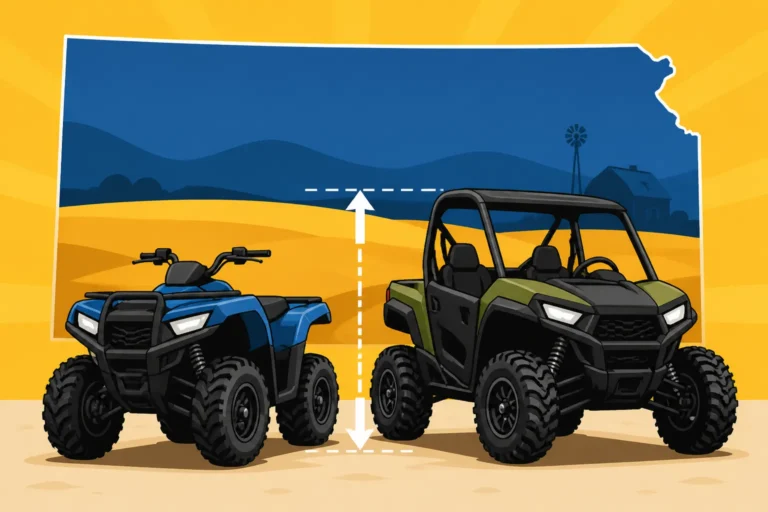
The width and type of your machine can determine where you can ride. School Creek is one example where a width restriction deserves advance attention. Other areas may also have rules about vehicle categories, passenger capacity, tires, or permitted use. Don’t assume that “ATV-friendly” automatically means every UTV is allowed.
Measure your vehicle in the way the site requires. If you’ve added wider tires, wheel spacers, a plow, or other equipment, ask whether the measurement includes those parts. When rules refer to a specific class rather than a simple width, check how the site defines that class. The general guide [Kansas Trails That Allow Side-by-Sides] can help you frame the questions to ask.
Also consider practical vehicle capability. A long, wide UTV may be comfortable for passengers and gear, but it can be awkward on narrow or technical routes. A small ATV may fit more easily but offer less storage and fewer passenger options. Neither is universally better; the right choice depends on the site and how you plan to ride.
Match terrain to your group’s comfort level
Sand and rock demand different techniques. In loose sand, momentum and smooth throttle control can matter; sudden braking or sharp steering can make a machine bog down. On rocky ground, careful line choice and slow, deliberate movement help reduce the chance of striking the undercarriage or losing traction. A route that feels exciting to an experienced rider can be stressful for a first-timer.
Think about the least experienced rider—not the most confident one—when choosing a destination. If one person in the group has never ridden off-road, a technical obstacle area may create pressure to follow others into a challenge they aren’t ready for. Let riders turn around or take an easier route without making them feel they’re holding the group back.
Families should also consider machine size, supervision, and passenger rules. A child’s ability to handle a vehicle depends on more than age alone; reach, coordination, attention, and judgment all matter. Review [Kansas Trails for Kids] and the park’s own age and supervision requirements before planning a family ride.
Pick the right kind of park for the day you want
A public ORV area may appeal if you want a designated riding place without the structure of a private park. A private park may be a better match if your group wants a particular terrain style or prefers the operator’s set entry process and trail rules. Either way, it’s worth checking the route description and machine requirements rather than choosing on name recognition alone.
For a rocky outing, Kansas Rocks Recreation Park near Mapleton is a destination to investigate. Its terrain can offer challenges that require slow, controlled riding and suitable underbody protection. If you’re new to rocks, ask the operator which routes are appropriate for your vehicle and experience level. Don’t assume a stock machine can take every obstacle simply because another rider made it through.
For a sand-focused outing, look into Syracuse Sand Dunes near Syracuse. Sand riding can be physically demanding and can put additional strain on a machine, so inspect the vehicle, carry appropriate recovery gear, and follow the park’s rules. The right preparation for sand is not identical to preparation for a rocky trail. Read [Kansas Rocks Recreation Park] and [Syracuse Sand Dunes Park in Kansas] before deciding which style suits your group.
How to plan a Kansas ATV or UTV trip
A successful ride often begins at home, not at the trailhead. Confirm access, choose a route that fits your group, prepare the machine, and make a plan for weather and emergencies. These steps are especially useful in Kansas, where riding options are spread out and some destinations are a significant drive from major towns.
Build in time for a quick check when you arrive. Look for changed signs, closures, or conditions that weren’t obvious from your earlier research. If something doesn’t match what you expected, ask the site staff or turn around rather than trying to improvise a route across land that may not be open.
Confirm access and conditions before you tow
Start with the official site or park operator. Confirm that the riding area is open, check its access and operating rules, and ask whether recent weather or maintenance has affected routes. A general park page may describe the site but not reflect a temporary closure on the exact loop you hoped to ride.
Then check your machine against the rules. Ask about permitted vehicle types and width limits, passenger rules, safety equipment, and any requirements for minors. If you plan to ride with a group, make sure every machine fits the rules—not just the one belonging to the person who made the reservation or called ahead.
Navigation apps can help you organize a route, but they do not grant access. Some riders use onX Offroad to review maps and plan where they intend to go; still, a mapped line is not proof that a route is open to OHV use. Compare digital information with current signs, official instructions, and the boundaries identified by the land manager. When in doubt, stay out and ask.
Prepare for changing weather and trail conditions
Kansas weather can shift quickly, and conditions that were manageable in the morning may become unpleasant or unsafe later. Heavy rain can make a route muddy, increase the risk of getting stuck, or damage trails. Strong wind, heat, and dust can also make a long ride harder than expected, particularly in open country or sandy terrain.
Check the forecast for the riding area, not just your home. Pack water, weather-appropriate clothing, eye protection, and basic first-aid supplies. For longer trips, bring a charged phone, a backup navigation plan, and a way to contact the rest of your group if you get separated. Cell coverage can be unreliable in rural areas, so don’t make a phone signal your only safety plan.
If a park closes routes after rain or posts a warning, take it seriously. Riding around a closure can damage the trail and may violate site rules. When conditions are questionable, call the operator or choose another day. The planning guide [Kansas Trail Conditions Before You Tow] can help you build a pre-trip check into your routine.
Pack for recovery and basic repairs
A few simple items can make a minor problem easier to manage: a tire repair kit suited to your machine, basic tools, a first-aid kit, water, and recovery equipment appropriate for the vehicle and terrain. Check that gear is secured before riding. Loose items can shift, fall out, or interfere with a passenger.
For group rides, agree on a communication plan. Riders can use a simple rule such as waiting at major turns or stopping at designated meeting points. If someone gets separated, a predictable plan is more useful than relying on everyone to improvise. Let the group know who has a first-aid kit and who is carrying recovery gear.
Inspect the machine before loading it, then again when you arrive. Look at tires, brakes, controls, lights where applicable, fuel, and obvious leaks or loose components. If a machine has been sitting for months, don’t assume it’s ready for a full day simply because it started in the driveway. A short pre-ride inspection is much less frustrating than troubleshooting on the trail.
Riding responsibly on public and private land
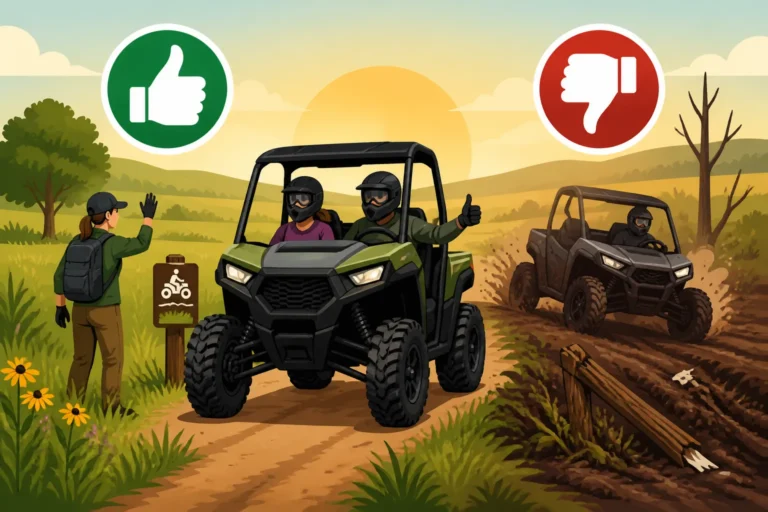
Where you ride is only part of the responsibility. Staying on designated routes, respecting closures, and keeping noise and speed under control help protect the places that make riding possible. Poor choices can affect other visitors, nearby residents, wildlife, landowners, and future access for everyone.
The same basic principle applies across public and private sites: follow the rules set for that location. A route that is permitted at one park may be closed at another. A private operator can set conditions that are stricter than a general state rule, and posted signs can clarify where machines may travel.
Stay within marked boundaries
Do not assume an unmarked path is an authorized trail. In rural Kansas, a two-track can lead across private property, farmland, or a service road that isn’t open to recreational riding. The fact that a route appears on an app or looks well-used does not establish permission.
This is where onX Offroad or another mapping tool can be useful as one part of planning: it can help you think through a route and identify questions about boundaries. But treat mapping as a planning aid, not as a replacement for permission, signs, or the land manager’s instructions. If a boundary is unclear, stop and ask rather than riding farther to find out.
On private land, get permission from the owner before riding. On public land, stay on the routes identified for machine use. Avoid cutting new tracks, riding around a closure, or crossing vegetation to bypass an obstacle. Those shortcuts can damage land and create problems for the next person who wants to ride there.
Respect other visitors and the land
Public riding areas may be shared with people who are hiking, fishing, camping, boating, or simply visiting the lake. Slow down near parking areas and access points, give others room, and follow posted speed or direction rules. Dust can be unpleasant and visibility can drop quickly, so reduce speed when approaching other people or vehicles.
At private parks, follow the operator’s guidance on trail direction, passing, staging, and designated riding areas. Don’t stop where another rider cannot see you, and avoid blocking a trail while taking a break. A little courtesy helps prevent close calls, especially on narrow routes or in busy areas.
Take your trash with you and avoid spilling fuel or fluids. Keep machines out of sensitive areas and obey closures intended to protect land or wildlife. Riding responsibly isn’t only about avoiding a citation; it helps keep access open and makes the day better for the people sharing the site.
Know that a title or permit is not trail permission
Paperwork can be confusing because several different rules may apply to an off-road machine. A title is not a tag, and having a title does not automatically make a machine road legal or authorize it on a trail. Likewise, a state park road-use permit, where applicable, should not be treated as a general OHV trail pass.
Check what the specific permit or document covers. Ask whether it applies to the place you intend to ride, the type of vehicle you have, and the route you plan to use. If you’re considering a trip that includes both a riding area and public roads, check road rules separately rather than assuming trail access carries over.
For more background, read [Kansas Has No State OHV Permit] and [Kansas Park Permit vs Trail Permit]. The practical takeaway is simple: confirm the rules for the machine, the land, and the route separately.
Planning specific Kansas riding trips
The best destination depends on where you’re starting, what you want to ride, and how much planning your group is comfortable doing. Someone looking for a short public-area outing near Manhattan may choose differently from a family building a weekend around sand riding in southwest Kansas.
Before choosing, think about the whole trip: drive time, trailer parking, fuel, food, lodging if needed, and what you’ll do if weather changes. A destination can be excellent for riding and still be a poor fit for a rushed day trip with an inexperienced group.
Build a northeast Kansas outing around Tuttle Creek or Perry Lake
Riders in northeast Kansas can compare Tuttle Creek near Randolph with the Perry Lake Spillway riding area. Both are public-area options to investigate, but neither should be approached as an unrestricted lake-wide route. Confirm the exact riding area and access details before setting out.
If you’re traveling from Manhattan, Tuttle Creek may be convenient to investigate. If you’re coming from the Lawrence area, Perry Lake may be a more natural place to check. These are starting points for planning, not guarantees about drive time or access. Use a route planner, then verify the riding area itself with its manager.
For a group, set expectations about the day before leaving. Decide whether everyone is comfortable with the terrain, whether you’ll ride together or in smaller groups, and where you’ll regroup. Keep a backup plan for a closure or poor conditions. If the main area isn’t available, don’t substitute an unapproved nearby road or field.
Consider School Creek only after checking fit
School Creek can be a good candidate for riders whose machines meet its rules and who want a designated area near Milford Lake. It’s especially important to confirm width and vehicle eligibility before taking a side-by-side there. Make the call with the machine’s actual measurements and configuration in hand.
If you’re traveling with mixed vehicle types, don’t assume the whole group can ride together. A restriction that excludes one UTV can change the plan for everyone. Ask whether there are permitted alternatives nearby, but only treat another location as an option once you have confirmed its access and rules independently.
For family groups, consider the logistics as well as eligibility. Are there enough experienced adults to supervise younger riders? Can the group stay together without pressuring a child or beginner to ride beyond their ability? If the answers are uncertain, choose a simpler outing and build experience gradually.
Make a private-park weekend about the terrain
Kansas Rocks and Syracuse Sand Dunes can make a longer trip feel like a more substantial riding weekend, especially for riders looking for a specific terrain style. Before booking or setting out, read the park rules closely and ask about the routes that suit your machine. A name and a general description won’t tell you whether a particular trail is appropriate for your experience.
For a rock-focused trip, plan for slow, careful driving and protective equipment suited to the vehicle. For a sand-focused trip, think about traction, heat, water, and recovery. Ask the operator what riders commonly overlook, and don’t hesitate to choose easier routes if you’re new to that terrain.
When mapping the route to the park, use onX Offroad or another navigation tool only for the journey and planning details it can actually help with. The park’s own instructions govern access and riding. Confirm the entrance, arrival process, and operating rules directly with the operator before you leave.
Common mistakes that can spoil a Kansas ride
A disappointing trip often comes down to one assumption: that an area is open, that a machine will fit, or that a visible road is okay to ride. The sparse network makes those assumptions costly. A little advance checking can save hours of towing and prevent problems with land access or safety.
It’s also easy to focus only on the machine. A capable ATV or UTV still needs an appropriate route, safe operating conditions, and a group plan. These common mistakes are worth avoiding whether you’re making a short local trip or traveling across the state.
Treating a map line as permission
A line on a digital map can look official even when it is not an authorized OHV trail. Mapping tools are useful for orientation and planning, but the land manager’s current directions and on-site signs take precedence. Check the source of the route information and confirm it with the facility.
The same caution applies to satellite images and tracks shared by other riders. A path can be old, private, closed, or intended for a different purpose. Don’t follow it simply because it appears in an app or someone posted about riding there.
If you’re unsure, stop before entering the route. Contact the site or landowner, check posted information, and choose a confirmed alternative. A short delay is preferable to trespassing or getting a group into an area with no safe way out.
Arriving without checking vehicle limits
A wide side-by-side may be welcome at one site and excluded at another. A vehicle with added accessories may no longer fit the size limit you assumed it met. Confirm rules before departure, and measure the actual machine according to the site’s instructions.
Also check passenger restrictions. A vehicle’s seating capacity does not necessarily answer every site-specific question about who may ride or where. Private parks may have rules for children, passengers, and safety equipment. Public areas can have their own operating requirements.
If a rule is hard to interpret, ask the operator directly and make a note of the answer. Don’t wait until you’re at the entrance with a trailer and a group of people eager to unload. That’s the moment when a small misunderstanding becomes an expensive, frustrating change of plans.
Assuming every public recreation area has trails
A reservoir may have campgrounds, boat ramps, roads, wildlife areas, and designated OHV access—but those uses are not interchangeable. Riding is limited to the locations and routes where it is permitted. Nearby land can have different ownership or rules even when it looks continuous.
This is particularly important when a group is traveling together. One rider’s memory of a past visit, or a social-media post about a nearby route, may not reflect current access. Confirm the exact riding location and its boundaries instead of planning around a general lake name.
If your destination is closed or the route is uncertain, don’t ride around the issue. Choose another confirmed area or reschedule. Protecting access is part of being a good guest on public and private land.
Underestimating distance, weather, and recovery needs
Kansas trips can involve long stretches between towns, so don’t count on finding fuel, food, or a repair shop beside the riding area. Plan fuel for both the drive and the ride, carry water, and bring basic supplies. Consider whether your machine’s range is enough for your intended route.
Weather and terrain can make a short ride take longer than expected. A stuck machine, a puncture, or a slower rider can change the day’s schedule. Leave a realistic margin before sunset or your planned drive home, and let someone outside the group know where you’re going and when you expect to return.
Finally, don’t let the group’s most experienced rider set the pace for everyone. A patient, well-planned ride is better than a rushed one that leaves a beginner overwhelmed or a machine damaged. Choose a route that allows people to enjoy the day and return safely.
Disclaimer
This article is for general informational purposes only and does not constitute professional advice. Laws, prices and regulations vary by location and change over time. Consult a qualified professional for guidance on your specific situation.