Lights Your Quad Needs to Ride After Sunset
It’s a scenario many Kansas quad and side-by-side owners know all too well: the sun starts dipping below the horizon, painting the big sky in oranges and purples, and you realize you still need to get your machine back to the barn or across that county road. Suddenly, the fun of the day turns into a scramble of questions: "Are my lights even legal for this? What exactly do I need on my quad after sunset in Kansas?" This guide is here to untangle the often-confusing world of Kansas lighting requirements for ATVs and UTVs when the daylight fades, helping you understand what's required and how to stay safe.
The Complexities of Riding After Sunset in Kansas
Let's be honest, figuring out if you can even be on a public road with your ATV or UTV after dark in Kansas is the first hurdle, and it’s a big one. Kansas law, at its core, generally restricts ATVs and most UTVs from operating on public roads, especially after sunset. This isn't just about having lights; it's about the fundamental legality of the machine's presence on the road. The statute [Kansas ATV Road Rules Under 8-15,100] sets this general prohibition. This means that for many riders, the question of "what lights do I need?" is secondary to "can I even be here?"
However, there are crucial exceptions that open the door for after-dark road use. These exceptions are often tied to specific vehicle classes or purposes. For instance, bona fide agricultural operations often have more leeway to cross or travel short distances on roads. Some cities in Kansas have also passed ordinances specifically allowing certain types of UTVs or golf carts on their streets, usually with specific restrictions and, of course, lighting requirements. Then there's the unique "work-site utility vehicle" (WSUV) class, which has its own set of rules. For any after-dark road use, even within these exceptions, proper lighting is absolutely non-negotiable. Trying to navigate a dim county road or cross a state highway without adequate illumination is not only illegal but incredibly dangerous.
It’s easy to get frustrated by the patchwork of rules. You might see a neighbor driving their side-by-side down a city street at dusk and wonder why you can't, only to find out their city has a specific ordinance that yours doesn't. Or perhaps you're using your quad on your farm, and while you're technically exempt for agricultural purposes, you still need to ensure you're visible to other traffic. The key takeaway here is that merely having a headlight on your ATV from the factory doesn't magically make it street legal at night. The underlying legality of your machine on that specific road at that specific time comes first. Always check your local city ordinances and understand the state's definitions for your machine.
Decoding Kansas's Lighting Requirements for After-Dark Road Use
When those exceptions do apply – whether you're making an agricultural crossing, operating a Work-Site Utility Vehicle (WSUV) where permitted, or your city has an ordinance for UTVs – your machine must be properly lit. Kansas law, while not always directly aimed at ATVs, often defers to lighting standards set for motorcycles or other motor vehicles when discussing visibility after dark. The goal is simple: be seen, and see where you're going. Neglecting these requirements isn't just an invitation for a ticket; it's a direct threat to your safety and the safety of others.
Here's a breakdown of the essential lighting components you'll need if you're riding a machine after sunset that is legally permitted on a Kansas road:
Headlights: Piercing the Darkness
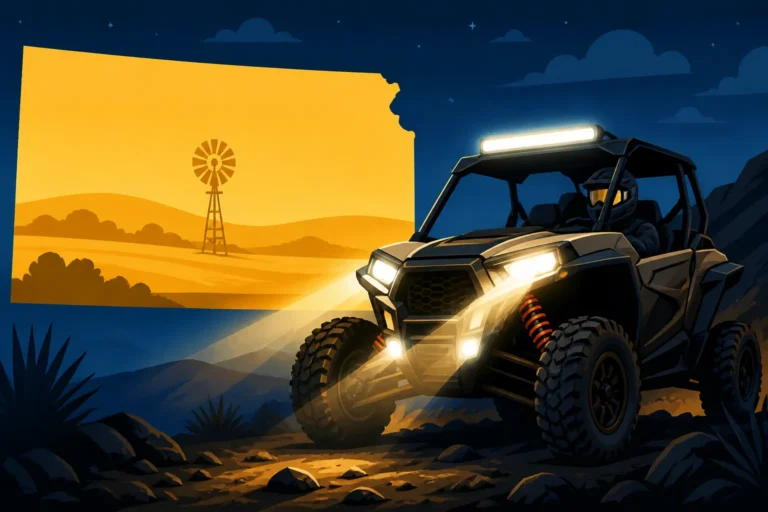
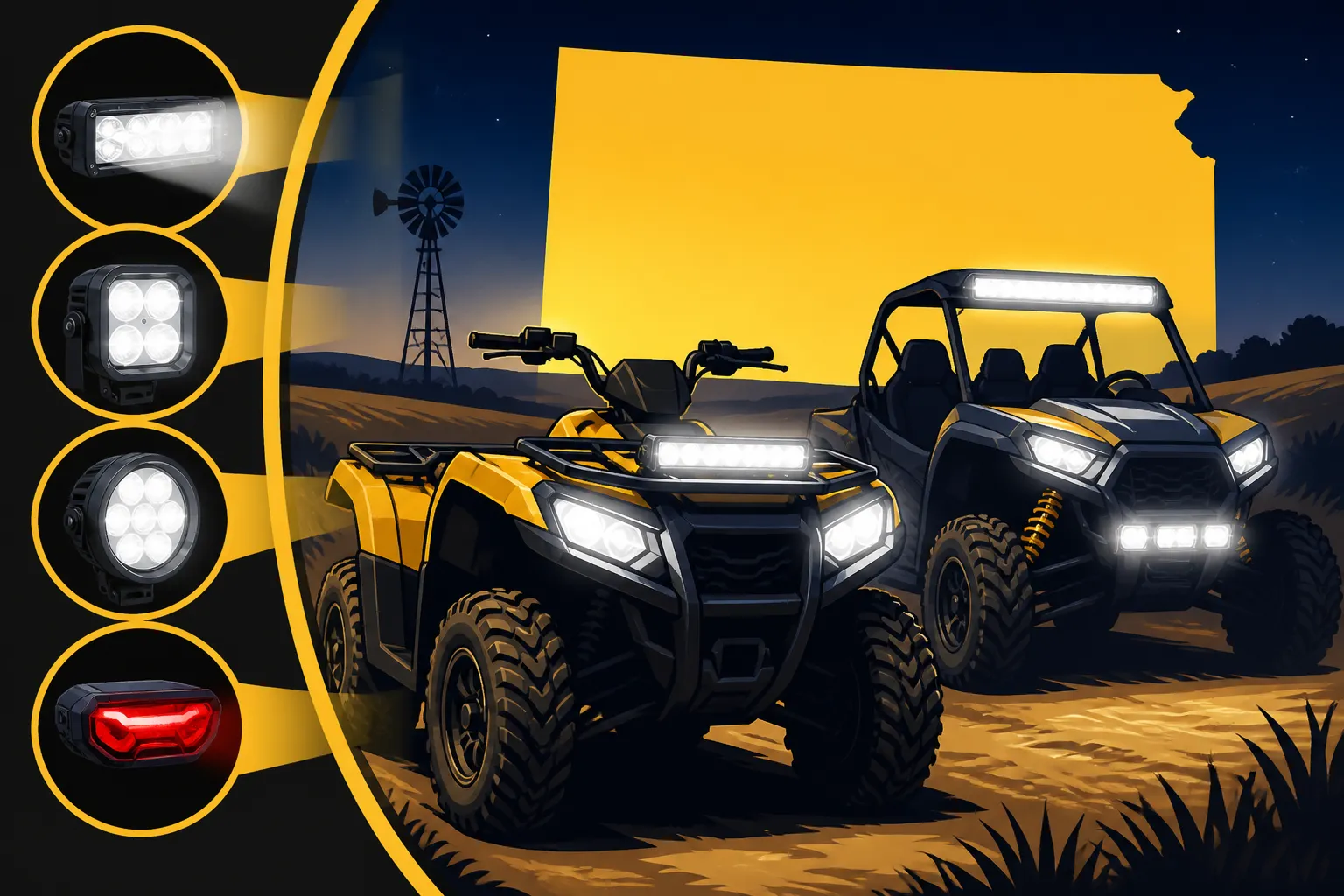
At a minimum, any ATV or UTV operated on a public road after dark in Kansas needs at least one, and ideally two, working headlights. These aren't just for showing you're there; they're for illuminating the path ahead. The legal standard generally requires headlights to be capable of revealing persons and vehicles at a certain distance – typically around 200 feet for low beams and up to 450 feet for high beams. Your factory headlights might meet the bare minimum, but for serious after-dark riding, especially on unlit rural roads, you might consider upgrading.
Many factory lights can feel inadequate once you leave the confines of your own property. Imagine trying to spot a deer darting out from a tree line or a pothole on a gravel road with only dim factory lights. It’s a recipe for disaster. Aftermarket options, like LED light bars or replacement headlights from companies like SuperATV, can dramatically improve your visibility and make a huge difference in your confidence and safety. Just make sure any auxiliary lighting you add is positioned and aimed correctly so it doesn't blind oncoming traffic, which is also a legal and safety concern. The intensity and spread of light are crucial, not just the presence of a bulb.
Tail Lights and Brake Lights: Signifying Your Presence and Intent
If headlights are about seeing forward, tail lights are all about being seen from behind. At least one red tail light, visible from 500 feet to the rear, is a fundamental requirement for any vehicle operating after dark on a road. This continuous red glow lets drivers behind you know a vehicle is present. Crucially, your machine also needs a working brake light (or lights) that illuminates brighter than the tail light when you apply the brakes. This is vital for signaling to anyone following you that you're slowing down or stopping.
Think about a dusty county road at dusk. Without a clear, bright tail light and an obvious brake light signal, a driver following you has very little information about your speed or intentions. This is particularly important for ATVs and UTVs because they are often slower, handle differently, and can be harder for larger vehicles to spot. Ensure your tail light is free of dirt and mud, and that your brake light switches are functioning correctly. Regularly test them by having someone stand behind your machine while you press the brake pedal. This simple check can prevent a rear-end collision, which can be devastating for a rider on a quad or side-by-side.
Turn Signals and Reflectors: Communicating Your Moves
While not universally required for all ATVs by Kansas state law, if your machine falls into a class that permits road use and requires turn signals (like many Work-Site Utility Vehicles or UTVs under specific city ordinances), then they must be fully functional. Turn signals, both front and rear, are essential for communicating your intentions to other drivers when making turns or changing lanes. These should be amber to the front and either amber or red to the rear, and clearly visible from 100 feet.
Even if turn signals aren't strictly mandated for your specific machine or local road use exception, it's always a good idea to consider adding them for safety. Many aftermarket kits are available to easily integrate turn signals onto your ATV or UTV, especially for those who frequently use their machines on public ways. In addition to active lighting, Kansas law also mandates certain passive reflective elements. These are crucial, as they provide visibility even if your active lights fail. You'll typically need red reflectors on the rear, and amber reflectors on the sides of your machine, placed at a certain height to be seen by other vehicle headlights. These often come standard, but it's wise to ensure they're clean and undamaged.
| Lighting Component | Minimum Kansas Legal Requirement (where road use is permitted) | Recommended for Enhanced Safety (especially rural roads) |
|---|---|---|
| Headlights | 1-2 White lights, visible ~200-450 ft | Upgraded LED lights, auxiliary light bars |
| Tail Lights | 1 Red light, visible 500 ft from rear | Brighter LED tail lights, dual tail lights |
| Brake Lights | Brighter than tail light when brakes applied | Responsive LED brake lights, flashing brake modules |
| Turn Signals | Required for some classes/ordinances | Aftermarket kits, bright LED signals (even if not mandated) |
| Reflectors | Red rear, amber sides | Additional reflective tape on machine and rider |
| License Plate Light | Required if machine has a license plate | Clear, bright illumination |
| Side Marker Lights | Not typically mandated for ATVs/UTVs | LED rock lights, underglow for side visibility |
Enhancing Nighttime Safety Beyond Legal Mandates
Meeting the bare legal requirements for lighting is a good start, but let's be real: safety, especially when you're on a machine that's smaller and lower to the ground than a typical car or truck, often demands more. Even if you're only making quick runs on farm roads or within a city that allows UTVs, adding extra visibility can be a lifesaver. This isn't just about avoiding a ticket; it's about making sure every other driver on the road sees you, and that you have the best possible view of your surroundings.
Consider the challenge of spotting wildlife on a dark, unlit Kansas county road. A deer or a coyote can appear out of nowhere, and even a slight delay in reaction time can lead to a serious accident. Factory headlights, while legal, might not provide the peripheral vision or the sheer light output needed to spot dangers early enough. This is where supplementary lighting truly shines. Installing an LED light bar across the front of your machine can transform your night vision, turning shadows into clear paths. These powerful lights cast a wide, bright beam, illuminating ditches, tree lines, and distant objects that your stock lights would miss. Just remember to use them judiciously and dim them for oncoming traffic if you're on a shared roadway.
Another crucial aspect of enhanced safety is making yourself more visible to other drivers. Reflective tape on your machine, especially on the sides and rear, can catch the headlights of approaching vehicles, even if your active lights momentarily fail or are obscured by dust. You can also get creative with things like whip lights, which are common in sand dune riding but can add a tall, undeniable beacon of light above your machine, making you visible over hills or from behind other vehicles. Many companies, like SuperATV, offer a wide range of accessory lighting, from rock lights that illuminate the ground around your tires to vibrant whip lights that ensure you stand out from afar. Investing in these can significantly reduce the risk of a collision after dark, whether you're working on the farm, cruising through town, or heading to your hunting spot.
Practical Tips for Riding Your Quad After Dark in Kansas
Riding your ATV or UTV after sunset, even in situations where it's legally permitted, introduces a whole new set of challenges compared to daytime operation. It's not just about flipping on your lights; it's about being prepared, being extra cautious, and being aware of your surroundings. A little foresight can prevent a lot of headaches, or worse, a serious accident.
Pre-Ride Checks Are Paramount
Before you even think about firing up your machine and heading out after dark, do a thorough pre-ride check, specifically focusing on your lighting system. Check every light: headlights (high and low beam), tail lights, brake lights, and turn signals if you have them. Are they clean and free of mud or dust? Are all the bulbs working? Wiggle the wiring to make sure there aren't any loose connections that could cause an intermittent failure. Check your battery terminals for corrosion and ensure your charging system is working properly, especially if you've added auxiliary lights. You don't want to be stranded on a dark road with a dead battery and no lights. It's also a good habit to keep spare fuses for your lighting circuit.
Beyond lights, ensure your tires are properly inflated, your brakes are responsive, and your fluid levels are good. Visibility isn't just about being seen; it's about being able to react quickly to what you can see. This is particularly important for machines that are often used for work. Imagine hauling a load of feed across a dark pasture and having a headlight suddenly go out – that's a problem you want to avoid by checking beforehand.
Enhance Rider Visibility and Personal Safety Gear
While the focus here is on machine lighting, don't forget about yourself! As the rider, you are part of the visibility equation. Always wear brightly colored clothing, even if it's primarily for daytime riding, and especially consider high-visibility, reflective gear for night outings. A reflective vest, jacket, or even reflective strips on your helmet can make a massive difference in how quickly other drivers spot you. Remember, drivers often look for the silhouette of a car or truck; an ATV rider is a much smaller, less predictable shape.
Eye protection is also non-negotiable, particularly at night. Clear goggles or a clear visor on your helmet will protect your eyes from dust, insects, and debris without impeding your vision. Tinted visors or sunglasses are a definite no-go after dark. If you're riding in an area with a lot of dust, consider investing in anti-fog solutions for your goggles or visor, as reduced visibility combined with poor lighting is a recipe for trouble. For those riding in areas where a helmet isn't legally mandated, choosing to wear one anyway – especially a bright or reflective one – is always a smart decision for safety.
Environmental Awareness and Navigational Preparedness
Riding after dark inherently means reduced visibility, so you need to be acutely aware of your environment. Dust kicked up by other vehicles or even your own machine can create blinding clouds, turning your powerful headlights into a diffuse glow. Slow down in dusty conditions and increase your following distance. Fog and heavy dew can also significantly reduce visibility and make surfaces slick. Be extra cautious on gravel roads, which can hide potholes or loose aggregate that are hard to spot in the dark.
Wildlife activity often increases at dusk and throughout the night. Keep an eye out for animals along roadsides and in fields. Their eyes can reflect in your headlights, giving you an early warning. It's also a good idea to have a reliable way to navigate. If you're exploring new areas, a GPS device or a paper map (with a flashlight to read it!) can be invaluable, especially in areas with spotty cell service. Know your route, tell someone where you're going and when you expect to return, and don't hesitate to pull over and wait if conditions become too challenging. Remember, while you might be permitted to ride on certain roads after dark, the rules for [Kansas Sunset to Sunrise Lighting Rules] are there to keep everyone safe.
Know Your Local Ordinances and Carry Your Paperwork
Finally, you can have all the lights in the world, but if you're riding on a road where your machine isn't legally allowed after dark, you're setting yourself up for a citation. As mentioned earlier, while state law has general prohibitions, cities and counties in Kansas have the power to create ordinances that allow ATVs and UTVs on their roads under specific conditions. [Kansas Cities That Authorize ATV Street Use] is a crucial resource. Always check with your local city hall or county clerk's office to understand the specific rules in your area. These ordinances will detail not only where you can ride but also the exact lighting and equipment requirements for that road use.
When riding on any public way, always carry your proof of ownership, title (if applicable, which for many Kansas machines will be a [Kansas Nonhighway Title Explained]), and any city-issued permits or registrations. [What a County Sheriff Can Ask a Rider to Show] often includes these documents. Being able to quickly and clearly demonstrate that you are operating within the legal framework can save you a lot of time and potential trouble during a traffic stop. Ignorance of the law is rarely an excuse, and a little homework can prevent you from facing [Kansas Penalties for Illegal Road Riding].
Disclaimer
This article is for general informational purposes only and does not constitute professional advice. Laws, prices and regulations vary by location and change over time. Consult a qualified professional for guidance on your specific situation.