Can You Drive an ATV on the Road in Kansas?
It’s a question almost every ATV or UTV owner in the Sunflower State eventually asks: "Can I drive my machine on the road in Kansas?" The desire to simply hop on your quad or side-by-side and cruise down a county road to a friend's house, or even into town for a quick errand, is completely understandable. Unfortunately, the answer isn't a straightforward "yes," and for most ATVs, it's a resounding "no." This guide will cut through the confusion, explaining why these machines are generally restricted from public roads and outlining the very specific, limited circumstances where you might find an exception for certain utility vehicles.
The Blanket Ban: Why Most ATVs Are Off-Limits on Kansas Roads
Let's face it, the thought of cruising your ATV down a quiet rural road sounds liberating, doesn't it? Maybe you just want to get to the next section of your property without having to load your machine onto a trailer, or perhaps you just want to take a short trip to a neighbor’s place. However, the reality of Kansas law often puts a damper on these aspirations. For the vast majority of all-terrain vehicles, public roads are strictly off-limits, and for good reason. The laws are primarily concerned with safety, as these machines are simply not designed for the rigors of paved roads, traffic, and higher speeds.
What Kansas Law Says About ATVs and Roads
Kansas law is quite clear when it comes to ATVs and public roadways: there's a general prohibition. This isn't just a suggestion; it's a statute designed to prevent accidents and ensure the safety of both ATV riders and other motorists. The law considers ATVs as "nonhighway vehicles," meaning they lack the features and safety equipment required for typical street use. This overarching ban can be incredibly frustrating for riders, especially those in rural areas who feel they could safely operate their machines on less-trafficked roads. You might see people doing it, but that doesn't make it legal or safe. The state's position is that these vehicles, by their very design, are meant for off-road environments, and attempting to integrate them into the flow of highway traffic poses significant risks. For a deeper dive into the specific statutes, you can look up [Kansas ATV Road Rules Under 8-15,100].
Think about it this way: your ATV has knobby tires designed for grip in dirt, mud, and rocks, not for smooth, high-speed asphalt. Its suspension is built for absorbing bumps and jumps, not for stable cornering at 55 mph. The lack of standard safety features like turn signals, rearview mirrors, and often even headlights that meet highway standards makes them a hazard, particularly at night or in heavy traffic. These aren't minor oversights; they're fundamental design differences that separate an off-road machine from a street-legal vehicle. This is why enforcement can be strict, even in seemingly remote areas, because the law is trying to protect everyone on the road.
The Definition That Matters: What Makes Your Machine an ATV in Kansas
Understanding why your machine is restricted often comes down to how Kansas law defines it. The state has specific classifications for different types of off-road vehicles, and an "all-terrain vehicle" or ATV has a very particular legal definition. Generally, an ATV is a motorized vehicle designed for off-highway use, having four or more low-pressure tires, a seat designed to be straddled by the operator, and handlebars for steering. If your machine fits this description, it's typically an ATV in the eyes of the law, regardless of how you personally use it. This definition is crucial because it dictates which rules apply to your machine, especially concerning road use.
Kansas law goes into detail about these classifications, carving out categories not just for ATVs, but also for utility vehicles (UTVs), golf carts, and micro utility trucks. Each of these categories has different parameters and, consequently, different rules for road legality, if any. The key takeaway is that the "straddled seat" and "handlebars" are defining characteristics of an ATV. A side-by-side, for instance, with its steering wheel and bench or bucket seats, falls into a different class, often leading to slightly different, though still restricted, road-use possibilities. Knowing where your machine fits within [An ATV Defined in Chapter 8] is the first step in understanding its limitations. This distinction isn't just bureaucratic; it's based on how the vehicles are operated and the perceived safety risks they pose on public roadways.
Exceptions to the Rule: Agricultural and Crossing Provisions
While the general rule is a firm "no" for ATVs on Kansas roads, there are a couple of very narrow exceptions that provide some relief for certain riders, primarily those involved in agriculture. These aren't loopholes to exploit for recreational riding; they are specific allowances for practical purposes. It's vital to understand that these exceptions are limited and come with their own set of rules and conditions. Misinterpreting them can lead to citations, fines, and even vehicle impoundment.
One primary exception allows for agricultural use. Farmers and ranchers can often operate their ATVs on public roads for agricultural purposes, such as moving between fields, checking livestock, or transporting equipment related to their farm operation. This is meant to facilitate farming activities, not leisure. For example, if you're checking fence lines on a large property that's divided by a county road, you might be able to ride your quad from one section to the next. However, this doesn't mean you can run into town for groceries on your ATV. The statute typically requires the machine to be used solely for the enumerated agricultural purposes and often necessitates that the operator holds a valid driver's license. You can find more details on [Kansas's Agricultural Exception for Road Use]. This exception is a lifeline for many rural Kansans, allowing them to perform their daily duties efficiently without constantly trailering their machines.
Another common exception involves crossing public highways. Kansas law generally permits an ATV to cross a public road or highway at a right angle, provided it's done safely and at the shortest possible distance. This means if your property is on both sides of a state highway, you can usually cross directly from one side to the other. You can't, however, ride down the shoulder for a mile before crossing. This provision is designed to allow owners access to their property that might be bisected by a road, but it's not an invitation to ride along the pavement. Always be hyper-aware of traffic when crossing, as you'll be on a machine that's hard for other drivers to see and not designed for quick maneuvers on asphalt. For specific guidance on this, consider the information on [Kansas Rules for Crossing a Highway]. This is a critical safety consideration, as an ATV pulling onto a 65 mph highway is incredibly vulnerable to fast-moving vehicles.
Understanding UTVs: A Different Set of Rules
While ATVs face a nearly universal ban on Kansas roads, utility terrain vehicles (UTVs), particularly those classified as Work-Site Utility Vehicles (WSUVs), operate under a slightly different, albeit still complex, set of regulations. This distinction is often a source of confusion for many riders, as UTVs visually resemble larger, more robust ATVs, yet their legal treatment can differ significantly. The key lies in their design and the specific legal classifications Kansas has established, which allow for certain road use privileges under defined conditions.
Not All UTVs Are Created Equal: Work-Site Utility Vehicles (WSUVs)
Kansas is somewhat unique in its legal definition of a "Work-Site Utility Vehicle" (WSUV). This isn't a classification you'll find in every state, and it's specifically designed to address the growing popularity and utility of side-by-sides in various work and recreational capacities. For a UTV to qualify as a WSUV, it must meet several criteria, including specific dimensions and operational characteristics. Generally, these machines are four-wheel drive, have a width of no more than 48 inches, an unladen weight of more than 800 pounds but not more than 2,000 pounds, and are designed to carry tools or materials. They must also have a steering wheel and seating designed for passengers to sit side-by-side, much like a traditional car or truck.
This classification is critical because WSUVs, unlike standard ATVs, are allowed to be driven on some public roads under specific conditions. They are recognized for their practical utility in agriculture, construction, and other work-related fields, making their limited road access a necessity for many operators. The legislative intent behind creating the WSUV class was to accommodate the increasing use of these vehicles for legitimate work purposes, where trailering them for short distances between sites would be impractical. Understanding [What Makes a Side-by-Side a Work-Site Utility Vehicle] is your first step. These criteria like [48 Inches and 800 Pounds] are not arbitrary; they help distinguish these larger utility machines from smaller, more nimble recreational ATVs.
For example, a rancher using a Kawasaki Mule or a Polaris Ranger might find their machine qualifies as a WSUV, allowing them to drive it down a county road to reach a different pasture or to service an irrigation pivot. This flexibility is a huge advantage over constantly loading and unloading. However, even with the WSUV classification, these machines are typically restricted to county roads and, in some cases, specific city streets where local ordinances permit. They are generally still banned from state highways, interstates, and federal roads. The rules are in place to balance utility with safety, acknowledging that even WSUVs are not full-fledged highway vehicles.
The Role of Local Ordinances: When Cities Say "Yes" to UTVs
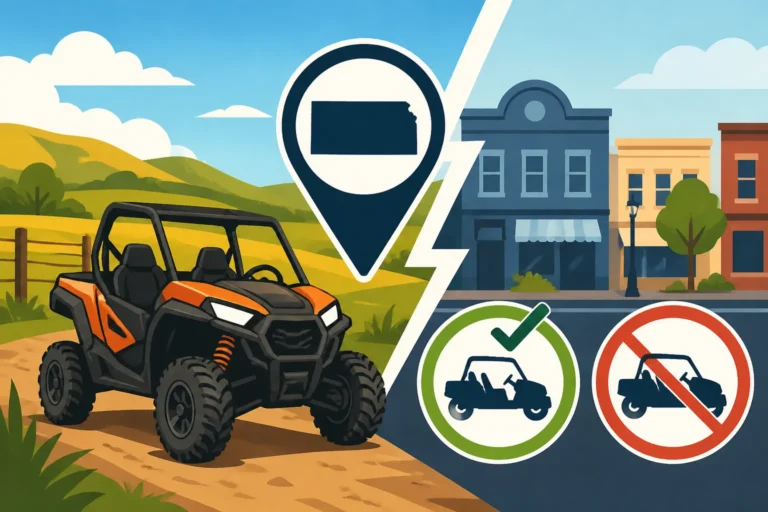
While state law provides a framework, individual cities and counties in Kansas have the power to enact their own ordinances regarding UTV use on their local streets. This "home rule" authority means that what's legal in one town might be strictly prohibited just a few miles down the road. This can be incredibly confusing for riders, as there isn't a single, statewide rule that applies to all municipal roads. The process typically involves a city council or county commission passing an ordinance to allow or restrict UTVs within their jurisdiction.
When a city decides to "opt-in" and allow UTVs on its streets, it almost always comes with a list of conditions and requirements. These often include specific equipment mandates, speed limits, designated routes, and sometimes even a local registration or permit process. For instance, a small town might decide to allow UTVs on all streets with a speed limit of 35 mph or less, requiring them to have headlights, taillights, turn signals, and a slow-moving vehicle emblem. They might also charge a small annual fee for a city-issued tag. It's crucial for riders to research the specific ordinances of any city or county they plan to ride in. A great starting point for this research is by looking into [Kansas UTV Street Legal Rules by City].
Imagine you live in a town that has embraced UTVs. You might be able to run to the hardware store or pick up your kids from school in your side-by-side, enjoying the open air. However, you'd need to ensure your machine meets all local equipment standards, you have the necessary city permit, and you stay on approved streets, adhering to speed limits. Straying outside these parameters, even unintentionally, could result in a ticket. This local control means that riders must be proactive in understanding their local laws, rather than assuming what's legal in one place applies everywhere.
Equipment and Licensing for Road-Legal UTVs in Cities
If you're fortunate enough to live in a Kansas city that permits UTVs on its streets, there's a strong likelihood that your machine will need some upgrades to meet local safety and equipment standards. Unlike off-the-assembly-line ATVs, UTVs destined for city streets often need to be modified to function more like traditional vehicles. These requirements are put in place to ensure visibility, allow for proper signaling, and provide a basic level of safety for both the UTV operator and other vehicles on the road.
Common equipment requirements often include proper lighting – headlights, taillights, brake lights, and turn signals – to ensure your machine is visible and can signal its intentions. Many ordinances also require a rearview mirror (or multiple mirrors), a horn, and often a slow-moving vehicle emblem, especially if the UTV's top speed is limited. Some cities may even require a windshield and windshield wipers. These aren't just suggestions; they are typically mandatory for obtaining a local permit or avoiding a citation. Many riders turn to aftermarket providers like SuperATV for these types of accessories, as they offer robust, application-specific kits designed to bring UTVs up to snuff for various road-legal requirements. Before you hit the pavement, be sure to check what [Kansas Micro Utility Truck Equipment Rules] or [Kansas Lighting Requirements on a Machine] might mean for your UTV.
Beyond the machine itself, the operator will almost always need a valid driver's license to drive a UTV on public roads, even within city limits. This is because you are operating a motor vehicle on a public roadway, which typically requires a licensed driver. While some specific state statutes for ATVs might discuss age, for road-legal UTVs, a standard driver's license is the norm. Furthermore, many cities that permit UTVs on their streets will require proof of liability insurance. This is a critical safeguard, ensuring that if you are involved in an accident, there is coverage for any damages or injuries caused. Without proper equipment, a valid license, and insurance, even riding in a "UTV-friendly" city can quickly lead to legal trouble. Always carry proof of your license, registration, and insurance with you when operating on city streets.
The Reality of Riding: Challenges and Risks
Even when an exception or local ordinance does allow an ATV or UTV onto a public road in Kansas, it’s crucial to understand that these machines are inherently different from cars and trucks. The notion of "street legal" for an off-road vehicle in Kansas is always constrained by its original design and purpose. Overlooking these practical realities can lead to both legal trouble and serious safety risks. It's not just about what the law says you can do, but also about what is genuinely safe and practical to do with an off-road machine on pavement.
The Fine Print of City Ordinances: Limits and Restrictions
For those lucky enough to live in a city or county that has embraced UTVs on its streets, it’s important to remember that these permissions often come with significant caveats. "Street legal" rarely means "street unrestricted." Local ordinances are often packed with fine print, outlining precise limits on where, when, and how you can operate your UTV on public roads. These restrictions are put in place to manage traffic flow, reduce noise complaints, and, most importantly, enhance public safety. Ignoring them, even accidentally, can quickly negate any perceived freedom you might have gained.
Common restrictions might include speed limits that are lower than the posted limit for cars, such as 25 mph or 35 mph, even on streets where cars can go faster. Many ordinances will also designate specific streets or types of roads where UTVs are permitted, often excluding major thoroughfares, state highways, or roads with higher speed limits. You might find that your UTV is allowed on residential streets but banned from the main commercial strip. Additionally, there could be time-of-day restrictions, prohibiting UTV use during late-night or early morning hours. For example, some cities, like Louisburg, have specific speed limits like [Louisburg's 45 mph Street Limit in Kansas] that apply to UTVs, and deviating from these can result in a ticket. Understanding these nuances is critical. It's not uncommon for a rider to be ticketed for driving a UTV on a street where they thought it was allowed, only to find they had crossed an invisible boundary or exceeded a subtle speed restriction. This highlights the importance of checking every detail of your local ordinances. To explore which cities have opted in, you can often find information by researching [Kansas Cities That Authorize ATV Street Use].
Enforcement and Penalties for Illegal Road Use
Regardless of whether you're riding an ATV or a UTV, operating them illegally on Kansas roads can lead to a host of unpleasant consequences. Law enforcement officers, particularly in rural areas, are generally well-versed in the state's nonhighway vehicle laws and local ordinances. They prioritize public safety, and if they observe a machine operating outside legal parameters, they are likely to intervene. The penalties for illegal road use can range from a simple traffic citation to more severe repercussions, depending on the nature of the offense and local jurisdiction.
A typical penalty might involve a fine, which can add up quickly when court costs are factored in. Beyond monetary fines, repeated offenses or particularly egregious violations could lead to your machine being impounded, leaving you with the added burden of retrieval fees and storage costs. In some cases, illegal operation might even impact your driving record, especially if it's tied to other infractions like reckless driving or operating without proper licensing or insurance. Nobody wants to be pulled over, let alone face these kinds of financial and legal headaches. The enforcement isn't meant to be punitive for its own sake, but rather to deter behavior that puts riders and the public at risk. For a detailed breakdown of potential consequences, you can learn more about [Kansas Penalties for Illegal Road Riding]. Avoiding these situations requires diligence and a clear understanding of the rules before you ever put a tire on pavement.
Safety Concerns: Why Off-Road Machines Struggle on Pavement
Perhaps the most critical reason behind the strict road-use laws for ATVs and UTVs in Kansas is safety. These machines are engineered from the ground up for off-road environments – for mud, dirt, sand, and rough terrain. Their design compromises for off-road capability inherently make them less suitable, and often dangerous, for high-speed, paved road use. Even with robust components from companies like SuperATV, designed for extreme off-road punishment, these machines are simply not engineered for the demands of asphalt.
Consider the tires: knobby, low-pressure tires provide excellent grip in loose terrain but have a small contact patch and poor traction on hard, dry asphalt, especially when braking or cornering. This can lead to unpredictable handling and significantly increased stopping distances compared to a car. The suspension systems are designed to absorb large impacts and articulate over uneven ground, not to provide stable, level handling at speed on a smooth surface. This can result in excessive body roll in turns, making the machine prone to tipping, particularly UTVs with a higher center of gravity. Furthermore, the braking systems, while effective off-road, may not be rated for the heat and friction generated during repeated high-speed stops on pavement. The inherent design choices, from the steering geometry to the overall weight distribution, prioritize agility and ruggedness over the stability and precision needed for road driving. Ultimately, [Why Road Rules Change With the Machine You Ride] boils down to fundamental engineering differences. Riding an off-road vehicle on pavement isn't just a legal risk; it's a significant safety gamble.
Here's a quick comparison of general road rules for ATVs and UTVs in Kansas:
| Feature | ATVs (All-Terrain Vehicles) | UTVs (Utility Terrain Vehicles – including WSUVs) |
|---|---|---|
| General Road Use | Generally Prohibited on Public Roads | Generally Prohibited, unless a WSUV or covered by a specific local ordinance |
| Agricultural Use | Limited exception for specific agricultural purposes on county roads | Limited exception for specific agricultural purposes on county roads (often WSUVs) |
| Highway Crossing | Permitted at a right angle, shortest distance, if safe | Permitted at a right angle, shortest distance, if safe (for WSUVs, typically) |
| City/County Roads | Generally Prohibited | Allowed only if a local city/county ordinance specifically permits it |
| Equipment | No specific road equipment required (as generally prohibited) | If allowed by ordinance: Headlights, taillights, brake lights, turn signals, mirrors, horn, slow-moving vehicle emblem often required |
| Driver's License | Required for agricultural exceptions | Required for operation on public roads where permitted |
| Insurance | Not state-mandated for off-road use | Often required by local ordinances for road use |
| Registration | Nonhighway titled, no annual registration/tag for state use | Nonhighway titled; local tag/permit may be required by ordinance for road use |
This article is for general informational purposes only and does not constitute professional advice. Laws, prices and regulations vary by location and change over time. Consult a qualified professional for guidance on your specific situation.