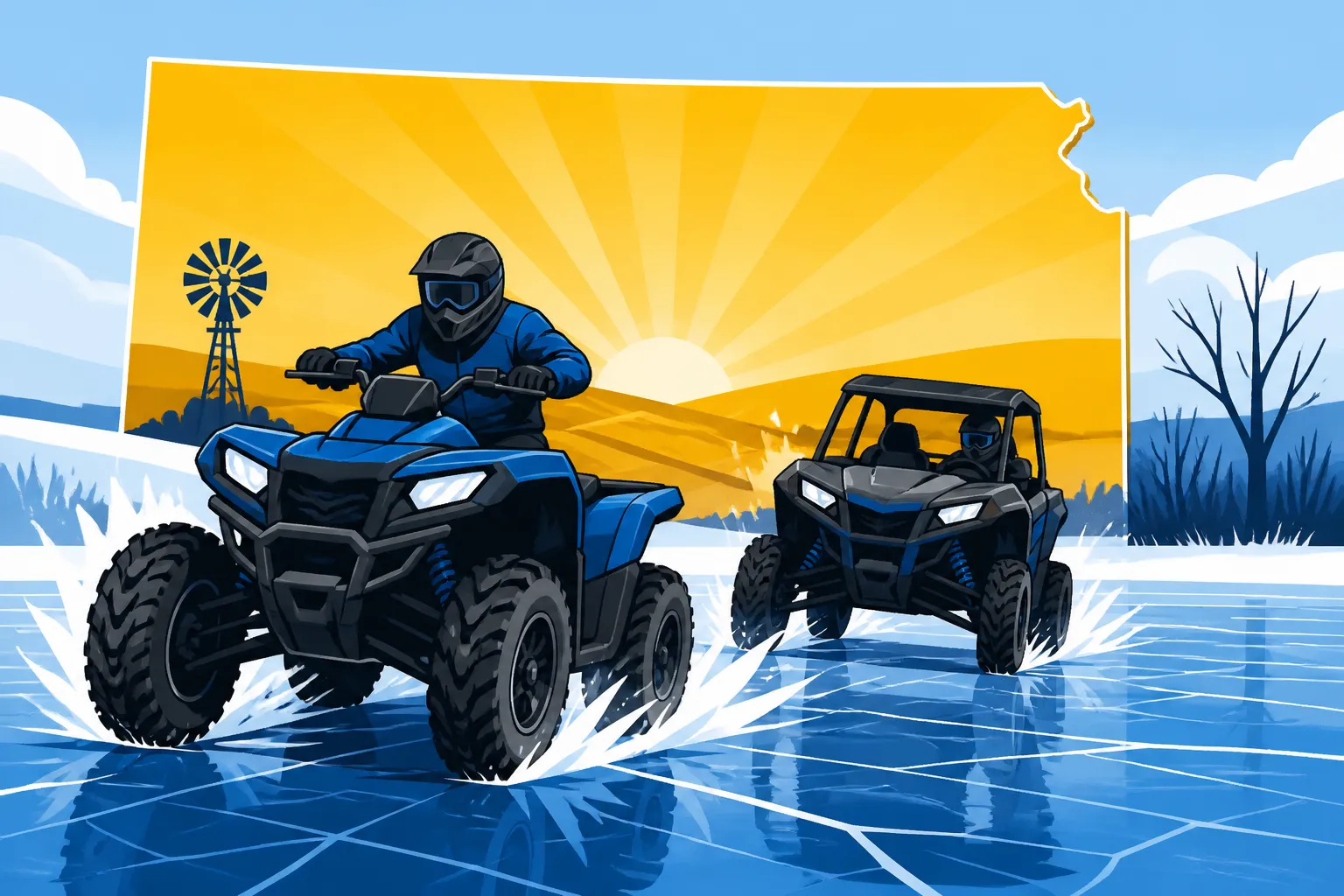
Machines on Frozen Water
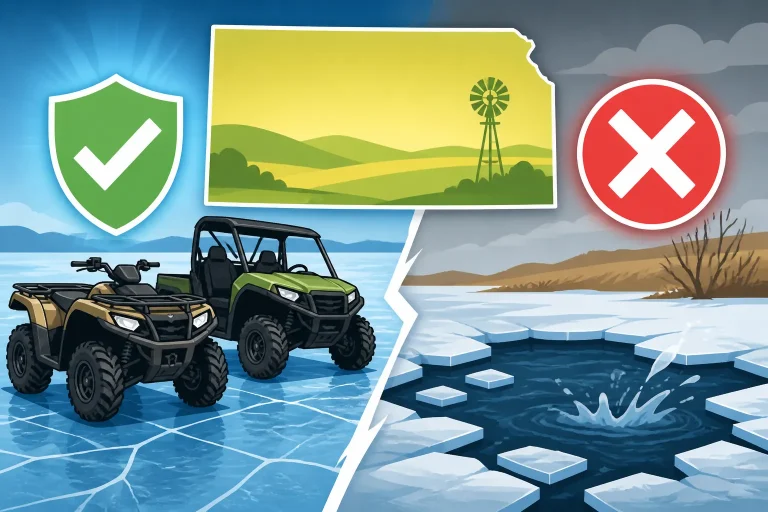
A frozen lake can look like an open route, but driving onto it is not automatically allowed just because the ice appears solid. In Kansas, access depends on the property’s rules and designated entry points, and a permit for roads does not necessarily authorize travel over ice. Here’s how to check the rules before taking an ATV or UTV out for ice fishing.
Start With the Property’s Rules, Not the Ice
Kansas does not have one blanket rule that makes every frozen lake, reservoir or pond open to off-road machines. The land manager controls access, and rules can differ between a state park, other public property and private land. A route that was available last winter may also be closed now.
Before unloading, find out whether the specific lake allows motorized machines on the ice and whether access is limited to ice fishing. Some places may permit a machine to travel from an approved entry to a fishing location while prohibiting general recreational riding. Others may prohibit motorized access altogether. Do not treat a visible tire track, an open gate or another person’s trip as permission.
At a Kansas state park, ask the park office about the rules for that particular lake and the current ice conditions. State park requirements for operating an unconventional vehicle on a park road are separate from permission to use the ice. A road permit does not, by itself, grant permission to drive wherever you want on frozen water. For background, see Kansas Park Permit vs Trail Permit and Kansas Department Road Riding Rules.
Rules for wildlife areas, federal property and privately managed lakes can be different. A state park’s access procedure does not apply automatically to a nearby reservoir or private pond. Check with the agency or landowner responsible for the place you plan to visit, and ask specifically about ATVs or UTVs on the ice—not just vehicle access to the parking area.
| Where you plan to ride | What to verify before unloading |
|---|---|
| Kansas state park | Whether motorized ice access is allowed, where to enter, operating hours and any park permit requirements |
| Wildlife area or other public land | The land manager’s vehicle rules, whether the lake is open to machines and any seasonal restrictions |
| Private lake or pond | Permission from the owner, authorized entry point and any limits on routes or hours |
| A road or parking area near the lake | Whether the vehicle may use that route and whether a separate permit or local rule applies |
Kansas has no general state OHV permit for trail riding, but that does not mean every public property is permit-free or open to motorized access. A state park may have its own requirements for unconventional vehicles on park roads. Those road rules and a lake’s ice-access rules are not interchangeable. Kansas Has No State OHV Permit explains the difference between a general state OHV permit and location-specific requirements.
If you are unsure who manages the area, call before the trip. Calling a State Park Office Before You Load Up can help you confirm which questions to ask, including whether the current access route is open. A clear answer from the land manager is more useful than assuming a rule from another lake applies.
Use the Designated Entry Point
Where a site allows machines onto frozen water, use only the entry point it designates. A shoreline that looks easy to cross may be soft, steep, muddy or concealed by snow. It may also be closed to vehicle access even when people can walk onto the ice nearby.
The designated route is part of the access rule, not merely a convenient suggestion. Do not make a new path through vegetation, cross a bank or launch from a boat ramp unless the site’s instructions identify that route for machine access. Do not assume that a ramp used by anglers on foot is approved for an ATV or UTV. Follow signs and barriers, and ask staff if the marked route is unclear. See Designated Ramps Are the Only Way Onto the Ice for more on why the entry point matters.
A designated access point does not certify that the ice is safe. It only identifies where access is allowed under the property’s rules. Ice thickness, currents, springs, changing water levels, recent weather and snow cover can make conditions vary across one lake. A machine that reaches the ice safely can still break through farther out. The land manager may close access when conditions change, even if the route was open earlier.
Before crossing the shoreline, pause to check for current closure notices and signs. Do not enter if the ramp or access point is blocked, if staff have closed the lake to vehicles, or if the route appears damaged or unsafe. If conditions look different from what the site described, turn around and contact the manager rather than improvising another way onto the ice.
A road permit is not an ice permit
A common source of confusion is the word “permit.” Kansas state park rules may require an unconventional vehicle permit for certain use of park roads. That permit is not a universal authorization to ride trails, cross closed areas or drive over frozen water. The lake’s rules still determine whether a machine may be on the ice and where it may enter.
There is also a difference between a Kansas requirement and a property-specific one. Kansas does not require visitors to buy a general state OHV sticker simply because they are from out of state, but an individual park or riding area can still set its own access conditions. Check Kansas Requires No Sticker of Visitors for the state-level distinction, then confirm the specific site’s requirements. Do not rely on a permit or sticker issued by another state as proof that a Kansas property allows ice access.
Follow Hours and Stay Within the Allowed Use
Some Kansas ice-fishing access rules limit when machines may enter or remain on the ice. At certain designated locations, access begins a half hour before sunrise, and machines must be off the ice at night. Those restrictions are not a general invitation to ride after dark at other locations. Confirm the hours and exact meaning of the local rule with the land manager. Ice Fishing Access Starts a Half Hour Before Sunrise and When You Must Be Off the Ice at Night cover those timing limits.
Plan your trip around the earliest permitted entry and the time you must be off the ice. Leave extra time to return to the access point, unload safely and respond to changing conditions. Do not wait until dusk to begin the trip back. Poor light, blowing snow and low visibility can make it harder to see the route, other anglers, open water and hazards along the shore.
If the site permits machines only for ice-fishing access, keep the trip focused on that purpose. Do not use the lake as a practice area, race course or shortcut to another part of the property. Stay within any marked boundaries and avoid areas posted as closed. A machine’s ability to travel across a frozen surface does not make that surface an authorized riding area.
Visitors should check the same rules as Kansas residents. The absence of a general Kansas OHV sticker requirement does not override a park’s hours, entry requirements or restrictions on use. If you are bringing a machine from another state, it is sensible to carry proof of ownership and confirm local requirements before leaving home. Kansas Proof of Ownership on the Trail explains why having ownership information available can be useful.
Make a Safe Plan Before You Unload
Legal access and safe ice are separate questions. A site may allow machines to use a designated route, but the land manager’s permission should not be treated as a guarantee that every part of the lake can support a vehicle. Ice can vary substantially, and snow can hide weak spots, cracks or open water.
Before the trip, check the property’s current notices and ask whether motorized access is open. Ask where the approved entry is, whether the machine may travel beyond it, what hours apply and whether there are restrictions for the type of vehicle you have. If staff cannot confirm that motorized access is allowed, do not assume it is.
On site, follow posted directions and stay with the approved route. Avoid traveling alone when possible, let someone know your plan and expected return time, and carry communication and emergency equipment suited to the conditions. Keep distance from other people and machines, and do not follow tracks onto ice if you cannot verify that the route is open and safe.
The vehicle itself also matters. A loaded UTV carrying passengers, tools or fishing equipment weighs more than an unloaded machine. Do not assume a route is safe for your machine simply because another, lighter vehicle crossed it. Follow the land manager’s instructions and use conservative judgment. If ice conditions, visibility or the return route become questionable, head back to shore while the route remains manageable.
A short check before unloading can prevent a costly mistake. Confirm the site, the entry point, the permitted use, the hours and the current conditions. If any part is uncertain, call the responsible office or landowner. For more general information about machine use on frozen water, see Kansas Ice Fishing Vehicle Rules.
Disclaimer
This article is for general informational purposes only and does not constitute professional advice. Laws, prices and regulations vary by location and change over time. Consult a qualified professional for guidance on your specific situation.