Kansas Visitors From Oklahoma
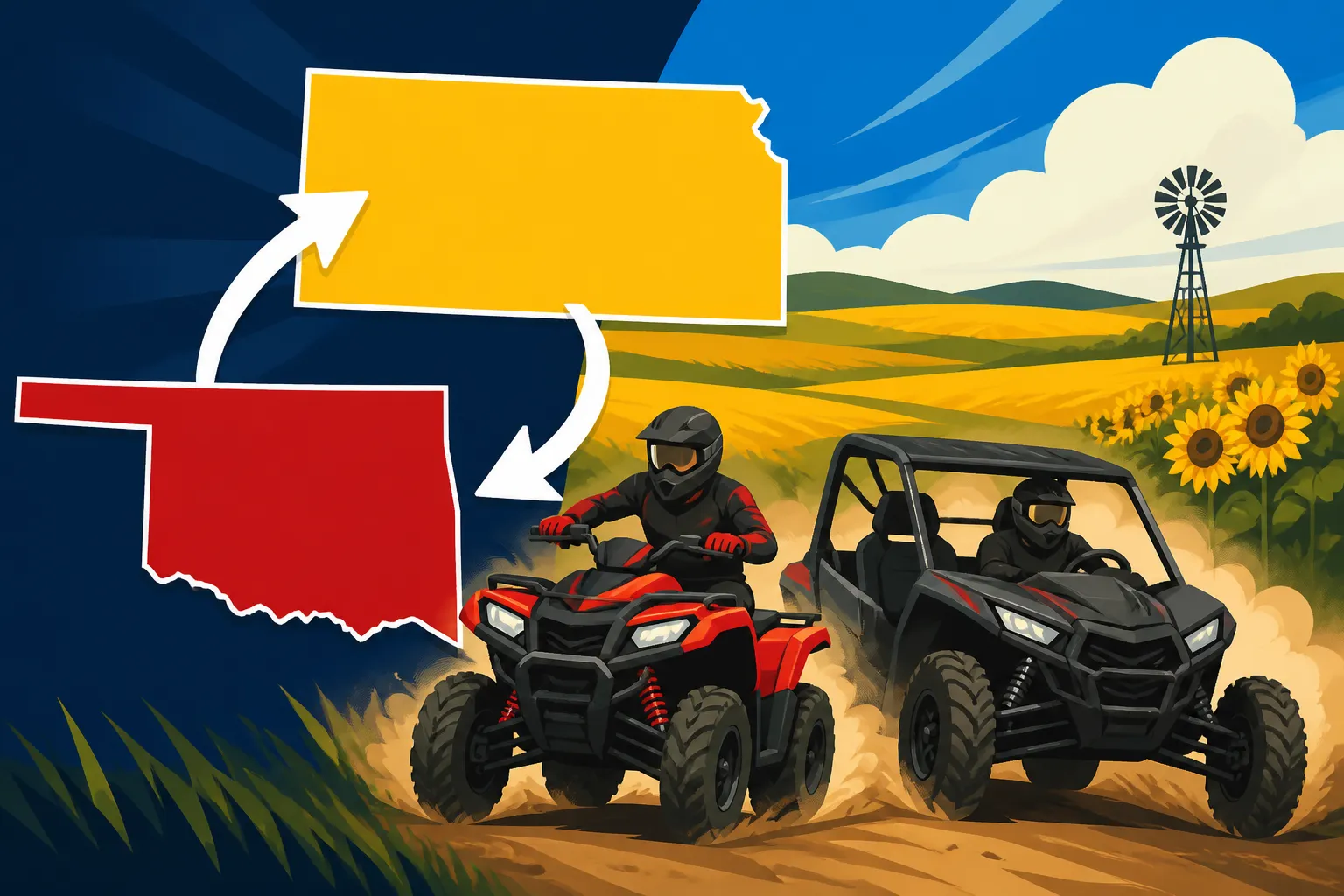
An Oklahoma registration sticker can be useful proof of home-state paperwork, but it does not automatically give an ATV or UTV permission to ride everywhere in Kansas. The key is separating state permits from site rules and road access. Here’s what visiting riders should check before unloading, and which Oklahoma documents are worth carrying.
Does an Oklahoma ATV or UTV sticker work in Kansas?
Kansas does not require visiting riders to buy a general statewide OHV sticker just to ride, and it does not offer a broad trail pass that an Oklahoma registration can replace. That makes “reciprocity” a little different from what riders may expect: there is no general Kansas trail sticker for an Oklahoma sticker to stand in for. See Kansas Requires No Sticker of Visitors and Kansas Has No State OHV Permit.
That does not mean an Oklahoma registration or permit gives you access to every Kansas riding area. The place where you ride sets the practical rules. A Kansas state park, Corps recreation area, private park, city street, and private ranch can each have different requirements. An Oklahoma sticker may help show that your machine is registered or documented at home, but it does not override those Kansas rules.
It also helps to keep three separate questions in mind:
- Do you need a Kansas statewide OHV permit? There is no general statewide trail permit required of visitors.
- Does the riding area require its own permit or have its own entry rules? Possibly. Check with the site before you travel.
- Can you ride the public road that leads to the area? Not automatically. Road use is governed by Kansas law and local ordinances, not by your Oklahoma sticker.
Kansas’s lack of a general OHV permit is not the same as permission to ride on public land or roads. Likewise, having a title, registration, or proof of ownership does not create permission to use a trail. For a closer look at the distinction, see Kansas Park Permit vs Trail Permit.
Check the Kansas riding area before you leave Oklahoma
The safest plan is to identify the exact place you intend to ride, then check its current rules directly. “Riding in Kansas” is too broad to answer the permit question on its own. Some places may be open to off-road riding under their own rules; others may allow machines only on designated roads or may not allow recreational riding at all.
State parks and Kansas-managed land
Kansas does not operate a general network of state OHV trails. A permit associated with certain Kansas park or department-road use should not be treated as a statewide off-road riding pass. It may apply to specific roads or areas, not to trails generally. The Kansas Unconventional Vehicle Permit explains why it is important to confirm what a permit covers before assuming it gives access.
Before visiting a Kansas-managed area, contact the park office or land manager and ask:
- Are ATVs, UTVs, or both allowed at this location?
- Are machines allowed only on designated roads and parking areas?
- Is a permit required for the intended route or use?
- Are there seasonal closures, hours, or equipment requirements?
- Does the rule apply differently to a visiting rider?
Do not assume that a campground, boat ramp, or park entrance road is open to off-road machines just because it is on public land. Signs and posted restrictions matter, and an exception at one site may not apply at another.
Corps areas and other riding sites
Some Corps recreation areas have designated riding opportunities, and the permit rules can differ from Kansas-managed park rules. For example, specific off-road areas may not require a Kansas park permit, but that does not make every road or piece of Corps land open to riding. Review the rules for the named location rather than relying on a general statement about Corps property. See Why Corps Riding Areas Need No Park Permit.
Private riding parks set their own admission, waiver, age, helmet, and machine rules. An Oklahoma sticker generally does not replace a park’s entry process. Check whether the park allows your machine type, whether passengers are permitted, and whether you need to bring proof of insurance or ownership. The site’s current rules are the ones to follow; start with Kansas Private Park Waivers and Rules.
| Where you plan to ride | What to verify before the trip | Does an Oklahoma sticker settle it? |
|---|---|---|
| Kansas-managed park or department area | Whether machines are allowed, where they may travel, and whether a site-specific permit applies | No |
| Corps riding area | The rules for that named area, including permitted routes and access conditions | No |
| Private riding park | Admission, waiver, machine, passenger, age, and equipment rules | No |
| City street | Whether the city allows the machine class and what local requirements apply | No |
| Private property | The owner’s permission and any conditions attached to it | No |
If you cannot confirm the rules online, call the site before loading the machine. A short check can prevent a long drive to a closed area or a location that does not allow your type of vehicle.
What to carry as an Oklahoma visitor
Kansas does not require a general statewide OHV sticker from visitors, but carrying sensible paperwork can make it easier to answer questions about who you are and where the machine came from. Bring your driver’s license and keep accessible any Oklahoma registration, title information, bill of sale, or other ownership records you already have. These documents are not a substitute for site permission, but they can help establish the machine’s identity and your connection to it.
For a machine that is borrowed, rented, or owned by someone else, ask the owner what documentation is available and whether the riding location requires written authorization. If you are traveling with a group, make sure each rider knows who owns each machine and which paperwork goes with it. The practical checklist in Kansas Proof of Ownership on the Trail can help you think through what to keep available.
Before leaving, also inspect the machine’s identification number and compare it with the paperwork. This is especially useful for an older machine, a recent private purchase, or one transported across state lines. If the serial number is difficult to locate or does not match the documents, resolve the issue before the trip rather than trying to explain it at a park entrance.
A good travel folder or phone record might include:
- Your identification and emergency contact information.
- The machine’s registration or ownership documents from Oklahoma, if applicable.
- The name and contact information for the riding area.
- Any reservation, permit confirmation, or entry instructions.
- Written permission if the machine is borrowed or the land is privately owned.
- The relevant site rules, saved offline in case cell service is poor.
Do not assume a paper or digital document will be accepted in every situation. If a park requires a particular form of proof, ask before you go. And keep in mind that a machine’s paperwork says nothing by itself about whether it is permitted on a given road or trail.
If you are moving to Kansas rather than visiting temporarily, or buying or selling a machine there, the title question may be different from the permit question. For a visit, don’t retitle a machine solely because you are taking it across the state line; for a move or ownership change, check the applicable requirements separately.
Road use is separate from permits and reciprocity
A visitor’s Oklahoma sticker does not make an ATV or UTV street legal in Kansas. Riding on roads is a separate question from riding at an off-road park, and the answer can depend on the machine’s class, the type of road, and the local ordinance.
Kansas road rules are not a single blanket permission for all ATVs and UTVs. State law, city ordinances, and specific exceptions can affect where a machine may be driven. Some cities authorize certain uses under local rules; another town may not. A city-issued plate or permit, when required, is also different from an Oklahoma registration sticker. For the broader state and local picture, see Kansas UTV Street Legal Rules by City and Kansas Rules for a Visiting Oklahoma Rider.
Before riding on any public road, verify all of the following:
- The machine’s class. An ATV, side-by-side, golf cart, and other utility vehicle may be treated differently under Kansas rules. Do not rely only on the machine’s marketing name.
- The road’s status. A route may be a city street, county road, state highway, or private road, and each can have different restrictions.
- The local ordinance. If you are inside a city, check whether the city allows your type of machine and what local conditions apply.
- The required equipment and documents. A local rule may set requirements that are not satisfied by an Oklahoma sticker.
- The purpose of the trip. A narrow exception, if one applies, should not be treated as general permission for recreational road riding.
A route that appears to connect a campground to a trailhead may still be a public road with its own restrictions. Do not ride along the shoulder or use a road crossing as a shortcut unless you have checked that the specific movement is allowed. The detailed overview at Kansas ATV Trails: Where You Can Actually Ride can help distinguish designated riding locations from roads and other public areas.
The simplest rule for an Oklahoma visitor is this: use the home-state paperwork as supporting documentation, not as a Kansas riding permit or road authorization. Confirm the rules for the exact riding area, ask about any site-specific permit, and treat road use as a separate legal check. That approach avoids both common mistakes: buying a permit that does not cover the ride, and assuming an Oklahoma sticker grants access that Kansas has not authorized.
Disclaimer
This article is for general informational purposes only and does not constitute professional advice. Laws, prices and regulations vary by location and change over time. Consult a qualified professional for guidance on your specific situation.