Hauling a Trailer Across Western Kansas in the Wind
A trailer that feels steady on a calm morning can start wandering when a crosswind sweeps across open Kansas farmland. On a long drive west, gusts, passing trucks, exposed bridges, and fatigue can turn a routine tow into a stressful one. This guide walks through how to prepare your ATV or UTV trailer, manage windy stretches, choose sensible stops, and arrive at a riding area ready to unload.
Prepare your trailer and tow vehicle before leaving
Check the load, tires, hitch, and lights
Before you pull out of a driveway or farmyard, take a slow walk around the entire setup. Check that the trailer is securely connected to the hitch, the safety chains are attached correctly, and the electrical plug works. Test the running lights, brake lights, and turn signals. A light that fails at home can be much harder to diagnose on a windy shoulder with traffic passing.
Inspect the trailer tires for visible damage, uneven wear, and proper inflation based on the tire and trailer manufacturer’s guidance. Do the same for the tow vehicle’s tires. A trailer tire that is underinflated, overloaded, or in poor condition can heat up during a long highway run. If the trailer has a spare, make sure it is usable and that the jack and lug tools fit the trailer’s wheels.
Secure the machine as carefully as the trailer itself. Use suitable tie-downs at secure points on the ATV or UTV, and check that the straps are not rubbing on sharp edges or hot components. For a side-by-side, look for places where a strap could loosen as the suspension shifts. Press down on the machine and check for unwanted movement. Recheck the tie-downs after driving a short distance, then again at your first safe stop.
Also confirm the trailer’s loaded weight is within the limits of the tow vehicle, hitch, tires, and trailer. A trailer can look small and still be heavily loaded, especially with a side-by-side, fuel, tools, camping gear, and spare parts aboard. Keep heavy cargo low and balanced, and avoid piling loose gear high where wind can catch it.
If your setup includes an ATV on a small utility trailer, remember that the trailer has its own requirements. Review Trailer Tags Are Required Even When ATV Tags Are Not before assuming the machine’s title or registration status covers the trailer.
Balance the load to reduce sway
A trailer that is too light at the hitch or unevenly loaded can be difficult to control, and wind may make that instability more noticeable. Follow the trailer and hitch manufacturers’ guidance for loading and tongue weight. Place the machine so the trailer sits level and the load is balanced, rather than shifting everything toward the rear because it seems easier to load.
Tie down accessories and loose cargo separately. A gas can, cooler, tool box, or spare tire should not be able to slide or bounce when the trailer moves. Keep any fuel containers secured and handled according to applicable safety rules. Before departing, close ramps and gates and confirm their latches are secure.
If you are new to towing a machine, practice in a large, quiet area before heading onto a highway. Get comfortable with how the trailer tracks behind the vehicle, how much room it needs to turn, and how it behaves when braking. Reversing is easier to learn without a line of impatient traffic waiting behind you. A second person can guide you, but agree on clear hand signals and stop if you lose sight of them.
Drive differently when the wind picks up
Read the conditions and make a conservative plan
Wind can be difficult to judge from inside the cab. Trees, flags, and blowing dust may give you clues, but conditions can change across the route. An exposed stretch west of Salina, an open section near Great Bend, or a broad highway outside Hays can feel very different from a sheltered town street. Check the forecast before leaving, and pay attention to wind direction and gust potential along the route rather than focusing only on the temperature.
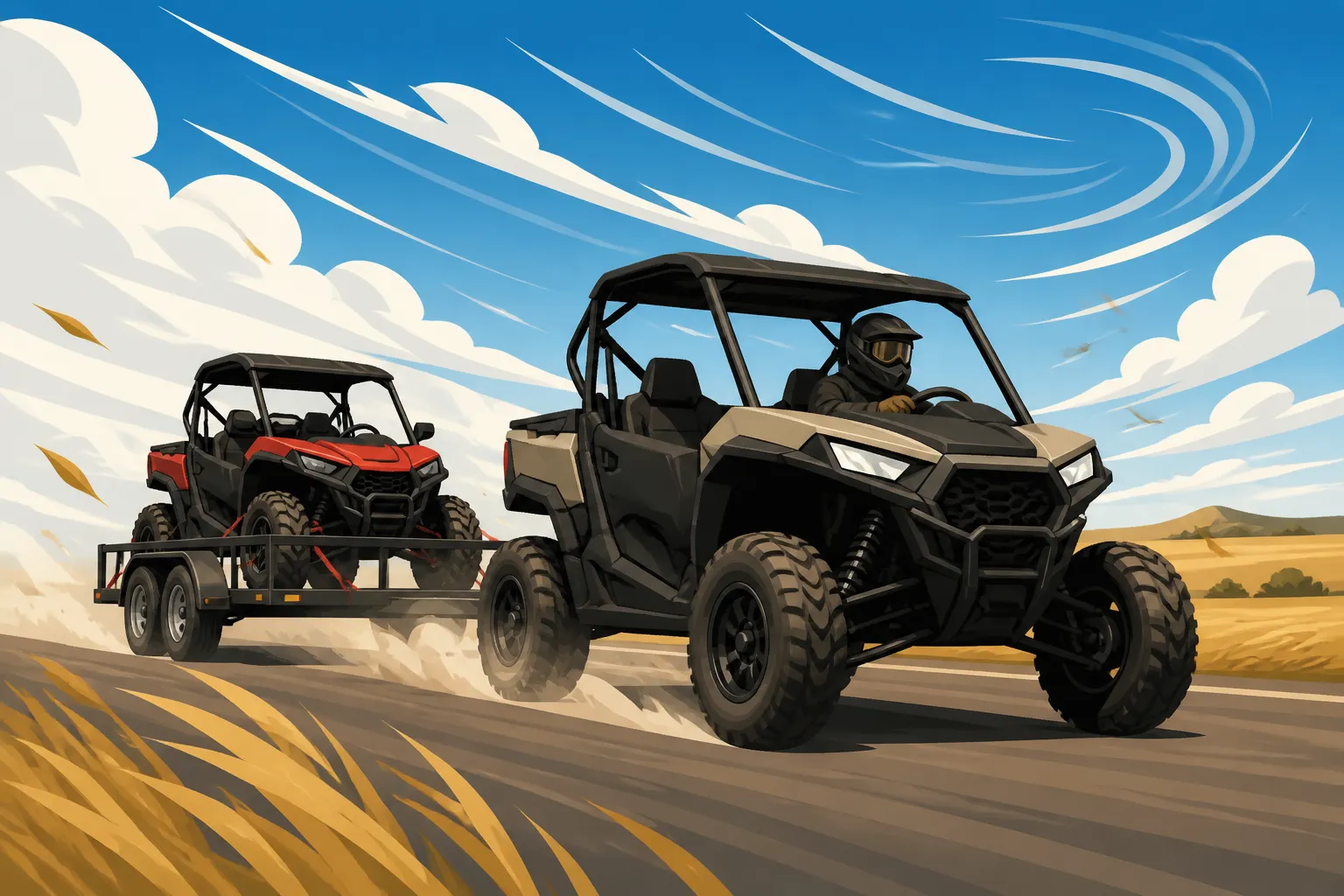
A strong crosswind can push against the trailer’s broad side. A UTV on an open trailer adds a large surface area for the wind to catch, while an enclosed trailer can act like a sail. The effect depends on the vehicle, trailer, load, road, and direction of the wind; there is no single speed that makes every combination safe. If the tow vehicle feels difficult to keep in its lane, the trailer begins to sway, or steering corrections become constant, treat that as a reason to slow down and reassess.
Plan a route with safe stopping options. Towns such as Russell, Hays, Great Bend, and Dodge City can be useful points to pause, depending on your route and destination. Do not stop in a narrow shoulder just because it is convenient. Look for a safe, legal place away from moving traffic, such as a suitable parking area or travel stop. If the conditions feel beyond your comfort level, waiting for a lull or postponing the trip is a sensible decision, not a failure.
Before you leave, look up the riding destination and the route to its entrance. Kansas Trail Conditions Before You Tow can help you think beyond road conditions to the state of the riding area itself. If your route depends on an unpaved access road, heavy rain, drifting soil, or local closures may affect whether your trailer can safely reach the entrance.
Use smooth inputs and give the trailer room
In gusty conditions, abrupt steering and sudden braking can make a difficult situation worse. Keep both hands ready, hold a steady lane position, and leave more following distance than you might when driving without a trailer. Smooth, measured corrections are generally easier to manage than sharp movements. Avoid cruise control when conditions are changing or traction is uncertain.
Passing and being passed can feel unsettling because the air movement around a large truck may briefly affect the trailer. Keep a predictable line and avoid speeding up just to pass a vehicle before a gust. If another vehicle is passing, stay steady and give yourself room. When you pass, do so only when you have clear visibility and enough distance to complete the maneuver without rushing.
Choose a speed based on what the setup can safely handle, not simply the posted limit. A lighter tow vehicle, a tall enclosed trailer, or a heavily loaded machine may need a more cautious pace than a low, well-balanced trailer. If sway starts, avoid making a sudden steering correction. Ease off the accelerator, keep the vehicle pointed in the intended direction, and follow the tow vehicle and trailer manufacturer’s guidance for controlling sway. Do not continue as though nothing happened; once safely stopped, inspect the load, hitch, and tires and decide whether it is wise to continue.
A safe travel plan includes permission to change it. If the wind is wearing you down, take a break. Fatigue makes it harder to notice sway, road debris, or a strap coming loose. A short stop in a safe place can help you reset and reassess the drive.
Plan the route to your riding area
Choose destinations with the trailer in mind
A route that works well in a car may be awkward with a long trailer. Before leaving, check where you can turn around, park, and unload. A narrow entrance, soft shoulder, tight gate, or crowded lot can create a headache even after the highway portion goes smoothly. If you are meeting friends, agree on a place where the whole group can gather without blocking access for other visitors.
Review Kansas Trailheads With Trailer Parking when comparing places to ride. Parking availability and access can shape the trip just as much as trail length. If the destination has limited space, arrive at a sensible time, park only where permitted, and avoid unloading where other vehicles need to pass.
The right riding area also depends on the machines in your group. Some places restrict vehicle width or machine type, so check the rules before loading a wide side-by-side. Use Kansas Trails That Allow Side-by-Sides and Kansas ATV Trails: Where You Can Actually Ride as starting points for deciding where your machine is appropriate. Confirm the destination’s own current instructions before you travel, especially if the trip depends on a particular trail or access point.
If you use onX Offroad to plan, treat it as a route-planning aid rather than a substitute for posted signs or local instructions. Check the route before leaving, save the information you may need, and make sure everyone in the group knows the destination and meeting point. A map app is most helpful when you have already thought through what to do if the route is blocked, cell service drops, or weather changes.
Prepare for weak service and changing access
Western Kansas routes can include long open stretches where a phone signal is unreliable. Download or save route information before departure, keep your phone charged, and consider carrying a paper map as a backup. If your group separates, an agreed meeting place is more dependable than assuming everyone can call or message from anywhere. Cell Dead Zones in Western Kansas and Carrying a Paper Map Where Cell Service Drops cover why backup navigation deserves a place in the plan.
Use onX Offroad or another map tool to review the route at home, but do not follow a line blindly. Private roads, closed gates, posted land, and changes to access can make a digital route unsuitable. Follow signs and property boundaries, and turn around if the route appears to cross land you are not authorized to enter. Before setting off, tell someone outside the group where you are going and when you expect to check in.
Groups should agree on the driving plan as well as the trail plan. Decide who is leading, where you will stop, and what everyone should do if a vehicle or trailer has a problem. Kansas Group Ride Planning offers useful preparation ideas, while Kansas Trail Etiquette Locals Expect can help your group arrive and ride considerately.
Make the trip easier from departure to unloading
Schedule stops for inspections and rest
Long, windy drives are tiring even when nothing goes wrong. Build in safe stops rather than trying to cover the route without interruption. At each stop, check the trailer connection, safety chains, lights, tire condition, tie-down tension, and any cargo that could have shifted. Look for signs of rubbing, loose hardware, or a tire that appears unusually hot or damaged. Do not touch a tire or component if it may be dangerously hot; use visual checks and let it cool before closer inspection.
Pick stopping places before you need them. A wide parking area in town may be more comfortable than an exposed shoulder, and it gives you room to inspect the rig without standing close to traffic. If you are traveling with more than one vehicle, agree on a stop that can accommodate the whole group and trailers. Keep the walk-around routine consistent so that a rushed stop does not turn into a missed check.
On arrival, take time to park on firm, level ground if possible. Set the tow vehicle and trailer securely before unloading, and keep people clear of ramps and tie-downs while the machine is moving. If wind is still gusting, be especially deliberate with ramps, doors, and loose gear. An open trailer ramp or a door on an enclosed trailer can move unexpectedly in a gust.
Decide when to stop, wait, or turn around
A good trip plan includes a point at which you will reconsider continuing. That might be when the trailer starts moving noticeably in its lane, visibility drops, the driver is fighting the steering, or the route becomes exposed enough that the setup feels difficult to control. A map route can make a destination look close, but it cannot make unsafe conditions manageable.
If you stop, choose a safe place, keep people away from traffic, and inspect the setup only when you can do so safely. Check whether the load has shifted and whether the hitch, straps, or tires show a problem. If you are unsure about the trailer’s condition, do not assume it will be fine for the remaining miles. Arrange help or wait for conditions to improve rather than pressing on because the riding reservation or group is waiting.
The same judgment applies after rain at the destination. A trail or access road that looked manageable on a dry map may be slick, rutted, or unsuitable for a tow vehicle and trailer. Check Kansas Trail Riding After Heavy Rain before committing to a route that may leave you stuck or cause damage. Sometimes the most enjoyable part of a riding weekend is making the cautious call early enough to try again another day.
| Before the drive | At a safe stop | At the riding area |
|---|---|---|
| Confirm the trailer, hitch, tires, lights, and safety chains are ready | Recheck straps, tires, hitch connection, and cargo | Park on firm, level ground where permitted |
| Balance and secure the ATV or UTV and loose gear | Look for shifting, rubbing, or visible damage | Keep people clear while unloading |
| Check the route, access, weather, and stopping options | Rest and reassess whether conditions are manageable | Follow posted access, parking, and trail rules |
| Save navigation information and agree on a meeting point | Continue only if the rig and conditions feel safe | Secure ramps, doors, and equipment in gusty wind |
A windy haul across western Kansas takes patience, a sound trailer setup, and the willingness to change plans. Load carefully, drive smoothly, inspect the rig at safe stops, and verify access before you leave. If the conditions make the trailer difficult to control, waiting or turning back is often the better start to a future ride.
Disclaimer
This article is for general informational purposes only and does not constitute professional advice. Laws, prices and regulations vary by location and change over time. Consult a qualified professional for guidance on your specific situation.