Kansas Designated Ice Entry Points
Kansas’s designated ice entry points are not interchangeable with ordinary boat ramps, shoreline roads, or open ground. If you plan to take an ATV or UTV onto the ice, the first job is to confirm that the specific location allows it and identify the approved access point. This guide explains how to check the rules, understand permits and out-of-state stickers, and avoid a costly wrong turn.
What a designated ice entry point means in Kansas
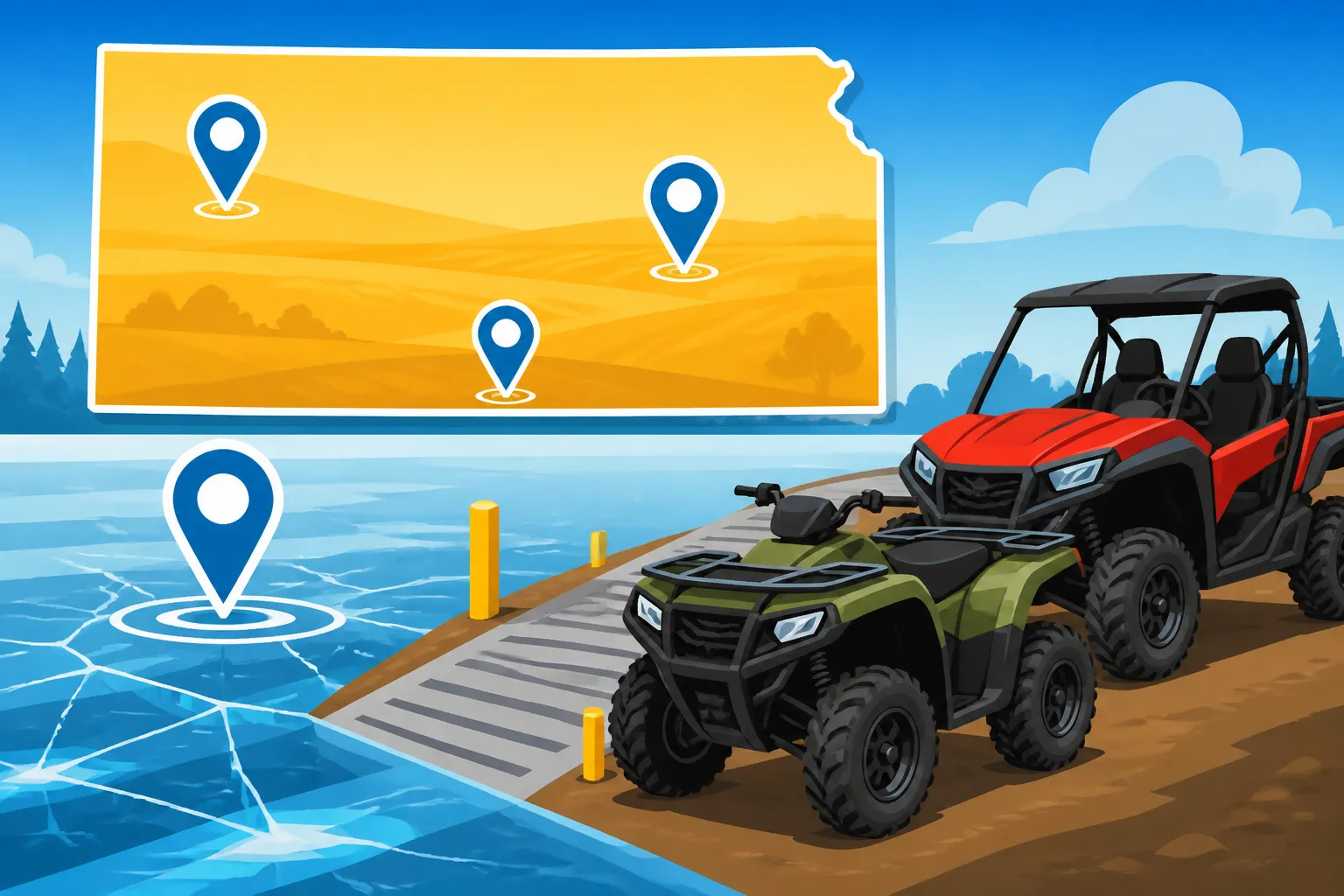
A designated ice entry point is an access location the land manager has authorized for reaching the ice with a machine for ice fishing. The key word is designated: permission to ride on one part of a lake or park does not automatically mean you can drive onto the ice wherever the shoreline looks convenient.
A boat ramp, fishing access road, parking area, or trail may serve a different purpose. Unless the manager says that location is approved for machine access to the ice, do not assume it is. The same is true if another angler has driven across a bank or a track in the snow appears to lead onto the lake. A visible tire track is not official permission, and it says nothing reliable about current ice conditions.
Rules can vary by lake and land manager. A state park, wildlife area, federal recreation area, city property, and private site may each have separate rules. A location can also change its access arrangements because of ice conditions, maintenance, construction, or a temporary closure. Before towing your machine, check the current information for the exact site and ask which access point is authorized. The general guidance in Kansas Ice Entry Point Rules can help you frame that check, but posted instructions at the location and directions from its manager matter.
The practical distinction is simple:
- A designated entry point is approved access. Use the route and location identified by the land manager.
- An ordinary ramp is not automatically an ice entry point. It may be intended for boats, foot traffic, or other uses.
- An open-looking shoreline is not permission. Do not create your own route across land or onto the ice.
- Permission to reach the ice is not a guarantee that the ice is safe. You are responsible for assessing conditions and deciding whether to proceed.
The entry point is only one part of the trip plan. You also need to know whether your particular machine is allowed, whether a park permit or other access requirement applies, what hours are in effect, and where you may drive once you reach the ice. Those rules are separate from the question of whether an ATV or UTV has a Kansas title. A title is proof of ownership; it does not grant access to a lake or make an off-road machine legal on public roads. For the distinction between access rules and machine paperwork, see Kansas Has No State OHV Permit and Kansas Proof of Ownership on the Trail.
How to confirm the right access point before you go
Do not plan around a vague answer such as “they let people ride out there” or “there’s a ramp by the parking lot.” Get confirmation for the water body, the machine, and the purpose of the trip. If you are unsure who manages the location, start with the agency or property office identified on the site’s official information or entrance signs.
A careful pre-trip check takes a few minutes and can prevent you from hauling to a closed or unsuitable access point.
- Name the exact lake and property. Similar place names, nearby public areas, and neighboring access points can have different rules. Have the site name and the side or area of the lake you intend to use.
- Ask whether machines may access the ice. Do not ask only whether “ice fishing is allowed.” Confirm that an ATV or UTV may be used for access, if that is your plan.
- Ask for the designated entry point by name or description. Get clear directions. If there are multiple ramps or parking areas, confirm which one is approved for ice access.
- Confirm the rules for your machine. A rule for snowmobiles, for example, may not automatically include an ATV or UTV. Give the manager a straightforward description of your machine.
- Check hours and temporary restrictions. Kansas access guidance includes an early-morning limit tied to sunrise for ice-fishing machine access. Confirm the current hours for the specific property rather than relying on a past visit or a general recollection.
- Ask which permits or access documents are required. Requirements can depend on the land manager and the kind of access involved. Confirm whether you need a park permit, a vehicle permit, or another site-specific authorization.
- Check again before loading. Weather, changing ice, or a management decision can close access after you first make your plans.
When you call, be precise. For example: “I’m bringing an ATV to ice fish at this lake. Is machine access onto the ice open, and which designated entry point should I use? Are there permit requirements or hours I should know about?” If you are bringing a side-by-side, say so rather than calling it simply an ATV. That gives the staff member a better chance of answering for the machine you will actually use.
If no one can confirm that your planned route is authorized, treat that as a reason to pause—not as permission to improvise. You can choose another confirmed access point, go without the machine if that is allowed, or postpone the trip.
| Question to confirm | Why it matters | What to do |
|---|---|---|
| Is machine access onto the ice allowed here? | General fishing access does not necessarily include machine access. | Ask about ATV or UTV access specifically. |
| Which entry point is designated? | Nearby ramps and shorelines may serve other purposes. | Get the site’s exact directions or description. |
| Is my type of machine allowed? | Rules may differ by machine class or site. | Describe the vehicle accurately. |
| What hours apply? | Access may be limited by time of day or current conditions. | Confirm current site hours before traveling. |
| Is a permit or pass required? | Park and land-manager requirements can differ. | Ask who issues it and what it covers. |
| Is access open today? | Ice, weather, or maintenance can change conditions. | Recheck shortly before departure. |
For broader rules about machines used for ice fishing, read [Kansas Ice Fishing Machine Rules]. The important habit is to treat the designated entry point as a specific approved route, not as a general invitation to cross any convenient part of the property.
Permits, park access, and out-of-state visitors
Kansas does not have a statewide trail sticker that every ATV or UTV rider must buy before using an off-road trail. That does not mean every public property is permit-free. A site can have its own access requirements, and a permit for one kind of use does not necessarily cover another.
This is where riders can get tripped up. They hear that Kansas has no general OHV permit and assume a park or other public property cannot require a permit. Or they buy a permit and assume it allows riding anywhere on the property. Neither assumption is safe. Check what the specific permit covers and whether it applies to the route you intend to use. The difference between an access permit and permission to ride trails is explained in Kansas Park Permit vs Trail Permit.
At a state park or another property with its own permit system, ask the managing office whether the permit applies to the planned trip and where it is required. Some permits are associated with use of park roads or other defined areas; that does not automatically authorize machine travel across the ice, over land, or beyond posted boundaries. For information on where a park permit can be obtained, see Buying an Unconventional Vehicle Permit at a Park Office. If you are uncertain whether the permit applies to an ice-fishing trip, ask the park office directly rather than relying on the permit’s name.
A permit, when required, also does not replace the need to use a designated ice entry point. Think of the requirements as separate checks:
- Access authorization: Is the property open to you for this purpose?
- Entry location: Is your chosen route the designated way to reach the ice?
- Machine eligibility: Does the rule include the ATV or UTV you are bringing?
- Permit: Do you need one, and what specific area or activity does it cover?
- Hours and conditions: Is access open at the time you plan to arrive, and is it currently safe and permitted?
For visitors from another state, a sticker or permit from home should not be treated as a substitute for Kansas property rules. Kansas generally does not require visiting riders to obtain a statewide OHV sticker simply because they are out-of-state visitors; however, an individual park or property may have its own requirements. Likewise, another state’s registration or trail sticker does not establish permission to use a Kansas ice entry point. See Kansas Requires No Sticker of Visitors and Kansas Honors No Other State Sticker for the state-level distinction.
The safest approach for a visitor is to bring the documentation that helps establish who you are and what machine you have, then follow the specific site’s rules. Keep in mind that registration, title, insurance, and permission to ride are different things. A machine can have valid ownership paperwork and still be prohibited from a particular public area. Conversely, a site’s access permit does not serve as a title or proof that you own the machine.
If the access point is on property managed by a federal agency, municipality, or private operator, do not assume a Kansas state-park answer applies. Ask the organization responsible for that exact location. For wildlife areas and other public lands, Kansas Wildlife Area Machine Rules is a useful starting point, but the property’s posted restrictions and current directions remain important.
Using the entry point safely and respecting site limits
Once you have confirmed the right entry point, use it as directed. Avoid widening the route, bypassing a barrier, or cutting across a bank to get closer to the ice. A route that seems harmless in winter may cross fragile ground, a closed area, or property where machine travel is not allowed.
At the site, look for posted signs, gates, barriers, and temporary notices. A sign that closes a road or shoreline route still matters even if the ice looks solid and other people are present. If the official access point is blocked, closed, or visibly unsafe, do not treat the closure as an inconvenience to work around. Contact the manager or leave.
Access hours deserve the same attention. Kansas guidance for ice-fishing machine access includes a restriction tied to sunrise, and a property may have additional hours or closures. Confirm whether the time limit concerns entering the access area, traveling onto the ice, or being present in the area. Do not assume that an access time you remember from another lake applies here. The site’s current direction is the useful one.
Ice conditions can change across a lake and over a short period. An authorized entry point does not certify the thickness or stability of the ice. Wind, moving water, springs, current, snow cover, and changing temperatures can all complicate what a person can see from shore. A machine adds substantial weight and can make a bad decision much more serious. Do not drive onto ice just because another machine has done so, and do not treat a familiar lake as automatically safe after a change in weather.
Plan for a breakdown or a change of mind. Tell someone where you are going, keep a charged phone or other communication option available, and avoid traveling alone if you do not have a reliable way to get help. Carry basic recovery and first-aid supplies suited to your machine and the conditions. Keep gear secured so it does not slide or interfere with steering, controls, or passenger safety.
When selecting equipment, use a checklist rather than buying items simply because they are marketed for ice or off-road use. A physical map or downloaded map can be useful when cell service is weak; a light, visible flag or reflective material may help people see your machine in poor visibility; and dry storage helps protect communication and emergency supplies. Amazon can be one place to compare basic items such as dry bags or reflective gear, but check dimensions, durability, and whether the item suits your machine and conditions. A listing is not a substitute for local rules or safe ice practices.
Keep your route and behavior considerate of others. Follow posted speed and access restrictions, give people on foot room, and do not crowd fishing spots or block the entry point. Do not leave trash, fuel, or equipment behind. If the route is narrow or busy, wait until it is clear rather than trying to squeeze past people near the shoreline.
If you need current directions, Calling a State Park Office Before You Load Up offers a useful approach for getting specific answers before a trip. When you call, ask about closures and the designated point, not just whether the lake is generally open.
Common mistakes and a simple pre-trip checklist
Most problems come from treating a general rule as if it answers every site-specific question. A rider may know that Kansas has no statewide OHV sticker, see a public access road, and assume they can ride from there onto the ice. But statewide permit policy does not select an entry point, confirm a property is open, or guarantee that an ATV is allowed at that particular location.
Avoid these common mistakes:
- Using the nearest ramp without confirmation. The closest ramp may not be the designated ice entry point.
- Treating a previous visit as current permission. A route can be closed or conditions can change.
- Assuming all machines follow the same rule. Identify whether you have an ATV, UTV, snowmobile, or another vehicle.
- Confusing a state permit with site authorization. A permit’s scope may be limited to particular roads, areas, or activities.
- Relying on an out-of-state sticker. It does not override Kansas property restrictions or local access rules.
- Following someone else’s tracks. Tracks show that a machine passed through, not that the route was legal or safe.
- Entering outside permitted hours. Confirm the hours for the property and the activity.
- Assuming title means access. Ownership documents do not provide permission to ride on public or private land.
- Improvising when a ramp is closed. A closure is a stop sign for your plan, not a prompt to find an unmarked route.
Before you leave home, run through this checklist:
- Confirm the exact lake and land manager.
- Verify that ATV or UTV access onto the ice is allowed.
- Get the designated entry point and directions.
- Confirm current hours, closures, and ice-fishing restrictions.
- Ask whether a park permit or other authorization is required.
- Check whether the rule applies to your particular machine.
- Make sure your planned route stays within the approved access area.
- Pack for cold, changing conditions, and a possible delay.
- Recheck the site information before towing.
For a useful question list to keep on hand, see Kansas Permit Questions Riders Ask. If the rules remain unclear after checking, do not infer permission from silence, a map symbol, or the presence of other riders. Choose a location where the manager can clearly confirm the access arrangement.
Designated ice entry points are meant to make access predictable and protect the property. Using the right point, checking the permit requirements, and respecting hours and closures turns the trip from guesswork into a plan. Most importantly, remember that authorization to reach the ice is not a safety certification. Confirm the route and the rules, then make a separate, cautious judgment about whether the ice and conditions are suitable for your machine.
Disclaimer
This article is for general informational purposes only and does not constitute professional advice. Laws, prices and regulations vary by location and change over time. Consult a qualified professional for guidance on your specific situation.