Kansas Has No State OHV Permit
Kansas riders often hear that an OHV permit is required, then find conflicting advice about state parks, local streets, and out-of-state stickers. The key distinction is that Kansas has no general statewide OHV trail permit, but separate rules may apply to state park roads, private riding parks, and city streets. This guide explains what visitors and residents should check before unloading a machine.
What Kansas Means by Having No State OHV Permit
No statewide trail sticker for ordinary OHV riding
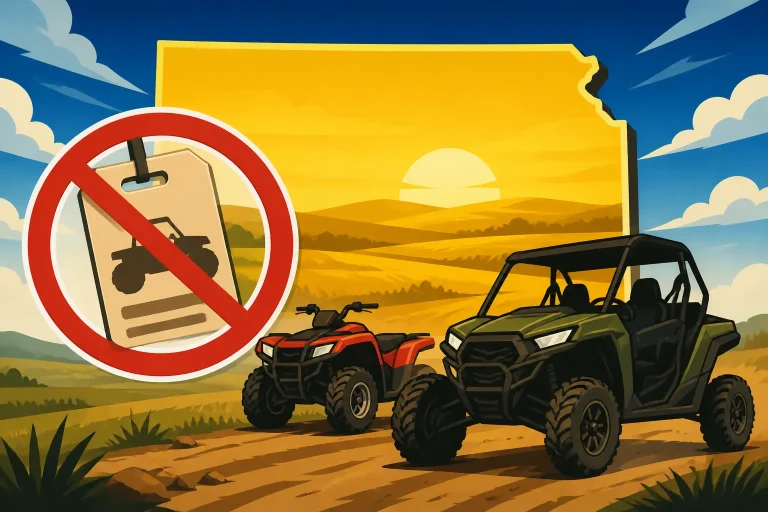
Kansas does not have a general state-issued OHV trail pass that every ATV, UTV, or dirt-bike rider must buy before riding. In other words, there is no single statewide OHV sticker that grants access to a network of public off-road trails across Kansas. That can be a relief if you are comparing rules with a neighboring state that requires a trail permit, but it does not mean every place is open to riding.
Access depends on the land and the rules that apply there. A private park can require its own pass, waiver, equipment checks, age limits, or proof of insurance. A state park can have rules for using a nonhighway vehicle on designated park roads. A town may have an ordinance governing a UTV on city streets. These are separate requirements, not versions of a statewide OHV trail permit.
This distinction is easy to miss when a sign, website, or conversation uses the word “permit” without saying what it covers. Before you pay for anything, ask which location or activity the permit applies to. A permit for a park road is not automatically a permit to ride off-road, and a private riding-area pass does not authorize road use elsewhere.
For a broader look at the state’s permit framework, see Kansas Unconventional Vehicle Park Permits and Why Kansas Sells No Trail Pass at All. The useful takeaway is simple: Kansas has no general state OHV trail permit, but location-specific requirements still matter.
No state permit does not mean unrestricted access
A lack of a statewide OHV permit is not permission to ride wherever you see a track or open-looking field. Land ownership, posted signs, local ordinances, and site-specific rules determine where you can go. A rural road, pasture lane, reservoir access road, or mowed strip beside a field may look inviting while still being off-limits to your machine.
Private land is a particularly common source of confusion. A landowner’s permission can allow you to ride on that property, but it does not make nearby roads or adjoining parcels available. If the property is leased, permission from the person who owns the land may still be necessary, depending on the arrangement. Do not assume hunting access, a familiar farm connection, or an unlocked gate gives you permission to ride.
Public land also has boundaries and operating rules. Some areas allow machines only on designated roads, while others prohibit OHVs or limit access to particular uses. Check the agency or managing organization for the exact location before you tow there. Kansas KDWP Land Rules for Machines explains why public ownership alone does not guarantee OHV access.
The practical question is not just “Do I need a Kansas permit?” It is also “Who manages this place, and what does that manager allow?” Answering both questions before you leave home can save a long drive, an awkward conversation at a gate, or a citation.
Kansas State Park Permits Are a Different Requirement
A park-road permit is not a statewide OHV trail pass
Kansas has a separate permit system for certain unconventional vehicles used on state park roads. That permit is tied to the state park-road setting; it is not a general OHV permit for riding trails throughout Kansas. The distinction matters because a rider may hear “Kansas requires a permit” and assume the rule applies everywhere, or hear “Kansas has no OHV permit” and assume no park paperwork can apply.
Think about a family taking a UTV to a state park campground. The family may want to drive the machine along designated park roads between their campsite and another permitted destination. That use can raise a different question from riding an ATV on a private off-road course. The state park’s requirements, vehicle eligibility, and any restrictions on where the machine may travel should be confirmed with the park.
A park-road permit does not convert a road into an OHV trail. It does not grant permission to leave designated roads and ride through grass, woods, shoreline areas, or closed routes. Nor does it replace any required entry, camping, or other park-related permits. Each permission covers a particular purpose, and riders should avoid treating one document as a universal pass.
For the distinctions between the state park permit and a trail pass, read Kansas Park Permit vs Trail Permit. If you are bringing a machine to a state park, What to Show at a Kansas State Park Gate is also a useful companion topic.
Confirm the vehicle and route with the park
Before hauling a machine to a state park, contact that specific park and describe the vehicle accurately. “Off-road vehicle” can mean several things: a four-wheel ATV, a side-by-side with a steering wheel, a dirt bike, or another nonhighway machine. Give the park staff the vehicle type and explain where you hope to drive it, such as from a campsite to a boat ramp or along a designated park road.
Ask whether the machine is eligible for the relevant permit, where that permit is obtained, and what roads are open to it. Also ask whether the permit must be displayed, whether the machine needs to meet equipment requirements, and whether there are seasonal or temporary restrictions. Those questions help distinguish a valid route from a tempting but prohibited shortcut.
For example, a visitor may plan to ride from a campground to a fishing area. The shortest path on a map might cross a grassy strip or a closed access lane. Even if the vehicle has the required park-road permit, the rider should stay on authorized routes and confirm that the destination can be reached legally. A route that is permitted for a golf cart or maintenance vehicle may not necessarily be open to every ATV or UTV.
Keep the park’s instructions with your trip notes, and follow signs at the site even if an older online discussion suggests a different route. Park rules can be location-specific, and a permit does not override a closure notice. When in doubt, ask before unloading rather than relying on assumptions once you are already at the gate.
Reciprocity for Out-of-State Riders
Kansas does not require visitors to buy a state OHV sticker
Because Kansas does not issue a general statewide OHV trail sticker, visitors do not need to purchase a Kansas OHV sticker simply to satisfy a statewide trail-permit requirement. A rider coming from Missouri, Nebraska, Oklahoma, Colorado, or another state should not assume that Kansas has a reciprocal trail pass system to join. Kansas Requires No Sticker of Visitors covers this point.
That does not mean an out-of-state machine has blanket access to every Kansas riding area. A visitor must still follow the rules of the property or facility they plan to use. A private park can charge for admission and require a waiver. A state park may have a separate permit rule for machine use on designated roads. A city may impose its own conditions before allowing certain vehicles on local streets.
A useful example is a weekend trip to a private off-road park. The visitor may not need a statewide Kansas trail sticker, but the park may require registration at the entrance, a signed waiver, compliance with posted sound or safety rules, and a day pass. That is the facility’s access policy, not a Kansas state OHV permit.
Before driving across the state line, check requirements for each destination separately. If a trip includes a state park and a private riding area, do not assume that one park’s rules cover the other. The easiest way to avoid last-minute surprises is to identify the land manager for every planned riding location.
A home-state sticker does not create Kansas access
A permit or registration decal from your home state does not automatically authorize you to ride on Kansas land. Since Kansas has no general state OHV trail sticker to reciprocate with, there is no statewide Kansas trail sticker that another state’s decal can replace. Kansas Honors No Other State Sticker explains why riders should not treat a home-state pass as a substitute for site-specific permission.
This is not the same as saying your home-state paperwork is meaningless. It may help demonstrate ownership or compliance with your home jurisdiction’s rules, and a park may ask for relevant information as part of its own check-in process. But it does not grant a right to enter private property, use a closed road, ride outside an authorized area, or bypass a Kansas park’s local requirements.
Imagine a rider arrives at a Kansas park with a valid sticker from home and sees other machines using a marked route. The sticker alone does not settle whether that rider’s machine is allowed on that route, whether a local pass is needed, or whether the route is temporarily closed. The rider needs to follow the Kansas location’s rules, not simply rely on a decal issued somewhere else.
If your trip crosses multiple states, check each destination and each land manager’s rules. A permit may be necessary in one state, unnecessary in another, and irrelevant to a private park’s separate admission policy. For interstate travel questions more broadly, Kansas Rules for an Out-of-State Machine is a helpful next read.
Where You Can Ride Without a State OHV Permit
Public land has its own access rules
Kansas has public land, but that does not translate into a statewide network of open OHV trails. Some public areas restrict motorized travel to agency roads, parking areas, or designated access points. Others may not allow recreational OHV use at all. The agency responsible for the property sets the boundaries and conditions.
This is why two places beside the same reservoir can have different rules. One managed area may allow a particular kind of machine on a designated road, while another nearby area may prohibit recreational riding. The fact that both places are public, or that vehicles are visible nearby, does not establish that your ATV or UTV is authorized there.
Corps-managed properties are another example where local details matter. The riding opportunities, access routes, and restrictions depend on the particular area. Review Kansas Corps of Engineers Riding Areas and then verify the rules for the exact location you plan to visit. Do not assume every Corps property has a riding area simply because another one does.
Before heading out, look for posted signs and contact the managing office if the route is unclear. Ask whether OHVs are allowed, which vehicle types are permitted, whether riding is limited to designated roads, and whether any local pass or fee applies. This is more reliable than treating “public land” as a single category with one statewide rule.
Private parks set their own conditions
Private riding parks often provide the most direct way to find a designated place to ride, but their rules are facility-specific. They may require admission, a signed waiver, a helmet, protective gear, a sound-compliant machine, or a minimum age. Some may restrict passengers or vehicle sizes, or close certain areas during wet conditions.
A rider who is planning a group weekend should check these details before inviting everyone. One friend might be bringing a wide side-by-side, another a youth quad, and a third a dirt bike. A park’s width limits, age policies, or machine restrictions could affect who can ride and where. It is frustrating to arrive with a loaded trailer only to discover that a machine is not permitted on the available routes.
Also ask what the admission pass covers. Does it allow riding for a specified visit, include camping, or simply grant access to the property? Are reservations needed for a campsite or organized event? What happens if weather closes a route? These are questions about the private operator’s terms, not statewide Kansas OHV permit rules.
Read Kansas Private Park Waivers and Rules before choosing a facility. If the park sells passes or requires a waiver, complete the steps the park asks for. A private pass is not a state-issued permit, but it may be essential to ride legally on that private property.
Permit, Title, Registration, and Road Access Are Not the Same
A title documents ownership rather than trail permission
A title and a riding permit answer different questions. A title is a record associated with ownership and the vehicle’s classification; it does not, by itself, grant access to a trail, park, field, or road. Likewise, the absence of a statewide OHV trail pass does not mean an owner can ignore title requirements that apply to the machine.
This distinction can matter when you buy a used ATV or UTV and plan to ride at a private facility. The seller’s paperwork may help establish ownership, but the park can still require its own admission pass and compliance with posted rules. Conversely, having permission to use a private trail does not necessarily resolve ownership paperwork for a machine you bought.
Keep the documents that are relevant to your situation organized and accessible. Depending on the setting, that might mean proof of ownership, a bill of sale, a park confirmation, or a local permit. A small waterproof document pouch can help protect papers from dust, rain, and muddy gear; riders sometimes find basic pouches through retailers such as Amazon or local outdoor stores. The important part is that the papers are legible and available when needed.
For ownership questions, see Kansas Proof of Ownership on the Trail. If you need to sort out the title process itself, Kansas Nonhighway Title Requirements is a more appropriate starting point than an OHV-permit search.
A city street tag or road rule is not an OHV trail permit
A city may set its own rules for certain vehicles on local streets. Depending on the municipality and the vehicle, those rules may involve a city tag, insurance, inspection, equipment, or limits on which streets can be used. Such requirements concern local road use; they do not create a Kansas-wide trail permit and do not authorize riding off-road.
This can be confusing for UTV owners who live in or visit a town that permits some street use. A city-approved tag may apply only within that city and only under the ordinance’s conditions. It does not automatically allow the same UTV on a county road, a state highway, another town’s streets, or a private riding area.
Similarly, a title or a local road-use approval is not a substitute for permission to ride on someone else’s land. A machine may be properly titled and allowed on certain streets, yet still be prohibited from an adjacent field or park road. Keep the purpose of each document clear: ownership paperwork, street-use approval, and site access each have different functions.
If road access is part of your plan, research the road rules separately from park or trail access. Start with Kansas UTV Street Legal Rules by City and check the specific city’s current ordinance and any route restrictions. Do not use the phrase “it’s permitted” without being clear about what, exactly, is permitted.
A Practical Checklist Before You Load the Trailer
Identify the land manager and the activity
Start by writing down every place where you expect to ride or drive the machine. For each location, identify who manages it: a state park, a federal agency, a city, a private park, or a private landowner. Then describe the activity precisely. Riding on a designated park road is different from riding on a trail, and driving through town is different from crossing private ground.
Next, ask the manager what rules apply to your vehicle type. Use specific terms such as ATV, side-by-side, UTV, dirt bike, or golf cart rather than saying only “OHV.” If you are not sure how the machine is classified, provide the make, model, and basic configuration. A steering wheel, seating arrangement, width, or vehicle design may affect how a facility treats it.
Check for separate requirements: entry passes, park-road permits, private-park waivers, city tags, insurance, age limits, passenger rules, and equipment standards. Not every item applies at every destination, but checking the categories prevents the common mistake of assuming that one permit covers everything. Kansas Park Entrance Permits and What They Cover can help clarify how a park entrance permit differs from permission to operate a machine.
Finally, check for temporary closures or special event rules before departure. Weather, maintenance, wildlife management, or a scheduled event can affect access even if the location normally allows riding. A quick confirmation with the managing office is especially worthwhile when the trip involves a long tow or an unfamiliar property.
Carry useful information without treating it as a universal pass
Bring the paperwork that applies to your machine and destination, but remember that papers do not replace permission. A title or bill of sale may help establish ownership; a private park receipt may show that you paid for access; and a state park permit may relate to travel on designated park roads. None of those documents automatically grants access to a different property or route.
For a multi-stop trip, keep a short note for each location with the manager’s contact details, the permitted routes, any pass or waiver instructions, and relevant restrictions. If cell service is poor, a printed copy or saved offline note can be useful. Some riders print a map or save a facility’s instructions alongside their trip papers; Amazon is one place people may look for basic paper maps or document supplies, but the map should be checked against the land manager’s official route information.
A waterproof pouch can keep receipts and ownership paperwork from becoming unreadable after a wet or dusty day. Amazon and local outdoor retailers carry general document-protection supplies, but any pouch is only a convenience. It is not an official permit holder unless the park specifically provides or requires one.
The best preparation is still a clear answer from the person or organization responsible for the land. If the rules are uncertain, do not rely on a friend’s recollection, an old social-media post, or a sticker from another state. Confirm the location, route, and vehicle type before riding.
Common Misunderstandings About Kansas OHV Permits
“No state permit” does not mean “no fees”
Kansas’s lack of a general statewide OHV trail permit does not mean every riding opportunity is free. A private park may charge an admission or camping fee, and a state park may have separate charges or permits for particular uses. Those amounts and terms depend on the facility, so check directly with the operator before you go.
The reverse misunderstanding also happens: riders hear that a park permit exists and assume Kansas requires every ATV and UTV to display a statewide decal. The park-road permit is a distinct, location-based requirement. It is not a universal pass for all trails or all public land.
When you see the word “permit,” look for the issuing authority and the activity it covers. A state agency permit, city tag, private-park day pass, event wristband, and camping authorization are not interchangeable. If the description does not make the scope clear, ask whether it applies to the machine, the location, the route, or the activity.
Being precise with these terms makes conversations easier. Instead of asking, “Do I need a permit in Kansas?” ask, “Do I need a permit to drive this UTV on the designated roads at this state park?” or “What pass is required to ride this private park’s trails?” A specific question is much more likely to produce a useful answer.
“My home state allows it” does not settle Kansas rules
Visitors sometimes arrive with a valid home-state OHV sticker and assume it gives them the same access in Kansas. It does not. Home-state credentials cannot create permission where Kansas land managers or private property owners have set different conditions.
The same principle applies to road use. A machine that can be used on a certain road in another state may not qualify for the same use in a Kansas city or on a Kansas road. Local ordinances and state road rules should be checked independently, especially when the plan includes connecting roads between riding areas.
A final common mistake is confusing vehicle paperwork with rider access. A titled machine is not automatically allowed on a trail; an out-of-state decal is not a Kansas trail pass; and a park admission pass does not automatically authorize city-street use. Each question has a different answer and may involve a different authority.
If you remember one practical rule, make it this: Kansas does not require a general statewide OHV trail permit, but every destination can still impose its own access conditions. Confirm those conditions for the exact vehicle, location, and route before you ride.
Disclaimer
This article is for general informational purposes only and does not constitute professional advice. Laws, prices and regulations vary by location and change over time. Consult a qualified professional for guidance on your specific situation.