Private Parks Filling the Gap
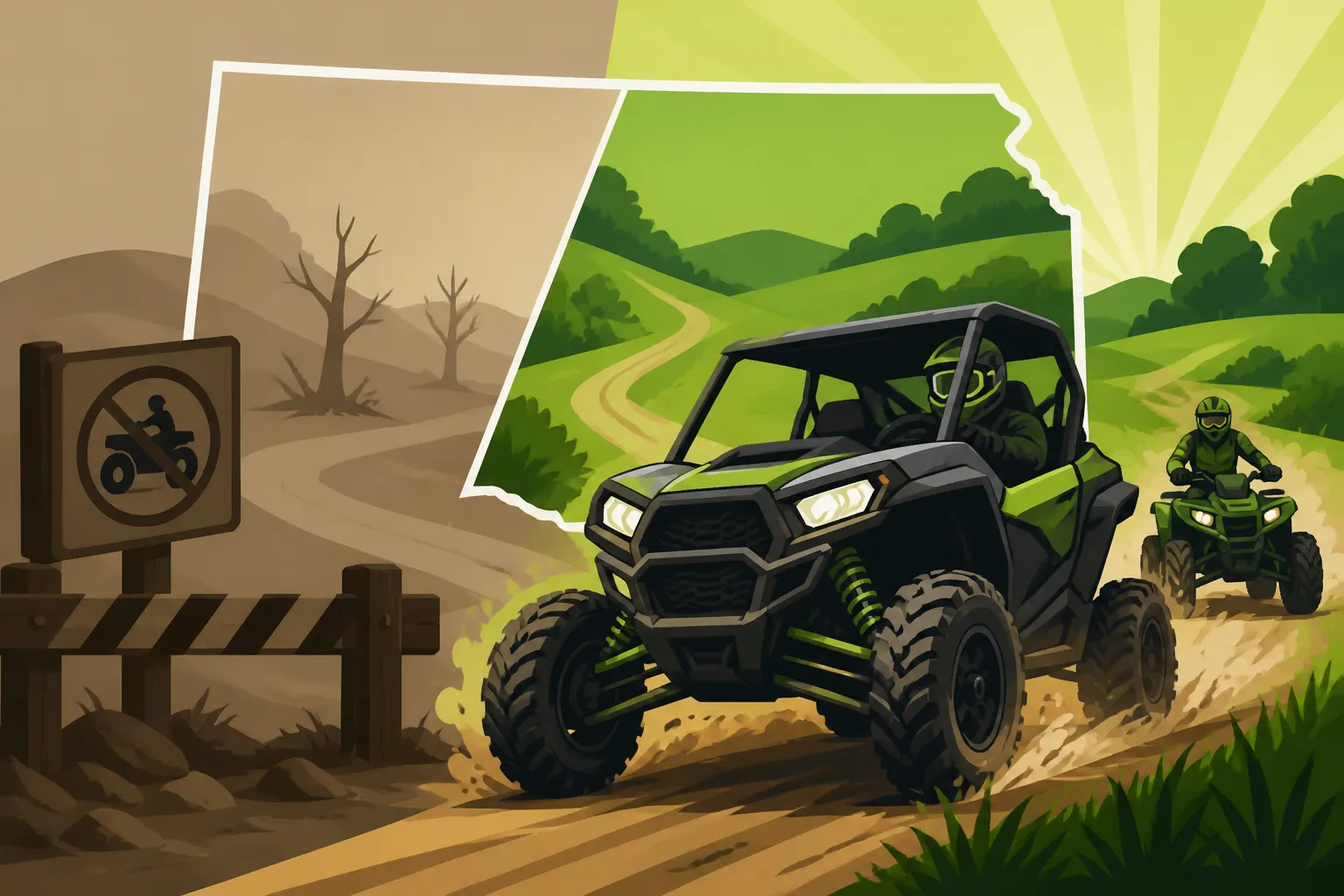
Kansas has plenty of gravel roads and open country, but that does not mean you can legally ride an ATV or UTV wherever there is space. Public trail options are limited, and private land requires permission. This guide explains how Kansas’s private off-road parks help fill that gap, what to check before you go, and how to plan a ride that suits your machine and group.
Why private parks matter for Kansas riders
Public riding options are limited
A common frustration for Kansas riders is finding a place that is both suitable for an off-road machine and open to riding. A field, pasture, or stretch of unpaved road may look inviting, but appearance does not grant permission. Riding without the landowner’s consent can cause problems for the rider and the people who live or work nearby.
Kansas also does not have a broad network of state-operated OHV trails. State parks may offer roads and other recreation, but they are not automatically ATV trail systems. Before loading up, learn the difference between a place that permits road travel and one that allows trail riding. Kansas State Parks Have No OHV Trails gives more context on that distinction.
There are public riding areas, including some associated with the U.S. Army Corps of Engineers, but they are specific places with their own boundaries and rules. They are not permission to ride anywhere around a lake or on nearby public ground. For an overview of those options, see Kansas Corps of Engineers Riding Areas.
Private parks create a destination for riding
Private off-road parks provide a place where riders can use designated terrain under park rules rather than trying to piece together access on scattered private property. That matters in a state where land is actively used for farming, grazing, and other work. Staying on trails set aside for riding helps avoid conflicts with landowners and reduces the temptation to take a machine onto ground where access is uncertain.
The terrain can also be a reason to visit. A rocky course, sandy dunes, and wooded paths are different kinds of riding experiences, and not every machine or rider will enjoy all of them. A beginner on a stock utility ATV may want a different outing from an experienced rider looking for ledges or deep sand.
Private parks do not all work alike. Some have designated riding areas and facility rules that differ by location, while access schedules, amenities, and fees can change. Treat each park as its own destination rather than assuming that a pass or permission at one place applies elsewhere. The broader guide to Kansas Private Off-Road Parks can help you compare the kinds of places to investigate.
Public areas and private parks serve different purposes
A public riding area may suit a quick day trip if it is nearby and its designated routes fit your machine. A private park may be a better choice when you want a more focused riding weekend, a particular kind of terrain, or a place where the riding rules are set out for park visitors.
Neither option should be treated as “ride anywhere.” Public land rules still apply, and private parks can restrict vehicle types, routes, passengers, hours, or equipment. Check the specific location’s information before setting out, especially if you are traveling from across Kansas or from a neighboring state.
| Riding option | What it can offer | What to check before leaving |
|---|---|---|
| Private off-road park | Designated terrain and a riding-focused visit | Operating schedule, permitted machines, park rules, fees, and amenities |
| Corps-associated riding area | Public access at certain designated areas | Current access, boundaries, allowed routes, and any posted restrictions |
| Private farm or pasture | Possible riding only with the owner’s permission | Clear permission, where you may ride, dates, and any limits |
| Public road or trail-like route | Travel only where that vehicle and route are legally allowed | Local rules, signs, vehicle class, and whether the route permits riding |
Notable private riding destinations in Kansas
Kansas Rocks Recreation Park near Mapleton
Kansas Rocks Recreation Park is a name to look into if your group wants a rocky riding environment. Rocky terrain can be demanding even at low speeds: a line that looks manageable from the seat may involve sharp edges, uneven footing, or a drop that is awkward for a longer or wider machine. A rider’s experience and vehicle setup matter as much as the park’s general reputation.
Before heading to Mapleton, check the park’s own rules and visitor details. Confirm that your machine is permitted, find out how the park handles check-in and access, and ask whether routes are marked by difficulty. If your group includes new riders, avoid assuming that everyone will be comfortable on the same trails. Someone who enjoys technical sections may be happy to repeat them; a family member on a smaller ATV may prefer easier ground.
It is also worth checking how the park expects visitors to prepare and behave. Parks may have specific requirements about waivers, protective equipment, passengers, alcohol, sound, or riding in designated areas. Kansas Rocks Park Rules for Riders is a useful starting point for thinking through the questions to ask, while Kansas Private Park Waivers and Rules covers why the gate paperwork deserves more than a quick glance.
Syracuse Sand Dunes in Hamilton County
Syracuse Sand Dunes offers a very different kind of outing: sand riding rather than rocky terrain. Deep, shifting sand can put extra strain on a machine and rider. Steering can feel different, visibility may be affected by dust, and a machine that handles familiar hard-packed ground comfortably may feel less predictable in dunes.
Prepare for the conditions instead of treating a sand park like a casual gravel-road ride. Make sure tires and vehicle equipment are appropriate for your machine and the park’s requirements. Bring enough water for the group, plan breaks, and keep a sensible distance from other riders when dust reduces visibility. If someone gets stuck, avoid rushing in without checking footing, traffic, and the safest recovery method.
Confirm the park’s current visitor information before making the drive to southwestern Kansas. Check the operating schedule, access and payment procedures, campsite availability if you plan to stay, and any seasonal or weather-related notices. The destination’s own rules should be the final word; Syracuse Sand Dunes Park in Kansas is another helpful overview to consult when planning.
Choose by terrain and group, not just distance
It is tempting to choose the nearest park and assume the day will work out. A better fit depends on who is coming, what they ride, and what kind of terrain they want. A group with children or first-time riders may value simpler routes, clear boundaries, and convenient places to stop. Experienced riders may prefer more technical ground, but should still check vehicle limits and route conditions.
A side-by-side can have different access restrictions from a small ATV, especially on narrow trails. A park’s general description is not enough to establish that every machine fits. Ask whether width, vehicle class, passengers, or other equipment affect access. If a park has marked routes, confirm that your vehicle can use the routes you are planning to ride.
For a broader sense of the state’s riding choices, compare private destinations with areas such as Tuttle Creek ORV Area in Kansas and School Creek ORV Area in Kansas. They are not substitutes for checking the specific rules, but comparing terrain and access can help you decide whether to make a day trip, plan a weekend, or wait for a better match.
How to plan a private park ride
Verify access before you load the trailer
A long drive can turn frustrating fast when a gate is closed, a section is unavailable, or your machine is not allowed on the routes you expected to ride. Before leaving, check the park’s official visitor information and contact the park if anything important is unclear. Pay special attention to the operating schedule, entrance instructions, whether reservations are needed, and how the park handles weather-related closures.
Do not rely on an old social media post, a friend’s memory, or a map pin alone. Access details and park policies can change, and a map may show a road or trail without confirming that it is open to the public. Tools such as onX Offroad can help you prepare by reviewing mapped routes and nearby terrain, but a mapped line is not proof that you have permission to ride it. Confirm access with the park.
Make a short checklist before departure:
- Confirm the park is open and your machine is allowed.
- Review the rules for passengers, helmets, waivers, and required equipment.
- Check the route options and any limits on vehicle size or type.
- Confirm gate procedures, payment options, and camping details if relevant.
- Check weather and road conditions for the drive as well as the riding area.
- Save the park’s contact details and directions in case cell service is limited.
Match your machine and gear to the terrain
A machine that is reliable on a ranch road may need additional preparation for rocks or deep sand. Inspect tires, brakes, steering, lights, and fluids before the trip. Check that any protective equipment—such as a helmet, eye protection, gloves, and appropriate clothing—is in good condition. Follow the park’s requirements even when a particular item is not required by a general state rule.
For rocky terrain, consider whether the vehicle’s tires and underbody protection are suitable for the route you plan to take. For sand, clean air filtration and sensible maintenance matter because fine dust can work its way into equipment. Do not make modifications solely because another rider uses them; first understand what the park allows and what your own machine needs.
Navigation can help with planning, but it cannot replace judgment or permission. onX Offroad may help you study an area and organize a route before the ride. Keep in mind that a route displayed in a mapping app is not automatically an authorized trail, and private property boundaries or local restrictions still matter. When in doubt, stay on park-designated routes and ask staff.
Plan around your group’s abilities
A good group ride is not a contest to see who can keep up. Choose a pace and route that work for the least experienced rider, and agree on what the group will do if someone falls behind or has a mechanical problem. At a park with different terrain options, decide in advance whether everyone will stay together or whether the group may split only where the park allows it and everyone has a safe way to regroup.
Give children and new riders a clear explanation of trail etiquette before starting. They should understand how to stop safely, leave space between machines, signal a problem, and avoid cutting across marked routes. Adults should be honest about a child’s skill and the size of the machine, rather than assuming that a short practice ride makes a challenging route suitable.
Useful preparation also includes telling someone outside the riding group where you are going and when you expect to return. If cell coverage is uncertain, download or save your route information before you leave. onX Offroad can be one planning aid, but carry a backup plan and follow the park’s posted directions if digital maps and signs do not match. For more general conduct guidance, see Kansas Trail Etiquette Locals Expect.
Access, maps, and common mistakes
Do not confuse a trail map with permission
One of the easiest mistakes is seeing a visible track on a map and assuming it is open for riding. A line may be a private access road, a maintenance route, a trail closed to motorized vehicles, or simply an outdated map feature. Verify the status with the property owner or park before using it.
This is especially important when navigating near farms, lake areas, and rural roads. Boundaries can be difficult to see from the seat of a vehicle, and a route that appears to connect two riding areas may cross land where you do not have permission. Use onX Offroad or another mapping tool to help orient yourself, not as a substitute for the park’s authorization or posted signs.
Kansas riders can also check Kansas ATV Trail Map Downloads when researching available routes. Treat any map as a planning resource: confirm the source, date, route designation, and whether motorized riding is permitted. If those details are unclear, contact the relevant park or land manager before traveling.
Avoid assumptions about fees, hours, and facilities
Private parks set their own policies, and the details can vary. Do not assume that an old price, a previous visit, or a friend’s pass information still applies. Check the park directly for current admission arrangements, payment methods, camping options, available services, and any special event schedule. If you are planning a group weekend, ask whether the park has limits on group size or requires advance arrangements.
Likewise, do not assume a park has fuel, food, repair services, wash stations, or reliable cell coverage. Bring what your group needs for the day, and prepare for a delay or minor repair. If you are camping, confirm what facilities are available and what you must bring yourself.
A useful habit is to save the park’s rules and contact information before leaving home. onX Offroad can help you think through the surrounding area and your route, but the park’s own directions and current notices should guide your final decisions.
Make the destination part of the plan
A private park visit is more enjoyable when the drive, riding, and recovery are all planned. Secure the machine properly, check the trailer and tie-downs, and leave enough time to unload without rushing. At the park, follow check-in procedures and ask staff about any conditions that could affect your route choices, such as recent rain, closures, or particularly difficult sections.
After the ride, inspect the machine before loading. Look for loose parts, damage to tires, packed debris, and signs of overheating or strain. Clean the vehicle in a way that follows park rules and local requirements. A little attention at the end of the day can prevent an unpleasant surprise on the drive home or during the next ride.
Private parks help Kansas riders find designated places to enjoy off-road machines, but each trip still depends on preparation and respect for the rules. Confirm access, select terrain that suits your group, and treat maps as guides rather than permission. That simple approach makes it easier to enjoy the ride and helps preserve the places where riding is welcome.
Disclaimer
This article is for general informational purposes only and does not constitute professional advice. Laws, prices and regulations vary by location and change over time. Consult a qualified professional for guidance on your specific situation.