Gypsum Hills Trail Rides Is Horseback, Not Off-Road
If you found “Gypsum Hills Trail Rides” while looking for somewhere to take an ATV or UTV, it’s easy to assume you’ve found an off-road park. The name points to horseback riding, not a designated motorized trail destination. This guide explains the difference and how to check a Kansas riding area before you load up and tow.
What Gypsum Hills Trail Rides Means for ATV Riders
It is a horseback-riding destination, not an OHV trail system
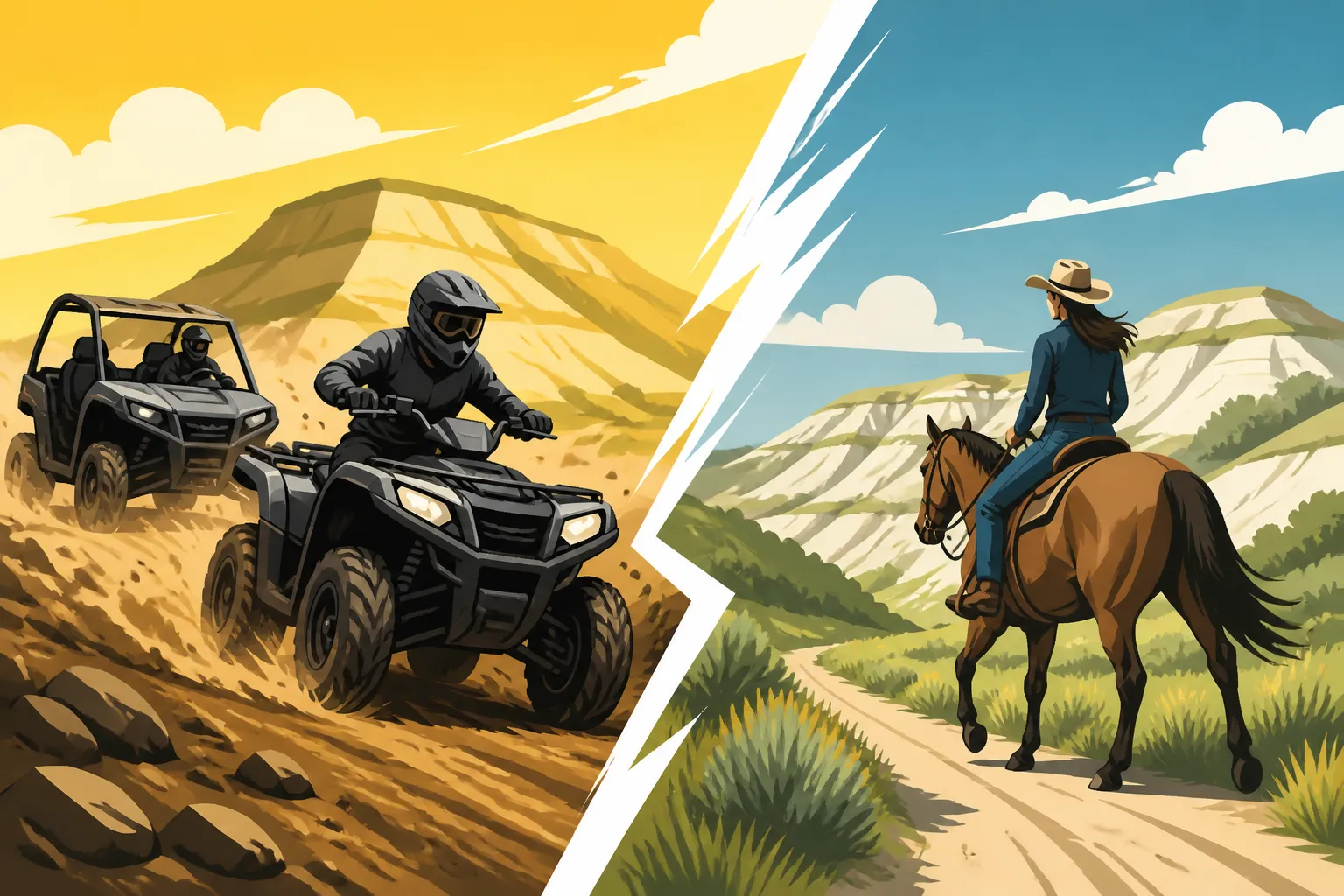
The key distinction is the activity: Gypsum Hills Trail Rides refers to horseback riding, not an ATV or UTV park. That can be confusing when you’re searching for Kansas trails, because “trail rides” often appears in both motorized and horseback-riding results. A listing or map label that mentions trails does not, by itself, mean motorized vehicles are allowed.
If you’re planning a day around the Gypsum Hills, don’t assume you can bring a quad or side-by-side to ride the same routes as horses. A horse trail may have narrow sections, soft ground, gates, private-property boundaries, or other restrictions that make it inappropriate or unavailable for motorized use. The fact that a route is visible on a map—or that you can reach its entrance by vehicle—does not establish permission to ride there.
For motorized riding, treat the destination and the activity as separate questions. You can visit a region for scenery, horseback riding, or other recreation without having a legal ATV route nearby. Before you make the drive, contact the operator or land manager directly to confirm what activities are offered, whether motorized machines are permitted, and where they may be unloaded. For a fuller explanation of the mix-up, see Gypsum Hills Trail Rides Is Horseback, Not Off-Road.
Why a trail name or map result can be misleading
Search results often group together places that share a location or a word such as “trail,” even when they serve completely different users. A horseback outfitter, a hiking path, a county road, and a private OHV park can all appear in a broad search for “trails near the Gypsum Hills.” That’s useful for discovering possibilities, but it is not enough to establish whether you can ride an ATV there.
A similar problem happens with mapping apps. An onX Offroad map can help you research routes and nearby terrain, but a mapped line is not the same thing as an open, authorized motorized trail. Check the landowner or managing organization’s rules before relying on any route shown in an app. In particular, look for clear information about permitted vehicle types, access points, seasonal closures, and whether permission is required.
Keep those two checks separate: first confirm that an area allows motorized riding; then confirm that your particular machine is allowed on the route. A park may permit ATVs but not wider side-by-sides, for example. If the information you find only describes horseback riding, hiking, or scenic access, don’t treat it as permission to ride a motorized vehicle.
How to Find Legal ATV and UTV Riding in Kansas
Start with places that clearly identify themselves as motorized areas
Kansas has relatively few public options dedicated to OHV riding, so a little extra research can save a long, frustrating tow. Begin with destinations that explicitly describe themselves as an ATV, UTV, ORV, or off-road riding area. The state’s overall trail landscape is different from states with extensive public OHV networks; Why Public Riding Is So Thin in Kansas explains why riders often need to look at a mix of public areas and private parks.
Examples of places to research include Tuttle Creek ORV Area, School Creek ORV Area, Kansas Rocks Recreation Park, and Syracuse Sand Dunes. These destinations have their own locations, access arrangements, and operating rules. Don’t assume that a rule at one site carries over to another. A route suitable for a dirt bike or narrow ATV may not accommodate a wider UTV, and an area that permits motorized riding may still have limits on where you can travel.
A good starting point is Kansas ATV Trails: Where You Can Actually Ride. Use it to build a short list, then confirm details with each location before setting off. If you’re considering private property or a privately operated park, verify that the site is open to visitors and learn what rules apply to your machine, passengers, and riding group.
| What you find | What it tells you | What you still need to confirm |
|---|---|---|
| A horseback-riding listing | The destination offers or describes horseback riding | Whether a separate motorized area exists nearby |
| A trail line in a map app | A route or feature appears on the map | Whether motorized riding is legal and currently allowed |
| A private off-road park listing | The property may offer motorized recreation | Vehicle limits, access rules, operating status, and fees |
| A public road or access road | A route may be open to ordinary traffic | Whether your ATV or UTV can legally use it |
| A general tourism page | The area has recreational or scenic attractions | Whether those attractions include authorized OHV riding |
Check access, vehicle limits, and current conditions
Once you have a possible destination, confirm the basics before you load the trailer. Ask whether the area allows your vehicle type, including your machine’s width if you ride a side-by-side. Check whether passenger rules differ by vehicle, whether helmets or other equipment are required, and whether there are age restrictions. Ask about parking and unloading too; reaching an entrance does not guarantee that there is room for a trailer or a safe place to stage a group.
Conditions matter just as much as access. Rain can make clay routes slick, damage trails, or lead to closures. Sand, rocks, mud, and steep terrain each create different demands on a machine and rider. For practical preparation, review Kansas Trail Conditions Before You Tow. Then check the destination’s own updates or call ahead, especially after heavy rain or if the trip depends on a specific route being open.
A map can help you understand the general area, but treat it as one part of your research. You might use onX Offroad to look at terrain and plan the drive, then contact the park or land manager to confirm current access and rules. If the map shows a route crossing private land, running along a road, or continuing beyond the designated riding area, do not assume that the entire line is open to OHVs.
A Practical Pre-Trip Check for Kansas Riders
Confirm the destination before you hitch up
A quick call or message can prevent the classic weekend disappointment: arriving with a trailer and finding out that the destination is for horses, that motorized riding is not allowed, or that your machine does not meet the area’s limits. Ask a direct question, such as, “Is this property open to ATV or UTV riding, and is my vehicle type allowed on the designated routes?” If you have a side-by-side, describe it rather than asking only whether “UTVs” are welcome.
Then confirm the details that affect your particular group. Ask where to enter, where to park and unload, whether reservations or advance arrangements are needed, and whether there are separate rules for children or passengers. If you’re bringing a wider machine, ask about width restrictions. If you plan to ride with several vehicles, ask whether group-size limits apply or whether the group should split into smaller parties.
Write down the name of the person or organization that confirmed access and the route or area they described. That note is not a substitute for permission, but it helps you remember exactly what you were told. For broader planning ideas, Kansas Trail Etiquette Locals Expect can help you think through how to share a riding area respectfully once you arrive.
Use maps as a planning aid, not proof of permission
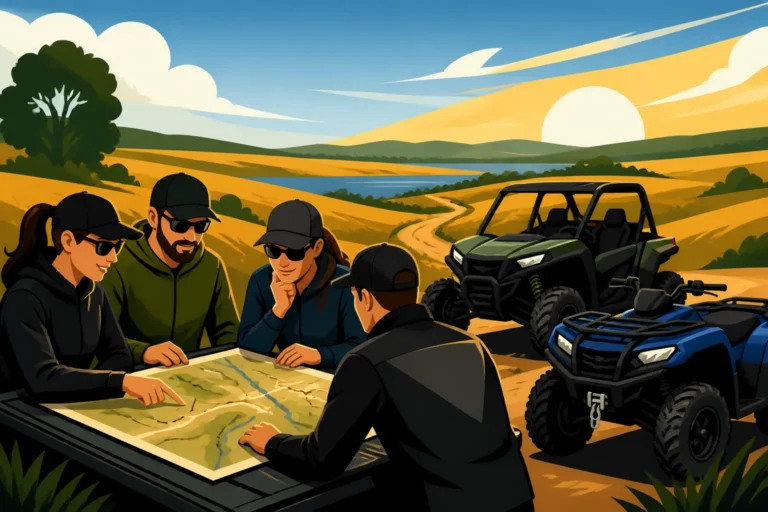
Before leaving, compare the destination’s directions with the access points shown on your map. Look for the official entrance rather than choosing a convenient-looking road or trail. A route that appears to connect two places may cross private ground, enter an area with different rules, or be meant for horses, hikers, or ordinary road traffic.
If you use onX Offroad or another mapping tool, check the route against the park’s published information and ask about any unclear segments. Zooming in can help you notice where roads, property boundaries, and mapped routes meet, but the screen cannot tell you whether a gate is locked, a trail is closed, or a landowner has granted access. Keep the park’s phone number and directions available in case cell service drops.
Kansas riders can also use Kansas ATV Trail Map Downloads as part of their planning, but map research should lead to a direct confirmation—not replace it. Take a screenshot or save directions before you leave town, and download or carry information you may need offline. This is particularly helpful when a trailhead is outside a town or you’re traveling through areas with patchy service.
Common Mistakes When Searching for Gypsum Hills Riding
Assuming the same landscape means the same access
The Gypsum Hills name describes a region and its scenery, not a blanket motorized-access designation. Nearby businesses, ranches, roads, and recreation areas can have different owners and rules. Permission to ride on one property does not extend to a neighboring parcel, and a horseback route does not become an ATV route because it crosses attractive terrain.
This is where an appealing map can lead riders astray. A line that looks continuous may include a public road, a private track, or a nonmotorized route. Keep your machine on routes the managing organization has specifically identified for motorized use. If you cannot establish who controls a route or whether ATVs are allowed, choose a confirmed riding area instead.
Don’t rely on informal assumptions such as “people ride there,” “there are tire tracks,” or “the gate was open.” Those clues do not prove that access is allowed today. When land access is unclear, get permission from the owner or manager before entering. Kansas Private Park Waivers and Rules is also useful for understanding why a private riding destination may have entry conditions that differ from a public recreation area.
Treating a nearby road or public area as an OHV park
A public road near a scenic destination is not necessarily an off-road trail. Road-use rules for ATVs and UTVs are different from rules at a designated riding park, and they can depend on the type of road, local ordinances, and the vehicle. Don’t use an ordinary road to connect to a trail unless you have confirmed that your machine may legally travel there.
Public land also has its own restrictions. Kansas Wildlife and Parks does not operate a broad system of state OHV trails; public property may limit machines to designated roads or specific access areas. That distinction matters if you’re hoping to unload at a state property and ride freely across it. For background, see Kansas State Parks Have No OHV Trails and check the managing agency’s rules for the specific location you plan to visit.
If your goal is simply to ride, choose an established motorized destination and verify its rules rather than trying to improvise a route around the Gypsum Hills. That approach may take a little more planning, but it is far better than towing for hours only to discover that the place you found is meant for horseback riding or that the route you hoped to use is not open to motorized vehicles.
Disclaimer
This article is for general informational purposes only and does not constitute professional advice. Laws, prices and regulations vary by location and change over time. Consult a qualified professional for guidance on your specific situation.