Kansas Riding Compared to Oklahoma
A Kansas rider planning a weekend in Oklahoma can run into a frustrating surprise: similar-looking trails may have very different access rules, terrain, and fees. This guide compares the riding experience in both states, explains how to check whether a machine is allowed, and helps you plan a trip without confusing a title, permit, or map with permission to ride.
The riding experience differs by terrain and access
Kansas offers pockets of riding rather than one continuous trail network
Kansas riding can be rewarding, but it often takes more advance planning than newcomers expect. The state’s open farmland and long rural roads can make a map look as though there is plenty of room to roam. In practice, land ownership and designated riding areas matter more than how open the countryside appears. A gravel road, pasture, ditch, or section line is not automatically an ATV trail.
The experience depends heavily on where you go. Near Tuttle Creek Lake, the Corps-managed ORV area offers a different outing from the rocky terrain at a private park or the sand at a southwestern riding area. These destinations are distinct sites, not necessarily connected by trails. You may need to load your machine onto a trailer to travel between them or to reach a legal riding area from home.
That patchwork is why it helps to start with a list of places that expressly allow off-highway riding. [Kansas ATV Trails: Where You Can Actually Ride] gives useful context for the kinds of riding destinations available, while [Kansas Corps of Engineers Riding Areas] can help you understand one category of public riding area. For private facilities, rules and access arrangements can differ from one operator to another; [Kansas Private Off-Road Parks] is a helpful companion topic.
Oklahoma may offer a broader mix of destination styles
Oklahoma has its own mix of riding areas, including places known for dunes, wooded terrain, and designated off-road use. Little Sahara State Park is a well-known sand-riding destination, while areas such as Appalachia Bay at Keystone Lake offer a different setting. Private parks add still more variety. The practical point is not that every Oklahoma region is open to riding, but that a trip there may let you choose among different kinds of terrain and riding experiences.
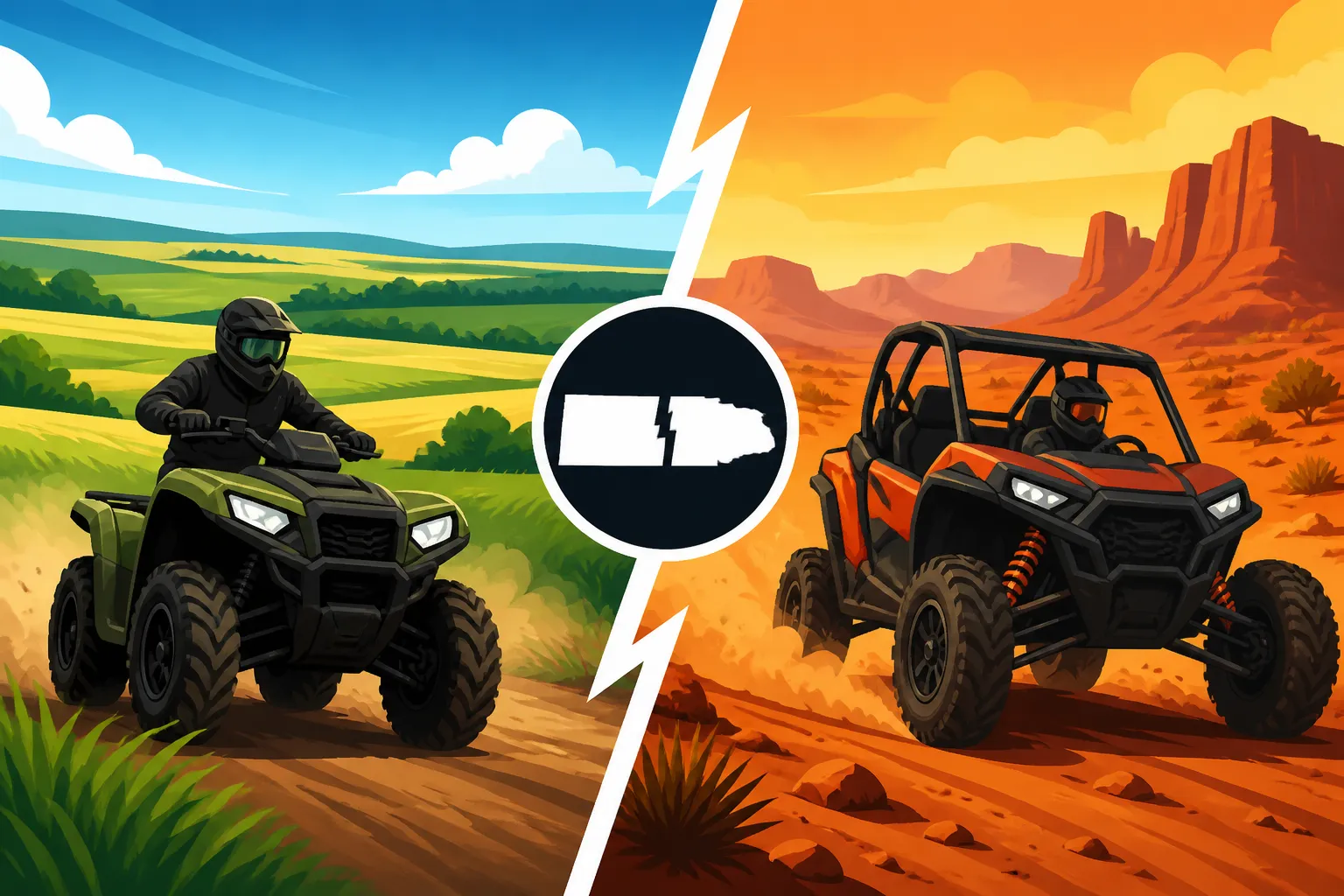
The change in scenery can be noticeable. A Kansas ride may mean prairie views, open ground, or a specific managed area; an Oklahoma trip might involve deeper sand, more wooded surroundings, or more rolling terrain, depending on the destination. Those differences affect more than what you see. Sand can increase heat and strain on a machine, while wooded or rocky routes can call for different tires, clearance, and riding pace.
Neither state should be treated as a giant open riding zone. A place’s name, nearby public land, or visible track on a map does not establish that your specific machine may ride there. Check the managing agency or park operator’s rules, the areas open to motorized use, and any posted restrictions before you leave.
Compare rules before you cross the state line
A Kansas title is not permission to ride on a trail
Kansas’s title system and riding access rules answer different questions. A title documents ownership and the machine’s classification; it does not give you permission to ride on a particular trail, public property, or road. Kansas also does not have a general state OHV registration program that functions like a universal trail pass. That does not mean every place is free to enter or that every machine is allowed everywhere.
State park rules are another point that can confuse visitors. A permit associated with using certain park roads is not the same thing as a trail pass that opens a park-wide OHV network. Kansas State Parks generally do not operate OHV trail systems in the way riders may imagine when they hear “state park.” Read [Kansas State Parks Have No OHV Trails] and [Kansas Has No State OHV Permit] to understand why “no general OHV permit” should not be interpreted as “ride anywhere.”
Oklahoma’s rules and access arrangements can be different from Kansas’s, and they can vary by site. A state park, a Corps-managed area, and a private riding park may each set its own entry conditions, machine limits, operating hours, safety requirements, or fees. Check the official site for the destination you intend to visit rather than assuming that a Kansas document or practice carries over.
Machine type and site rules can change the answer
Do not assume an area that allows ATVs also allows side-by-sides, dirt bikes, or every size of UTV. Width limits, vehicle categories, passenger rules, sound restrictions, and designated route boundaries can all matter. A trail that accommodates a narrow quad may not be suitable or open to a wider side-by-side. If you ride a UTV, confirm the vehicle is specifically allowed before loading it.
Kansas classifies certain off-road vehicles under categories that may differ from how riders describe their machines in everyday conversation. The legal class can depend on characteristics such as construction and dimensions. [Kansas Trails That Allow Side-by-Sides] is a useful starting point for checking whether a destination is suitable for a wider machine, but the site’s own posted rules should be your final check.
A quick comparison can help you organize the questions to ask:
| Planning question | Kansas | Oklahoma |
|---|---|---|
| Is all public land open to ATVs? | No. Use designated areas or obtain permission for private land. | No. Access depends on the land manager or private operator. |
| Does a title authorize trail riding? | No. A title is separate from access permission. | No. Follow the destination’s access and operating rules. |
| Should you check rules for your machine type? | Yes, especially for side-by-sides and wider UTVs. | Yes. Verify allowed vehicle types and any site-specific limits. |
| Can a permit or fee apply? | It may, depending on the location and activity. | It may, depending on the location and activity. |
| Is a map alone proof of access? | No. Confirm with the land manager or owner. | No. Confirm with the land manager or owner. |
Plan the trip around the destination, not just the state
Confirm access, hours, and trail conditions before loading
A long drive makes a closed gate or unsuitable trail especially disappointing. Before heading out, confirm that the area is open, the riding zone is operating, and your machine is allowed. Check whether access is limited to certain hours or seasons, whether a reservation or day-use process is required, and whether the entrance is easy to find with a trailer.
Weather deserves its own check. Heavy rain can make clay routes muddy or vulnerable to damage, while hot, dry conditions can mean dust and reduced visibility. Sand areas can ride differently after changes in weather, and a route that looked easy online may be tiring for a new rider or a smaller machine. Use [Kansas Trail Conditions Before You Tow] as a reminder to check conditions close to departure, and look for an equivalent update from an Oklahoma destination.
Mapping apps such as onX Offroad can help you prepare by showing routes and supporting offline navigation where available. Use a map as a planning aid, not as proof that you have permission to ride. Compare what you see with the park’s official map and current rules, and pay attention to property boundaries. If your phone loses service, an offline map is useful only if you downloaded the area beforehand and know how to interpret it.
Match your equipment to the surface
For Kansas, your gear needs will depend on the destination. A rocky route can call for good tire condition, appropriate protective gear, and careful attention to ground clearance. Sand riding calls for a different approach: expect the machine to work harder, carry extra water, and plan for recovery if you or a riding partner gets stuck. In either state, bring basic tools, a tire-repair kit suited to your machine, and enough water and food for the time you expect to be out.
Before a longer ride, inspect tires, brakes, lights, steering, and fluid levels. Secure loose cargo and confirm that any trailer is suitable for the machine’s weight and width. If you are traveling with a group, agree on where to meet if someone gets separated and make sure each rider knows the route and emergency plan. On unfamiliar ground, keep a pace that lets you react to blind corners, loose surfaces, and changing trail conditions.
If you use onX Offroad, consider downloading the area before you reach a spotty-coverage zone and checking the route against official site information. It can help you keep track of your planned path, but it cannot replace signs, closures, permission, or a park operator’s directions. Keep another navigation option available when possible, particularly if you are exploring an unfamiliar area.
Choose Kansas or Oklahoma for the kind of ride you want
Kansas can suit a focused outing close to home
Kansas can be the better choice when you want a destination you can reach without making a major trip, or when a specific local area offers the kind of riding you enjoy. A weekend at a managed ORV area, a private rock park, or a sand destination can feel like a complete trip if you plan around that site. The key is to avoid expecting a continuous public trail network or assuming rural land is open simply because it looks accessible.
For a group with different experience levels, compare the site’s terrain, machine restrictions, and available facilities before inviting everyone. A beginner may be more comfortable at an area with clearly described routes and manageable terrain than at a destination known for technical rocks or deep sand. Ask whether the site has a trail map, what equipment is recommended, and what happens if weather forces a closure.
Oklahoma can be worth the drive for a different landscape
Oklahoma may be attractive when your group wants a change of terrain or a destination built around a particular style of riding. A sand-focused trip, for example, requires different preparation from a rocky Kansas ride. The extra travel also means you should plan fuel stops, trailer parking, food, lodging, and recovery equipment before leaving. Check whether the park has separate rules for passengers, sound, safety gear, or vehicle dimensions.
For either state, make the final decision based on the exact riding area rather than a broad state-versus-state reputation. Review the official route map, confirm the machine you are bringing is allowed, check current operating information, and call the site if a rule is unclear. onX Offroad can support route planning and help with offline navigation, but the land manager or property owner is the authority on where riding is permitted.
A little homework can prevent the most common cross-state disappointment: arriving with the wrong machine, expecting a trail where none is open, or mistaking a map line for permission. Choose a designated destination, verify its rules directly, and plan your equipment around the terrain you will actually ride.
Disclaimer
This article is for general informational purposes only and does not constitute professional advice. Laws, prices and regulations vary by location and change over time. Consult a qualified professional for guidance on your specific situation.