Lights Like a Motorcycle After Dark
It's incredibly frustrating when you just want to get your ATV or UTV from point A to point B on a public road, especially when dusk starts to fall, and you're left wondering if your machine is even visible, let alone legal. Kansas has some very specific, and sometimes confusing, rules about riding off-road vehicles on public roads, particularly when it comes to lighting after dark. This guide is here to unravel those complexities and clarify exactly what "lights like a motorcycle" means for your ATV or UTV in the Sunflower State.
Understanding the General Ban on Kansas Roads
Let's start with the hard truth that often catches new and even experienced riders off guard: generally speaking, ATVs and UTVs are not street legal in Kansas. The state views these machines primarily as off-highway vehicles, designed for dirt, trails, farms, and private property, not for cruising down Main Street or county highways. This can be a real headache for folks who just need to get across a road to another section of their property, or want to ride into town from their rural home. The law is written with the presumption that these machines are not for road use, and any exceptions are very carefully carved out.
When you think about it, this makes a certain amount of sense from a safety perspective. ATVs and UTVs handle differently than cars or motorcycles. They're often wider, more exposed, and built for low-speed, high-traction environments. Putting them on paved roads, especially at higher speeds or in traffic, introduces risks that the state legislature has tried to mitigate through these general prohibitions. However, for the person trying to get chores done or enjoy a ride, it feels like an unnecessary hurdle.
Why Off-Road Machines Are Restricted
The primary reason for these restrictions boils down to safety and vehicle classification. Unlike automobiles, ATVs and UTVs generally lack standard safety features like airbags, crumple zones, and fully enclosed cabins. They're also often missing equipment that's standard on road-legal vehicles, such as proper turn signals, mirrors, or DOT-approved tires, though many newer models are starting to include some of these. The state's legal framework classifies them differently than regular cars or motorcycles, placing them in a category of "nonhighway vehicles" that aren't intended for public road use. This classification is key to understanding why special rules apply.
Moreover, the sheer diversity of machines under the "ATV and UTV" umbrella makes it difficult to create a one-size-fits-all road rule. A small sport quad is vastly different from a large, multi-passenger utility side-by-side, yet both fall under similar general restrictions. This leads to a lot of head-scratching for owners who see their UTV as perfectly capable of handling a short jaunt on a gravel road, only to find the law disagrees.
The Role of Local Ordinances
While the state law generally restricts ATVs and UTVs from public roads, there's a significant caveat: local municipalities have the power to create ordinances that allow these machines on their city streets. This is where things get truly localized and, frankly, a bit confusing. What's legal in Louisburg might be illegal in Andover, and completely unheard of in Wichita. It means that simply knowing the state law isn't enough; you also have to be aware of the specific rules in the city or county you're in. This patchwork of regulations often leaves riders feeling like they need a lawyer or a local government researcher just to figure out where they can ride. [Kansas Cities That Authorize ATV Street Use] covers this in more detail.
These local ordinances typically come with their own set of requirements, which often include specific lighting standards, insurance requirements, and sometimes even a local registration or tag fee. For example, a city might require your UTV to have brake lights, turn signals, and a horn, even if the state's general exceptions for agricultural use don't explicitly demand them. It’s a good idea to check with your city clerk's office or local law enforcement if you're considering riding on city streets, as the penalties for non-compliance can be steep.
When You Can Ride on Kansas Roads and What Lights You Need
Despite the general ban, there are specific situations where you might find yourself legally operating your ATV or UTV on a public road in Kansas. These exceptions are critical for farmers, ranchers, and sometimes even recreational riders, but they come with strict conditions – especially concerning visibility after dark. The moment the sun dips below the horizon, your machine transforms from a daylight-friendly vehicle into something that needs to be seen clearly by other motorists.
The key phrase that often comes up in Kansas statutes regarding off-road vehicles and visibility is "lights like a motorcycle." This isn't just a casual suggestion; it's a legal standard. It means your machine needs to mimic the lighting setup of a street-legal motorcycle to ensure it's adequately illuminated and visible to other drivers, particularly during that tricky twilight hour or in full darkness. This can involve more than just a single headlight; it often implies a whole suite of lighting components designed for road safety.
Agricultural Use Exceptions
Kansas law provides an important exception for those using ATVs and UTVs for agricultural purposes. If you're using your machine for farm work, such as moving between fields, checking livestock, or hauling supplies on a public road, you might be allowed to do so. This is a lifeline for many rural Kansans who rely on their side-by-sides to keep their operations running. However, this isn't a free pass to joyride on county roads. The use must be directly related to agricultural activities. [Kansas's Agricultural Exception for Road Use] details this more.
Even with this exception, lighting is non-negotiable after dark. Your farm machine, whether it's a quad or a side-by-side, still needs to be highly visible. This means a functional headlight that projects a white light and a red taillight visible from a certain distance. If you're towing equipment, that equipment also needs to be lit, typically with brake lights and turn signals, to indicate your intentions to traffic behind you. Neglecting these basics during a late-night hay run could lead to a citation or, worse, an accident.
Crossing Highways and Roads
There are also provisions for crossing public roads or highways. Kansas law generally allows ATVs and UTVs to cross state highways and county roads, even if they aren't otherwise permitted on them. This is often necessary for riders to access different parts of their property, reach a trail, or move between riding areas. While crossing, you're expected to do so safely, yielding to all traffic, and taking the most direct route across. It's not an excuse to drive down the highway for a mile; it's about getting from one side to the other.
When crossing after dark, the "lights like a motorcycle" rule still applies. You must have your headlights and taillights on, clearly indicating your presence to any oncoming or approaching traffic. This is particularly crucial on higher-speed highways where drivers might not expect to see an off-road machine crossing their path. Think about how quickly a motorcycle's lights catch your eye at night; your ATV or UTV needs to achieve that same level of immediate recognition.
City Ordinances for Street-Legal Machines
As mentioned, some cities in Kansas have passed ordinances allowing ATVs and UTVs (often specifically UTVs) to be street-legal within their municipal limits. These ordinances are typically very specific about the equipment required. Beyond the basic headlights and taillights, many will mandate turn signals, brake lights, a horn, rearview mirrors, and even a windshield. These requirements are put in place to ensure these machines can safely coexist with regular vehicle traffic on city streets. [Kansas Cities With UTV Tags] can give you a starting point for research.
If your city has such an ordinance, and you've gone through the process of getting a city tag and meeting all the requirements, then your machine essentially becomes a legal road vehicle within those city limits. This is where investing in quality aftermarket lighting and safety accessories, perhaps from a brand like SuperATV, becomes important. You'll want components that are durable, reliable, and meet the specific criteria outlined in the local ordinance to avoid issues with local law enforcement.
What "Lights Like a Motorcycle" Actually Means
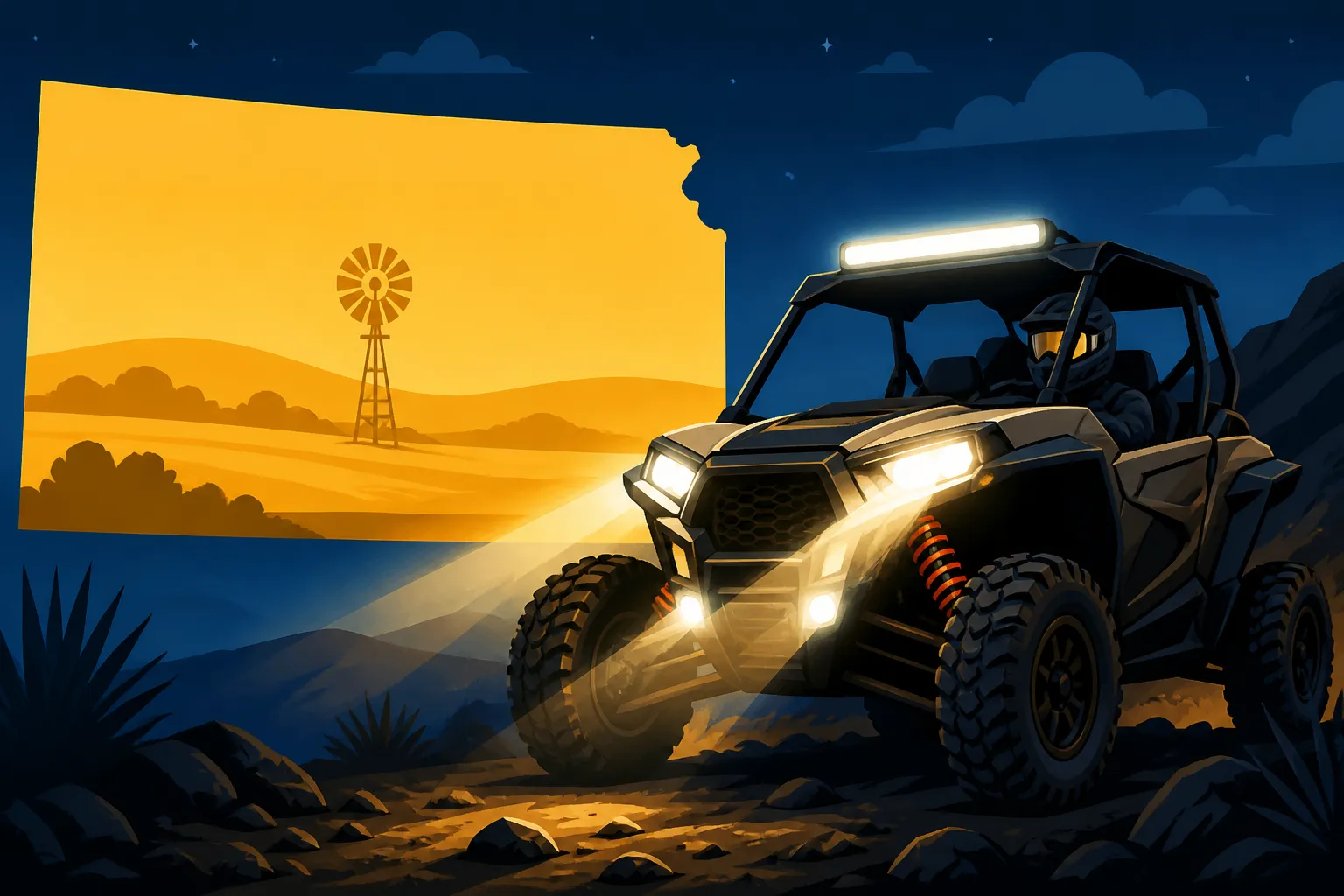
When the Kansas statutes refer to "lights like a motorcycle after dark," it's not just a poetic suggestion; it's a legal standard. This means your ATV or UTV needs to replicate the visibility provided by a properly equipped, street-legal motorcycle. This goes beyond simply having a functioning headlight and taillight; it implies a full suite of lighting designed to make you seen and understood by other drivers in low-light conditions. Ignorance of these specific requirements won't exempt you from a ticket or, more importantly, from an accident.
Many riders, especially those new to using their machines on public roads, mistakenly believe a single, dim factory headlight is sufficient. However, a motorcycle's lighting system is engineered for road safety, ensuring visibility from various angles and distances. Your off-road machine needs to meet that same benchmark to keep you and others safe when operating on public thoroughfares after sunset. It's about being conspicuous, not just present.
Headlights: The Forward Beam
A motorcycle typically has a white headlight that illuminates the path ahead and makes the motorcycle visible to oncoming traffic. This light needs to be bright enough to be seen from a significant distance, often hundreds of feet, and must project a clear beam. For your ATV or UTV, this means having a headlight (or headlights, if your machine is equipped with two) that emits a white light, is properly aimed, and is bright enough to meet these visibility standards. It's not just about seeing where you're going; it's about ensuring others see you coming. Many factory ATV/UTV headlights are designed for off-road speeds and might not cut it for the demands of sharing a road with cars.
Kansas law generally states that lights must be used from sunset to sunrise, and whenever visibility is less than a certain threshold. The headlight must be mounted at a specific height range – not too low, not too high – to be effective and avoid blinding oncoming drivers. This is where some aftermarket lights from companies like SuperATV can be incredibly helpful, as they offer brighter, more focused beams that are designed for enhanced visibility and performance, often exceeding basic factory specs.
Taillights and Brake Lights: Visibility from Behind
Just as crucial as the headlight is the taillight system. A motorcycle has a red taillight visible from the rear, often integrated with a brake light that illuminates brighter when the brakes are applied. For your ATV or UTV, you must have at least one red taillight on the rear of your machine, visible from a specific distance, typically around 500 feet. This light must be functional from sunset to sunrise, or whenever lighting conditions require it.
The brake light component is equally, if not more, important. When you slow down or stop, the brake light needs to activate, clearly signaling your intentions to anyone behind you. Many factory ATVs, especially older models, might only have a constant taillight and no dedicated brake light, which is a huge safety deficit on public roads. If your machine lacks an integrated brake light, you'll need to install one to meet the "like a motorcycle" standard. This is a common upgrade for riders who intend to use their machines on public roads, even under exceptions.
Turn Signals: Communicating Intent
This is where many ATVs and UTVs fall short of motorcycle standards right out of the factory. While motorcycles are legally required to have front and rear turn signals (typically amber or white in front, amber or red in the rear), most off-road machines do not come equipped with them. For any road use beyond quick crossings, especially if operating under a local city ordinance, functional turn signals are usually a mandatory addition. Without them, you're left to hand signals, which are often difficult for other drivers to see or understand, especially at night.
Adding turn signals is a common aftermarket modification. These systems usually involve amber lights on both the front and rear of the machine, activated by a switch on the handlebars or dashboard. Ensuring they are visible from the front, rear, and sides is crucial. Remember, the goal is clear communication of your turning intentions to other motorists, just as a motorcycle would.
Reflectors and Other Visibility Enhancements
Motorcycles also often incorporate reflectors to enhance passive visibility, especially from the sides. While not always explicitly stated for ATVs and UTVs in all statutes, it's a wise practice to add amber reflectors to the front sides and red reflectors to the rear sides of your machine. This helps your machine be seen even if its active lighting temporarily fails or if it's parked on the side of a road. Consider it an extra layer of safety.
Beyond legal requirements, common sense dictates maximizing your visibility. Brightly colored machines, reflective tape on helmets or clothing, and even auxiliary lighting can all contribute to being seen by other drivers. Remember, the "lights like a motorcycle" rule is about minimum compliance, but for your safety, exceeding those minimums is always a good idea.
Table: Comparing Lighting Requirements
To help clarify, here's a general comparison of what "lights like a motorcycle" implies, versus what many ATVs and UTVs come with from the factory, and what you might need to add:
| Lighting Component | Motorcycle Standard (Road Legal) | Typical ATV/UTV (Factory) | Required for "Like a Motorcycle" | Recommended Enhancements |
|---|---|---|---|---|
| Headlight | White, high/low beam, visible >500ft | White, typically single beam | White, visible >500ft, properly aimed | Brighter LED, auxiliary spot/flood |
| Taillight | Red, visible >500ft from rear | Red, visible from rear | Red, visible >500ft from rear | Brighter LED, multiple taillights |
| Brake Light | Red, brighter than taillight, illuminates on braking | Often none, or combined with taillight | Red, distinct from taillight, illuminates on braking | Brighter LED, multiple brake lights |
| Turn Signals | Amber/White front, Amber/Red rear, blinking | Almost always none | Amber front & rear, blinking | LED turn signals, integrated mirrors |
| Reflectors | Amber (front sides), Red (rear sides) | Often minimal or none | Amber (front sides), Red (rear sides) | Reflective tape on machine/rider |
| Horn | Required, audible >200ft | Often none | Required, audible >200ft | Loud, clear tone |
| Mirrors | At least one rearview, typically two | Often none | At least one rearview mirror | Two mirrors for better visibility |
It's clear that to meet the "lights like a motorcycle" standard, most factory ATVs and UTVs will require significant upgrades, especially for turn signals and a dedicated brake light.
Consequences of Non-Compliance
Operating an ATV or UTV on a public road in Kansas without the proper lighting after dark, or without adhering to the specific rules of an exception or local ordinance, can lead to a range of unpleasant consequences. These aren't just minor inconveniences; they can hit your wallet, affect your driving record, and most importantly, put your safety and the safety of others at serious risk. Many riders mistakenly assume that because they're on a less-traveled road, enforcement will be lax, but a single interaction with law enforcement can change that perception quickly.
A deputy or local police officer might spot your machine from a distance, or pull you over during a routine patrol if your lighting setup is clearly insufficient. The "lights like a motorcycle" standard means they're looking for specific compliance, not just a vague glow. If your machine doesn't meet that standard after dark, you're not just breaking a minor rule; you're creating a hazard.
Fines and Court Costs
The most immediate consequence of operating an improperly lit ATV or UTV on a Kansas road after dark is a traffic citation. The specific fine amount can vary depending on the jurisdiction and the exact nature of the offense, but it's rarely cheap. On top of the base fine, you'll almost certainly incur court costs and administrative fees, which can quickly double or triple the initial ticket amount. These costs can add up, especially if you're cited for multiple violations (e.g., no headlight and no brake light). [Kansas Ticket Costs for Road Riding] can give you an idea of the financial impact.
Fighting these tickets in municipal court can be time-consuming and often requires you to miss work or other commitments. Even if you're able to argue down the fine, you've still spent valuable time and energy on something that could have been avoided with proper preparation. It's a prime example of how a little preventative maintenance and understanding the law upfront can save you a lot of headache and money down the line.
Impoundment and Towing Fees
In more serious cases, or depending on the local jurisdiction's policies, law enforcement might have the authority to impound your ATV or UTV if it's deemed unsafe for road use or if you're operating it illegally. This is a far greater financial hit than a simple ticket. You'll not only face the initial citation but also towing fees, daily storage fees at the impound lot, and possibly even an administrative release fee from the city or county. Getting your machine back can be an expensive and frustrating ordeal.
Imagine needing your UTV for farm work and suddenly it's stuck in an impound lot because you didn't have a proper brake light after dark. It's not just the monetary cost, but the loss of functionality and the sheer hassle of dealing with the bureaucracy to retrieve your machine. This scenario underscores why meeting the "lights like a motorcycle" standard is so crucial – it's about keeping your machine where it belongs: with you.
Safety Risks and Liability
Beyond the legal and financial repercussions, the most significant consequence of insufficient lighting is the increased risk of an accident. Operating an ATV or UTV after dark without adequate lighting makes you incredibly difficult for other drivers to see. This dramatically increases the chances of a collision, which can lead to serious injuries or even fatalities for you, your passengers, or other motorists. The limited visibility of off-road machines on paved roads is precisely why these lighting rules exist.
If you are involved in an accident while operating your machine illegally or without proper lighting, you could face significant civil liability. Your insurance company might deny coverage if you were operating the vehicle outside of legal parameters. This means you could be personally responsible for property damage, medical bills, and other costs incurred by everyone involved in the crash. The small investment in proper lighting and understanding the law pales in comparison to the potential costs of an accident. Safety should always be the top priority, and that starts with being seen.
Disclaimer
This article is for general informational purposes only and does not constitute professional advice. Laws, prices and regulations vary by location and change over time. Consult a qualified professional for guidance on your specific situation.