Kansas Rules for Riding in Wichita
It can be incredibly frustrating to own an ATV or UTV in Kansas, especially when you live in a larger city like Wichita, and feel like you have nowhere legal to ride but your own backyard. Many riders come here with questions about taking their machines on city streets, hoping there's some loophole or local rule that permits it. This guide is here to clear up the common misconceptions and provide a realistic, no-nonsense look at the rules for riding ATVs and UTVs within Wichita's city limits, helping you avoid costly mistakes and legal headaches.
The Core Rule: Why Wichita Streets Are Generally Off-Limits
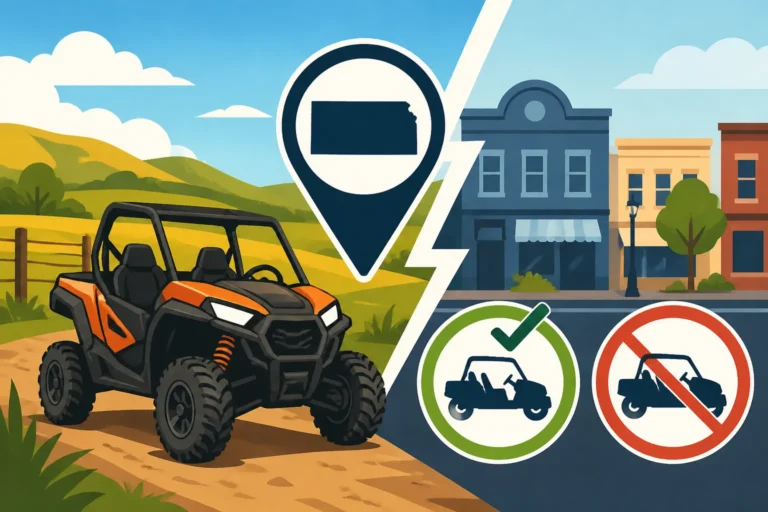
Let's cut right to the chase: if you're hoping to cruise down Kellogg, navigate the Old Town district, or even take your side-by-side to the local hardware store in Wichita, the answer is almost certainly no. Kansas state law sets a very clear precedent for off-road vehicles, and cities like Wichita largely adhere to it, leaving little room for street use.
The Statewide Ban on ATVs and UTVs
Kansas has a foundational statute that's pretty direct: All-Terrain Vehicles (ATVs) and Utility Task Vehicles (UTVs), which include side-by-sides, are generally prohibited from being operated on public roads and highways. This isn't just a suggestion; it's the law. The state defines these machines as "nonhighway vehicles," a classification that comes with significant restrictions. [Kansas Bans ATVs Inside City Limits by Default] is the core of this issue. This means that, by default, these machines are not considered suitable for the public road system designed for cars, trucks, and motorcycles.
While the law does allow for exceptions – primarily for agricultural purposes or specific work-related tasks on county roads, and for cities to opt-in through local ordinances – the default position is a ban. For most personal recreational use, this ban is absolute within city limits unless a city council has explicitly passed an ordinance to permit it. This isn't about ignoring ATVs or UTVs; it's about regulating vehicles that don't meet the safety and equipment standards typically required for road-going traffic. The state wants to ensure public safety, and nonhighway vehicles, by their very design, often lack things like sealed cabs, crumple zones, and extensive lighting systems found on traditional vehicles.
What the Lack of a City Ordinance Means for Riders
Unlike some smaller towns or rural communities in Kansas, Wichita has not enacted a local ordinance to allow the general operation of ATVs or UTVs on its public streets. This is a crucial distinction. In communities that have opted in, you might see side-by-sides with city-issued tags, operating under strict rules regarding speed, time of day, and required equipment. However, Wichita has not taken this step.
What does this mean for you as a rider? It means that if you operate your ATV or UTV on a public street in Wichita, you are breaking the law. The consequences can range from a simple warning to a significant citation. You could face fines, court costs, and potentially even have your machine impounded. Imagine the headache of trying to retrieve your beloved quad from an impound lot, often incurring daily storage fees on top of the initial impoundment cost. It's a financial burden and a major inconvenience that no rider wants to experience. Beyond the immediate legal trouble, there's the critical safety aspect: operating a machine not designed for road speeds, alongside larger, faster vehicles, can put you and others at serious risk. The lack of proper turn signals (though many riders add them using aftermarket kits from places like SuperATV), brake lights, and reflective surfaces, combined with their differing acceleration and braking characteristics, makes them ill-suited for busy city traffic.
Understanding What "Riding in Wichita" Really Means
When we talk about "riding in Wichita," it's important to clarify where you're talking about riding. There's a big difference between cruising down a city street and simply trying to get from one private property to another. These nuances can often be confusing, leading to accidental violations.
The Difference Between Riding ON Streets and CROSSING Streets
While prolonged travel on Wichita's streets is generally illegal for ATVs and UTVs, there's a specific, often misunderstood, exception: crossing. Kansas law, under certain conditions, does permit a nonhighway vehicle to cross a public road or highway. This is typically allowed at a right angle to the road, after yielding to all traffic, and only when traveling between two pieces of private property. [Kansas Rules for Crossing a Highway] lays out these general principles.
However, even this "crossing" rule comes with caveats, especially within city limits. You can't just cross anywhere; it must be at the nearest point to gain access to another parcel of private land. And you certainly can't ride down the shoulder for a quarter mile just to get to a better crossing point. Police in urban areas are often much stricter about enforcement than in rural settings, where a quick dash across a quiet county road might go unnoticed. The key here is minimal time on the public road, maximum caution, and absolutely no intent to use the road as a travel route. A common scenario might involve a farmer needing to move a piece of equipment from a field on one side of a low-traffic city-adjacent road to another field across the street. Even then, the equipment must be operated safely and follow all applicable traffic laws.
Private Property vs. Public Roads in the City
This distinction is perhaps the most critical for Wichita residents. If you own private land within the city limits, or have explicit, written permission from a landowner, you can generally ride your ATV or UTV on that specific private property. This includes your own backyard, a large lot you own, or a friend's acreage. The moment your tires touch public pavement, however, the rules change drastically. [Kansas Trespass Law for Riders] is also highly relevant here; even on private land, you absolutely must have permission to ride. Without it, you could face trespassing charges, even if you’re just in an open field.
The problem arises when riders confuse "private property" with "public land that looks unused." Ditches, easements, vacant lots without clear ownership, and even public parks are not free-for-all riding zones. In Wichita, these are public spaces, and operating an ATV or UTV on them would likely fall under the same prohibitions as riding on the street. It's easy to spot a seemingly abandoned field or a wide-open ditch along a road and think, "no harm, no foul." But these areas often have specific owners (city, county, state, or private individuals) who do not authorize off-road vehicle use, and you could find yourself facing fines for illegal operation or trespassing, or both. Always assume public land is off-limits unless you can find a specific ordinance or signage stating otherwise, and for private land, always get permission first.
Specific Machines and Their Road Rules in Wichita
It's natural to wonder if different types of off-road machines have different rules. While Kansas law does classify some vehicles differently, leading to varying street-legal possibilities in other jurisdictions, Wichita's overarching stance simplifies things considerably for most.
ATVs and Side-by-Sides: The Default Nonhighway Status
For the vast majority of ATVs and side-by-sides, Kansas law classifies them as "nonhighway vehicles." This means they are designed for off-road use, not for public roads. [How Kansas Law Defines a Nonhighway Vehicle] outlines these characteristics, often focusing on features like handlebars (for ATVs), specific seating arrangements (for side-by-sides), and overall design for rough terrain rather than asphalt. Crucially, even if you go through the process of getting a title for your ATV or side-by-side, which is mandatory in Kansas, that title is a [Kansas's Nonhighway Title Explained] – it never comes with a registration tag that would permit street legal operation. [Why an ATV Is Titled as a Nonhighway Vehicle] clarifies that this titling process is primarily for ownership records, sales tax collection, and proving legitimate possession, not for road authorization.
Many enthusiasts invest in aftermarket parts to make their machines more visible or seemingly "road-ready." Think about adding a turn signal kit, a horn, a rearview mirror, or even some impressive LED light bars. Companies like SuperATV offer a wide range of these accessories, from full street-legal kits (for jurisdictions that do allow it) to heavy-duty winches, upgraded axles, and lift kits. While these modifications might make your machine safer or more capable off-road, they do not magically grant street legality in Wichita. A deputy isn't going to wave you on because your side-by-side has cool aftermarket mirrors and a loud horn if you're riding down a city street where it's explicitly forbidden. The core legal classification of your vehicle as a nonhighway machine, combined with the absence of a specific city ordinance, overrides any equipment you've added.
Golf Carts and Micro Utility Trucks: A Different Set of Rules (and Why Wichita Doesn't Apply Them)
Here's where it gets a little more nuanced, but unfortunately, it still doesn't open Wichita's streets to these machines for general use. Kansas law makes specific provisions for vehicles like golf carts and micro utility trucks. These classes of vehicles can be allowed on public streets in certain cities, but only if the local city council passes an ordinance explicitly permitting them and setting forth specific operating rules and equipment requirements. [Kansas Golf Cart Road Rules] and [Kansas Micro Utility Truck Road Rules] detail the types of regulations such cities might implement. This could include requirements for headlights, taillights, turn signals, seatbelts, speed limits, and even annual city-issued tags.
However, just like with ATVs and UTVs, Wichita has not passed such ordinances for golf carts or micro utility trucks to be used generally on its streets. So, while a golf cart might be street legal in a smaller Kansas town like Louisburg (which has its own specific city tag and rules), it is generally not legal for street use in Wichita outside of private property like a golf course, private community, or industrial complex. Don't assume that because your neighbor in a different county uses their golf cart to run errands, you can do the same in Wichita. Each city has the authority to decide, and Wichita has largely chosen to maintain the state's default prohibition on these types of vehicles on its public roadways. This means even if your golf cart meets every conceivable safety standard, without a specific Wichita ordinance, it's still restricted to private property.
The Risks and Penalties of Illegal Riding in Wichita
It's easy to think, "What's the harm in a quick ride?" But the harm can be substantial, both legally and financially. Law enforcement in Wichita takes traffic laws seriously, and operating an illegal vehicle on public roads can lead to a cascade of problems.
What Happens If You Get Pulled Over
If you're caught riding your ATV or UTV on a public street in Wichita, you're likely going to face a citation. Depending on the officer, the circumstances, and your attitude, this could be a warning, but more often than not, it will be a ticket. The specific charge might vary, but it will typically relate to operating an unregistered or non-street-legal vehicle on a public roadway. These citations carry fines, and often, additional court costs. [Kansas Penalties for Illegal Road Riding] can outline the general scope of fines associated with such violations, which can quickly add up.
Beyond the immediate financial hit, there's the distinct possibility of your machine being impounded. This is a common consequence for vehicles being operated illegally, especially if there are safety concerns or if the driver lacks a valid license (which is required even for nonhighway vehicles when operated where a license is needed). The impoundment process involves towing fees, storage fees that accrue daily, and administrative costs to get your machine back. It's not uncommon for these fees to exceed the initial fine, turning a seemingly minor infraction into a multi-hundred-dollar headache. And if you're a repeat offender, the consequences can escalate, potentially involving more severe fines or even further legal action.
Insurance Implications and Accident Reporting
This is a critical, often overlooked, aspect of illegal street riding. Your standard auto insurance policy for your car or truck will absolutely not cover an ATV or UTV when operated on a public street where it's not legally allowed. Even if you have a specific off-road vehicle insurance policy, it will almost certainly have exclusions for illegal street use. Imagine you're riding your side-by-side down a Wichita street, hit a pothole, lose control, and collide with a parked car. Who pays for the damage? If you're operating illegally, your insurance company will likely deny coverage. This leaves you personally liable for all damages, potentially thousands or tens of thousands of dollars, depending on the severity of the accident.
In the event of an accident, you are still required to report it to the authorities, especially if there's significant property damage or injury. [Kansas Accident Reporting for an ATV Crash] applies regardless of whether you were legally riding. However, the legal implications for you will be far more severe if you were operating your machine illegally. You could face charges for operating an uninsured vehicle, reckless driving, and the original charge of illegal street use, on top of being sued for damages. While Kansas doesn't mandate ATV insurance statewide, many riders opt for it for their peace of mind when riding off-road. However, that policy is unlikely to protect you from the consequences of breaking the law on city streets. Always carry proof of any insurance you do have, even for off-road use, but be realistic about what it will cover if you're riding where you shouldn't be.
Here's a quick overview of how different machine types stack up in terms of street legality in Wichita:
| Vehicle Type | Designed for Road Use? | Default Kansas Road Status | Wichita City Ordinance for General Street Use? | General Wichita Street Legal Status | Potential Consequences of Illegal Use in Wichita |
|---|---|---|---|---|---|
| ATV (Quad) | No | Nonhighway Vehicle | No | Not Street Legal | Fines, Impoundment, Liability for Accidents |
| Side-by-Side (UTV) | No (mostly) | Nonhighway Vehicle | No | Not Street Legal | Fines, Impoundment, Liability for Accidents |
| Golf Cart | No | Special Vehicle Class | No | Not Street Legal | Fines, Impoundment, Liability for Accidents |
| Micro Utility Truck | No | Special Vehicle Class | No | Not Street Legal | Fines, Impoundment, Liability for Accidents |
| Standard Car/Truck | Yes | Highway Vehicle | N/A (Already Permitted) | Street Legal | Normal traffic violations |
It's clear from this table that for most common off-road machines, Wichita's streets are not an option.
In conclusion, while the allure of taking your ATV or UTV for a spin around Wichita might be strong, the current legal landscape makes it a risky and generally illegal endeavor. Kansas state law, combined with Wichita's lack of specific enabling ordinances, means that these machines are intended for off-road use or private property only within city limits. Instead of risking fines, impoundment, or worse, always seek out designated riding areas. There are fantastic options like [Kansas ATV Trails: Where You Can Actually Ride] outside of city limits that offer safe, legal, and exhilarating experiences without the stress of breaking the law. Always be a responsible rider, know the rules, and keep your adventures to the places they're meant to be enjoyed.
Disclaimer
This article is for general informational purposes only and does not constitute professional advice. Laws, prices and regulations vary by location and change over time. Consult a qualified professional for guidance on your specific situation.