Kansas Bans ATVs on Interstates
It's incredibly frustrating when you invest in a powerful ATV or UTV, imagining all the places you can go, only to hit a wall of confusing road rules. You want to get from one great riding spot to another, or maybe just across town, and the idea of hopping on a major highway seems like the most straightforward path. But here in Kansas, when it comes to the big interstates, there’s a hard and fast rule that can put a damper on those plans. This guide is here to untangle the complexities of why ATVs and UTVs are specifically banned from interstates in Kansas, what that means for your ride, and how to navigate the state's other road regulations safely and legally.
The Blanket Ban on Kansas Interstates Explained
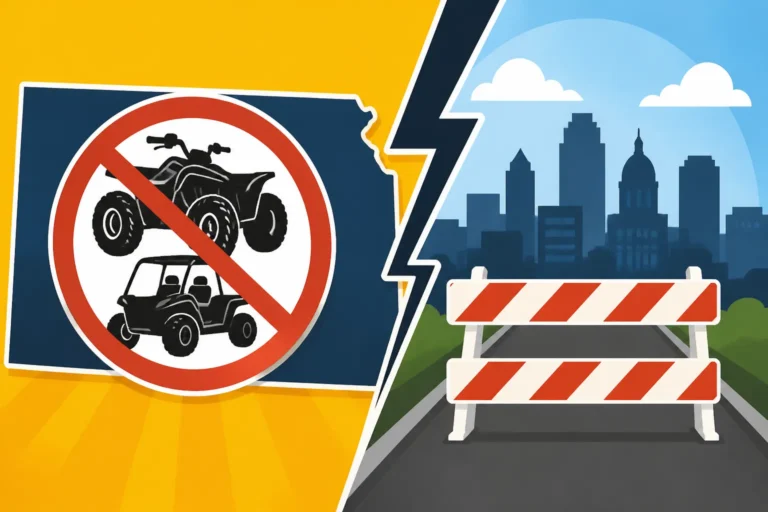
For many off-road enthusiasts, the thought of zipping down an interstate on their ATV or UTV is either a dream scenario for convenience or a perplexing question mark when considering how to transport their machine. However, Kansas law is quite clear: ATVs and UTVs are generally not permitted on interstates. This isn't just a suggestion; it's a foundational rule designed with safety and traffic flow in mind. It's a reality that can be tough to accept, especially if you’re looking at a map and seeing a direct interstate route to your destination. But understanding the 'why' behind this can help you plan your travels more effectively and avoid costly mistakes.
Why the Law Draws a Line at Interstates
The primary reasons behind the interstate ban for ATVs and UTVs boil down to significant differences in vehicle design, speed capabilities, and the sheer volume and pace of traffic on these major arteries. Interstates are built for high-speed, long-distance travel, typically with minimum speed limits and large, fast-moving vehicles like semi-trucks, cars, and SUVs. Your average ATV or UTV simply isn't engineered for this environment. They generally have a lower top speed compared to highway vehicles, which can create dangerous speed differentials on roads where traffic often moves at 70-80 mph. Imagine trying to keep up with that flow, or worse, being a slow-moving obstacle.
Furthermore, the design of ATVs and UTVs, while perfect for tackling rugged terrain, lacks many of the safety features standard on street-legal vehicles. Things like crumple zones, advanced braking systems designed for high-speed stops, or comprehensive occupant protection in a multi-vehicle highway collision are not built into most off-road machines. The risks of severe accidents increase exponentially when these vehicles are introduced into high-speed interstate traffic. The law aims to protect both the ATV/UTV rider and other motorists from these inherent dangers, making the interstate a no-go zone for these machines. This isn't about singling out off-road riders; it's about maintaining a predictable and safe environment for all vehicles operating under interstate conditions.
Distinguishing Between Interstates and Other Highways
It’s easy to lump all major roads together as "highways," but for the purpose of Kansas ATV and UTV laws, it's crucial to understand the distinction between interstates, federal highways, state highways, and county roads. An interstate highway, easily identifiable by its "I-" prefix (like I-70 or I-35), is a specific classification of limited-access, multi-lane road designed for high-speed travel connecting states. These are the roads where the ban is most absolute. It’s also worth noting that Kansas generally [Kansas Bans ATVs on Federal Highways] as well, which are often major arterial routes but may not always be limited-access or multi-lane like an interstate.
State highways (often designated by "K-" numbers, such as K-10 or K-96) and county roads, on the other hand, operate under a different set of rules. While still public roads, they typically have lower speed limits, more intersections, and are not designed solely for high-speed through-traffic. It's on these types of roads that you might find specific allowances or exceptions for ATVs and UTVs, depending on local ordinances or the purpose of your travel. The key takeaway here is that an "interstate" designation carries the strictest prohibition, and simply because a road is a "highway" doesn't automatically mean it's off-limits if it's not an interstate or federal highway, though you'll still need to check specific local and state regulations.
Understanding Kansas's Foundational Road Rules for ATVs and UTVs
Navigating the roads in Kansas with your ATV or UTV requires more than just knowing what an interstate is. The state has a foundational set of rules that apply to off-road vehicles attempting to share the asphalt, even for short distances. Many riders are under the impression that if a road isn't a federal highway or interstate, it's fair game. Unfortunately, it's not quite that simple. Kansas law establishes a baseline for what's allowed and, more often, what isn't, for these powerful machines designed for dirt and trails. Ignoring these can lead to fines, citations, or worse.
Kansas ATV Road Rules Under 8-15,100
Kansas Statute 8-15,100 sets the stage for where ATVs can and cannot legally operate on public roads. This statute essentially establishes a general prohibition: most ATVs are considered nonhighway vehicles and are therefore not permitted on public streets, roads, or highways. This is the overarching rule that catches many new owners by surprise. The expectation for many is that if it has wheels and an engine, it can go on the road, but the law classifies ATVs differently than cars or motorcycles. The rationale here again circles back to safety. ATVs are built with a narrow wheelbase and high center of gravity, which makes them inherently less stable on paved surfaces, especially when making turns or encountering uneven patches at speed. Their tires, designed for maximum grip in dirt, mud, or sand, can also be less effective for traction and braking on asphalt.
However, this doesn't mean all hope is lost for any road use. The same statute often outlines specific exceptions. For example, there's the well-known agricultural exception, which allows ATVs to be operated on public roads for agricultural purposes, under certain conditions. This might include moving between fields or to market, but it's not a carte blanche to joyride on county roads. Furthermore, specific local ordinances can create additional allowances, which we'll delve into shortly. But without those specific exceptions or local permissions, [Kansas ATV Road Rules Under 8-15,100] dictates that your ATV should stay off the paved public roads.
The Critical Difference for Work-Site Utility Vehicles (WSUVs)
While ATVs face a broad prohibition on most roads, Work-Site Utility Vehicles (WSUVs) can have a slightly different, though still restricted, set of rules. It’s important to understand that not all UTVs automatically qualify as WSUVs. Kansas law has specific definitions that a UTV must meet to be classified as a WSUV. Generally, these machines are characterized by their design for work applications, often having features like a cargo bed, a specific width (often 48 inches or less), and a certain unladen weight (typically over 800 pounds). The crucial distinction lies in their intended purpose and engineering.
If a UTV does meet the WSUV criteria, it may be eligible for limited road use that isn't typically afforded to standard ATVs. [Kansas Work-Site Utility Vehicle Road Rules] often permit WSUVs to operate on public roads for specific purposes, such as accessing a work site, performing agricultural tasks, or even for short-distance travel within certain areas. However, these privileges usually come with requirements for specific equipment like headlights, taillights, brake lights, and sometimes even turn signals. They are still largely restricted from high-speed highways and certainly interstates. The WSUV classification offers a bit more flexibility, but it’s far from making your machine a fully street-legal vehicle like a car. Understanding if your UTV truly fits this definition and what those specific allowances are is key to avoiding issues.
The Role of Local Ordinances and Exceptions
While state law sets the baseline, Kansas operates under a system that grants local municipalities a degree of autonomy in regulating certain aspects of ATV and UTV use within their own jurisdictions. This means that what's legal in one town or county might be strictly prohibited just a few miles down the road. This patchwork of rules can be incredibly confusing for riders, especially if you travel across county lines or visit different communities. It's not uncommon to hear stories of riders getting tickets for doing something they thought was perfectly fine, simply because they weren't aware of a specific local ordinance.
Kansas Cities That Authorize ATV Street Use
This is where things can get interesting – and a little complicated. While the state statute generally prohibits ATVs on public roads, many [Kansas Cities That Authorize ATV Street Use] through local ordinances. These are towns or cities that have chosen to "opt-in" to allow certain off-road vehicles, usually UTVs and sometimes ATVs, on their municipal streets. The reasons for this vary; it could be to support local businesses, accommodate farmers, or simply reflect the community's culture where these machines are common for short trips. However, these city ordinances always come with a strict set of conditions that riders must meet.
Typically, if a city allows UTVs or ATVs on its streets, you'll need to obtain a city permit or tag, which often involves an inspection of your machine to ensure it meets specific safety equipment requirements. These requirements commonly include headlights, taillights, brake lights, turn signals, a horn, a rearview mirror, and sometimes even a windshield. You'll also likely need proof of insurance and a valid driver's license. Furthermore, these ordinances often impose restrictions on where you can ride (e.g., only on roads with speed limits under 35 mph, no state highways passing through town) and when (e.g., no night riding without full lighting). It's never a free-for-all; cities will impose rules to ensure public safety. For example, towns like Louisburg, Andover, and Scott City have well-known ordinances, but their specific requirements and fees can differ. Always check with the local city hall or police department before you assume you can ride on city streets. [Kansas Cities That Opt In by Ordinance] are the exception, not the rule, so always verify locally.
The Agricultural Exception for Road Use
One of the most significant and widely used exceptions to Kansas's general ban on off-road vehicles on public roads is the agricultural exception. This rule acknowledges the vital role ATVs and UTVs play in farming and ranching operations across the state. Farmers and ranchers often need to transport equipment, check livestock, or access different parts of their property that might be separated by a public road. This exception allows them to use their machines on public roads for legitimate agricultural purposes. However, it's not a blanket permission to take your quad out for a spin down the highway on a Sunday afternoon.
The agricultural exception typically has several important caveats. The machine must be used "incident to the agricultural pursuit," meaning directly related to farm work. It often comes with restrictions on the type of road (usually county or state highways, but never interstates) and sometimes limits on the distance traveled. Riders must also typically operate the machine in a safe manner, adhere to speed limits, and, if operating during dawn, dusk, or nighttime, have appropriate lighting. [Kansas Agricultural Trips on a 65 mph Road] can be tricky, as even with this exception, discretion and safety are paramount. While it provides necessary flexibility for the agricultural community, it's not a loophole for recreational road use. Misinterpreting this exception is a common mistake that can lead to unexpected citations, so if you're using your machine for farm work, ensure your road travel is genuinely for that purpose and adheres to all other safety requirements.
Safety, Enforcement, and Consequences of Illegal Road Use
It's easy to think that you can slip onto a rural road or even a quiet stretch of highway unnoticed, especially if you're just trying to get from one field to another or to a trail. However, law enforcement in Kansas, particularly county sheriffs and state troopers, are well-versed in the regulations surrounding ATVs and UTVs on public roads. Ignoring the rules or taking chances can lead to serious repercussions, ranging from financial penalties to the impoundment of your machine. Understanding what officers are looking for and the potential costs of non-compliance is essential for every rider.
What a County Sheriff Can Ask a Rider to Show
If you're stopped on a public road in Kansas while operating an ATV or UTV, a county sheriff or state trooper will likely ask for several key pieces of information and documentation. First and foremost, they'll want to see your valid driver's license. While ATVs and UTVs are nonhighway vehicles, if you're operating one on any public road where an exception applies (like an agricultural trip or in a city with an ordinance), you generally need to hold a valid driver's license, just as you would for any other vehicle. This is a common requirement to ensure the operator has demonstrated basic driving competence.
Beyond your license, an officer will typically ask for proof of ownership for the machine. This usually means showing your nonhighway vehicle title. In Kansas, most ATVs and UTVs are issued a [Kansas Nonhighway Title Explained], which is different from a standard vehicle title because it does not come with a road-legal registration or tag. If you're operating under a local city ordinance, you may also be asked to produce your city-issued permit or tag, along with proof of insurance, as many municipalities require coverage for road use. An officer may also perform an equipment check to ensure your machine has the required safety features like lights, mirrors, or turn signals if riding under a specific ordinance. [What a County Sheriff Can Ask a Rider to Show] covers a range of documents and machine features, so it's wise to have everything in order before venturing onto any public road.
Kansas Penalties for Illegal Road Riding
The consequences of operating an ATV or UTV illegally on Kansas roads can be quite severe, extending beyond a simple verbal warning. If you're caught riding on an interstate, a federal highway, or a city street without a valid local permit, you're likely looking at a citation. The specific [Kansas Penalties for Illegal Road Riding] can vary, but generally, you'll face fines, which can quickly add up, especially once court costs and administrative fees are factored in. These fines are often comparable to those for other moving violations, indicating that the state takes these rules seriously.
Beyond monetary penalties, your machine could be impounded. If your ATV or UTV is deemed to be operated unlawfully, an officer has the authority to have it towed and stored, and reclaiming it can involve significant towing and storage fees on top of any fines. This can be a major headache and an unexpected financial burden. Repeated offenses or operating in a particularly dangerous manner could even lead to more serious legal consequences. It's not just about avoiding a ticket; it's about avoiding a scenario that could cost you hundreds or even thousands of dollars and the hassle of recovering your machine. Adhering to the rules, no matter how inconvenient they might seem, is always the safest and most economical approach.
Equipping Your Machine for Any Permitted Road Use
Even though interstates are off-limits, and most other roads are heavily restricted, there are still legitimate scenarios where your ATV or UTV might legally touch public pavement in Kansas – think agricultural exemptions, crossing a state highway, or operating in a city that has an ordinance. In these instances, having your machine properly equipped isn't just a good idea for safety; it's often a legal requirement. These aren't the high-speed demands of an interstate, but even for short, low-speed road use, visibility and communication with other drivers become paramount.
Kansas Lighting Rules After Sunset
If you plan to operate your ATV or UTV on any public road during the hours between sunset and sunrise, or during times of insufficient light, Kansas law requires specific lighting. This is crucial for your safety and the safety of others sharing the road. At a minimum, your machine will need a functional headlight that emits a white light visible from a certain distance to the front, and a taillight that emits a red light visible from a certain distance to the rear. These aren't just for you to see; they are primarily so that other motorists can see you. Many stock ATVs and UTVs come with basic lighting, but these might not always meet the full legal requirements for road operation, especially if you're relying on a city ordinance for permission.
For situations where an ATV or UTV is allowed on a public street by local ordinance, the lighting requirements can become more stringent. Many city ordinances will demand not only headlights and taillights but also brake lights that illuminate when the brakes are applied, and sometimes even turn signals. Reflectors can also play a role in enhancing visibility. Without proper lighting, you're essentially invisible to other drivers in low-light conditions, drastically increasing the risk of an accident. So, before you consider any permitted nighttime or low-light road use, double-check [Kansas Lighting Rules After Sunset] to ensure your machine is fully compliant.
Enhancing Visibility with Aftermarket Accessories
While basic lighting is a legal minimum for permitted road use, there's a strong case to be made for going beyond the bare necessities, especially when operating on shared public roads. Even on low-speed county roads or city streets, other drivers might not be expecting an ATV or UTV, and anything you can do to make your presence more obvious is a smart investment. This is where aftermarket accessories come into play, allowing you to upgrade your machine for enhanced safety and visibility.
Consider adding brighter LED headlights or auxiliary lights to truly cut through the darkness and make your front profile undeniable. For the rear, additional taillights or even a strobe light (where legal and appropriate) can significantly increase your visibility to approaching traffic. Turn signals, while not always stock on every ATV, are almost universally required by city ordinances for street legality and are critical for clearly communicating your intentions to other drivers. Mirrors – both rearview and side mirrors – are also vital, as they allow you to monitor traffic around you without constantly turning your head, a maneuver that can be unstable on an ATV. Companies like SuperATV offer a wide range of these accessories, from full street-legal kits that include mirrors, horns, and turn signals, to individual lighting upgrades that can make your machine stand out. Installing these enhancements isn't just about meeting a checklist; it's about actively reducing risk and making your permitted road trips as safe as possible for everyone involved.
Other Important Road Rules and Considerations in Kansas
Understanding the interstate ban and the general state laws for ATVs and UTVs is a great start, but Kansas's road rules for these machines are a nuanced landscape. There are often specific scenarios or types of roads that come with their own unique set of regulations or allowances. Overlooking these details can be just as problematic as ignoring the major prohibitions. Every rider should strive for a comprehensive understanding of where they can and cannot ride, and what specific conditions apply.
Kansas Rules for Crossing a Highway
Even if you're generally banned from riding on a federal or state highway, there are often legitimate reasons why you might need to cross one. For instance, your property might be bisected by a highway, or your agricultural land could be on both sides of a major road. Kansas law typically makes allowances for these essential crossings. The good news is that [Kansas Rules for Crossing a Highway] usually permit an ATV or UTV to cross a state or federal highway at a right angle, provided it's done safely and directly. This isn't an invitation to ride down the highway for a quarter mile before crossing; it's strictly for traversing the road from one side to the other.
When performing such a crossing, you must yield to all oncoming traffic and ensure the path is clear. It's about minimizing the time your machine is on the high-speed roadway and doing so in the safest possible manner. This exception is critical for farmers, ranchers, and property owners who need to access their land. However, it's not applicable to interstates – you cannot cross an interstate with an ATV or UTV. For all other highways, safe and direct crossings are generally permitted, provided you exercise extreme caution and are highly visible to other drivers.
Kansas Bans ATVs on Federal Highways
Just as interstates are off-limits, Kansas law typically extends a similar prohibition to federal highways. While not all federal highways (like U.S. Routes such as US-50 or US-77) are multi-lane, limited-access roads like interstates, they are still major arteries with higher speed limits and significant traffic volumes. The same concerns about speed differentials, vehicle stability, and occupant safety that apply to interstates also largely apply to [Kansas Bans ATVs on Federal Highways]. Attempting to ride your ATV or UTV on a federal highway, even for short distances, generally violates state law unless a very specific and narrow exception, such as a valid agricultural purpose, applies.
It's crucial not to confuse federal highways with state or county roads, as the rules become progressively more restrictive as you move up the hierarchy of road classifications. While a county road might, in some rare cases, permit certain UTVs under local ordinance, and state highways might have specific agricultural exceptions, federal highways are usually a no-go zone. Always verify the specific classification of the road you intend to use. If it's designated as a US-something route, assume it's off-limits unless you have confirmed a specific, narrow, legal exception that applies to your machine and purpose.
Why the Definitions Matter for Roads
The legal distinctions between different types of off-road machines and different types of roads are not just bureaucratic nitpicking; they are the foundation of what's permissible and what's prohibited. Understanding [Why the Definitions Matter for Roads] is key to navigating Kansas laws successfully. An All-Terrain Vehicle (ATV), a Utility Vehicle (UTV), a Work-Site Utility Vehicle (WSUV), a Golf Cart, and a Micro Utility Truck all have distinct definitions under Kansas law, and each of these classifications comes with its own set of rules for road use. What might be allowed for a WSUV in a specific circumstance could be entirely illegal for a standard ATV.
Similarly, the classification of the road itself—interstate, federal highway, state highway, county road, or city street—dictates the applicable laws. A blanket statement like "ATVs are illegal on roads" is often too simplistic. Instead, it's "ATVs are generally illegal on most public roads, especially interstates and federal highways, but may be permitted for specific purposes on certain state or county roads, or on city streets if a local ordinance exists, provided the machine meets specific equipment requirements and the rider holds a valid license." This level of detail is necessary to stay on the right side of the law and avoid fines or accidents. Before you even think about putting a wheel on pavement, know exactly what kind of machine you have and what kind of road you're on.
Disclaimer
This article is for general informational purposes only and does not constitute professional advice. Laws, prices and regulations vary by location and change over time. Consult a qualified professional for guidance on your specific situation.