What the Law Counts as a Golf Cart
There's nothing quite like the freedom of zipping around in a golf cart, whether it's on the greens, through your neighborhood, or down to the community pool. But here in Kansas, that seemingly simple machine can quickly become a legal headache if you don't understand how the law actually sees it. Many folks get confused, thinking a golf cart is just a golf cart, until they try to take it on a public road or deal with an insurance claim, only to find out their machine doesn't fit the official definition. This guide is here to clear up that confusion, diving deep into what Kansas law specifically considers a "golf cart" and why that definition is so incredibly important for owners like you.
The Basics: What Kansas Law Says About Golf Carts
When you think "golf cart," a specific image probably pops into your head: a compact, open-sided vehicle designed for cruising the fairway. And you wouldn't be wrong, but Kansas law gets a little more technical, and those technicalities can have a big impact on where you can legally drive your machine. It’s not just about what you call it; it’s about what the statute defines it as.
The Core Definition in Statute
Kansas law defines a golf cart with some very specific parameters, and these aren't just suggestions; they're hard limits. Primarily, a golf cart is legally recognized as a motor vehicle that is "designed and manufactured for operation on a golf course." This immediately tells you that its original intent is a huge factor. It's not about how you use it today, but what it was built for.
Beyond its design purpose, there are physical and performance characteristics that are part of the legal definition. A true golf cart, according to Kansas statutes, must have an unladen weight of not more than 1,300 pounds. "Unladen weight" means the weight of the vehicle itself, without any passengers, cargo, or accessories that weren't part of its original build. So, if you've added heavy batteries, a lift kit, or a cargo box that pushes it over that 1,300-pound limit, you might inadvertently be operating something that no longer fits the legal definition of a golf cart.
Then there's the speed. The law specifies that a golf cart must be designed to be and is actually capable of exceeding 20 miles per hour but not exceeding 25 miles per hour. This is a crucial detail. Many stock golf carts will fall within this range, but if you've done modifications to make your cart faster—a common practice among enthusiasts—you could be pushing it out of the legal golf cart classification. If your machine can go 30 mph, it's no longer a golf cart in the eyes of the state, and this simple fact can create a lot of headaches, especially if you get stopped by local law enforcement. It's easy to get frustrated when you feel like you're just enjoying your property, but these specific speed limits are often what trip people up.
Finally, the law generally assumes a seating capacity for no more than four persons, though this isn't always as rigidly enforced as the weight and speed. The key takeaway is that the state is looking for a vehicle purpose-built for golf courses, light in weight, and with a very specific, limited top speed. When you stray from those factory specs, you start to move into a grey area, and that's where the trouble often begins.
Why the Definition Matters for Road Use
Understanding this precise legal definition isn't just an academic exercise; it's absolutely fundamental to knowing whether and how you can legally operate your golf cart on public roads in Kansas. Unlike ATVs or some UTVs which have distinct titling and registration requirements (or exemptions), golf carts operate under a different set of rules entirely. The state doesn't require them to be titled or registered, which is a huge relief for many owners. However, this lack of state oversight doesn't mean you can just drive them anywhere.
The fact that golf carts aren't registered at the state level means that the authority for regulating their use on public streets falls squarely to local governments—your city or county. This is where the specific definition of a golf cart becomes incredibly important. A city council can only pass an ordinance allowing "golf carts" on its streets if the machines being driven actually fit the state's definition. If your machine is too fast, too heavy, or was never designed for a golf course in the first place, it might not qualify for the local golf cart ordinance, no matter what you call it.
For instance, if your town has passed an ordinance allowing [Kansas Golf Cart Road Rules] on certain streets, that ordinance is implicitly referring to machines that meet the state's unladen weight and maximum speed criteria. If your modified cart exceeds 25 mph, even if the city says "golf carts are allowed," your machine isn't legally a golf cart under the umbrella of that ordinance. This is a common source of frustration, as owners modify their carts for utility or speed, thinking they're just making a better golf cart, only to find they've moved it into a different legal classification with different (and often more restrictive) road rules. It's about ensuring your machine is always operating within the bounds of what the law intends for its specific class.
Distinguishing Golf Carts from Other Low-Speed Vehicles
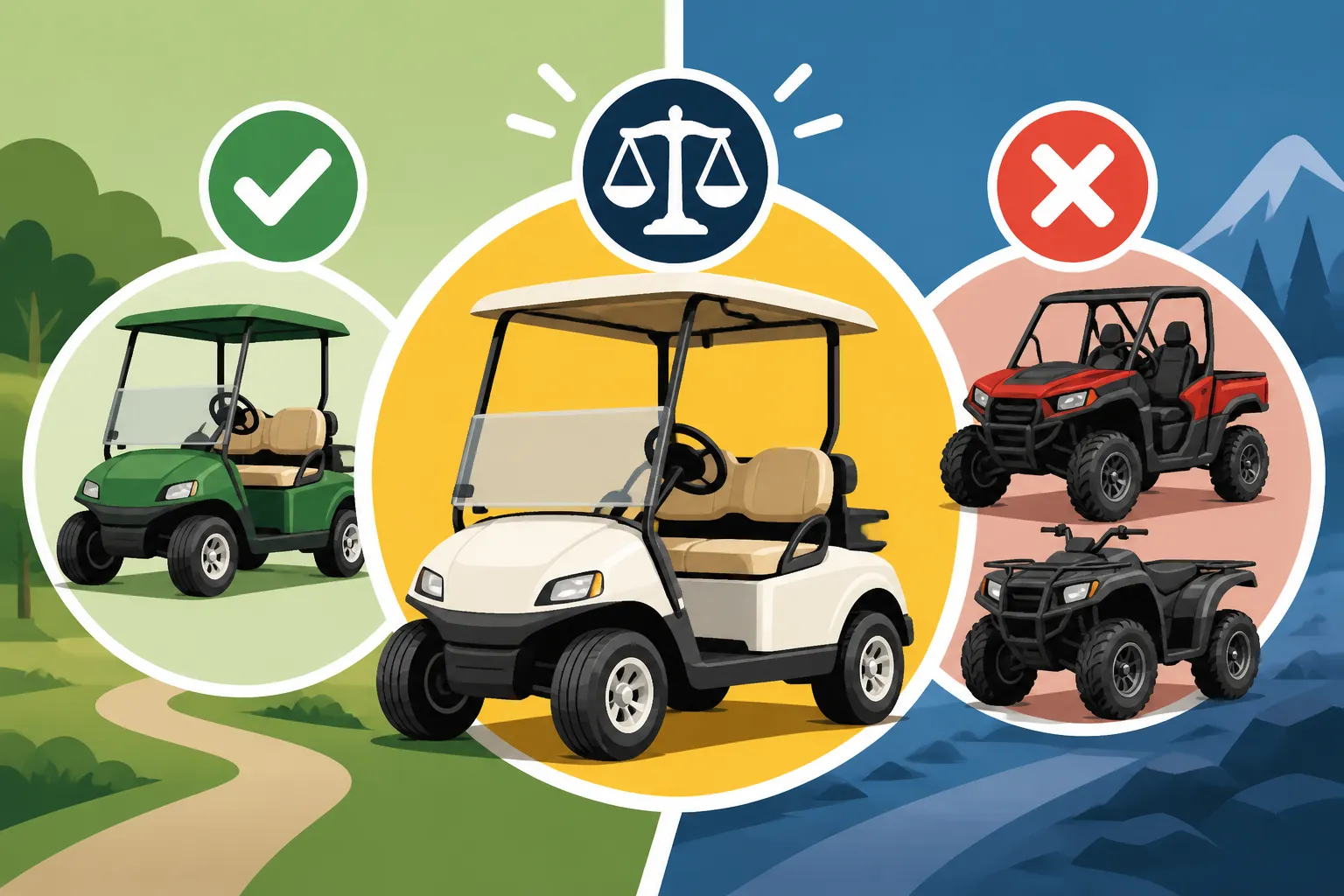
The landscape of small, off-road, and low-speed vehicles has expanded dramatically, and with that expansion comes a lot of confusion. Many machines look similar but are legally distinct, and understanding these differences is key to staying on the right side of the law in Kansas. Thinking everything that looks like a golf cart is a golf cart can lead to costly mistakes.
Golf Carts vs. Work-Site Utility Vehicles WSUVs
One of the most common points of confusion arises when comparing golf carts to Work-Site Utility Vehicles, or WSUVs. While both might be used for light hauling or transport, their legal definitions and intended purposes are quite different. As we discussed, a golf cart is designed for golf courses, with specific speed and weight limits. [Kansas Work-Site Utility Vehicles Explained] clarifies these differences further.
A WSUV, on the other hand, is specifically defined for work purposes, typically on job sites, farms, or large private properties. Kansas law defines a WSUV as a "motor vehicle that is not less than 48 inches in width, has an unladen weight, including the weight of fluids and accessories, of more than 800 pounds and is not more than 2,000 pounds, is capable of speeds of at least 20 miles per hour but not more than 40 miles per hour, and is designed to carry a load of not less than 500 pounds." Right away, you see some key distinctions. WSUVs are wider, often significantly heavier (over 800 pounds but not exceeding 2,000 pounds), and can be designed for higher speeds—up to 40 mph. Plus, they're explicitly designed to carry a load of at least 500 pounds, whereas a golf cart's cargo capacity is usually an afterthought to passenger transport.
The critical difference for owners is that WSUVs have their own distinct titling and road rules. Unlike golf carts, WSUVs must be titled as nonhighway vehicles in Kansas. This is a big deal, as it involves a trip to the county treasurer's office and adherence to specific paperwork requirements. [Titling a Side-by-Side in Kansas] provides more detail on how these machines get their legal paperwork. While some cities allow WSUVs on their streets, the requirements are often more stringent than for golf carts, including specific equipment like headlights, tail lights, and sometimes even turn signals. So, if you've got a beefy, lifted UTV that you use to haul feed around your property, and it exceeds the golf cart's speed or weight limits, it's almost certainly a WSUV, not a golf cart, and you need to treat it differently from a legal perspective.
Golf Carts vs. Micro Utility Trucks MUTs and Low-Speed Vehicles LSVs
The confusion doesn't stop with WSUVs. Kansas law also recognizes [What the Law Counts as a Micro Utility Truck] (MUTs) and, by extension, the concept of federally defined Low-Speed Vehicles (LSVs). These classifications further illustrate [Why the Definitions Matter for Roads] and how easily one machine can be mistaken for another.
Micro Utility Trucks are another class of vehicle designed for light hauling, typically small, open-bed trucks used on campuses, in parks, or similar settings. Kansas defines an MUT as a motor vehicle that is "a light truck that is less than 60 inches in width, has an unladen weight of less than 2,000 pounds, is capable of speeds of at least 20 miles per hour but not more than 25 miles per hour, has an enclosed cab and is equipped with a cargo bed." Notice the key differences from a golf cart: an enclosed cab, a dedicated cargo bed, and specific width and weight limits. While the speed range (20-25 mph) can overlap with golf carts, the overall design and features are distinct. MUTs are also treated differently regarding titling and road use, often requiring state registration just like regular vehicles, depending on their ultimate classification.
Then there are Low-Speed Vehicles (LSVs). This is primarily a federal classification, generally defined as a four-wheeled vehicle with a top speed between 20 and 25 mph, weighing less than 3,000 pounds, and equipped with safety features like headlamps, tail lamps, turn signal lamps, stop lamps, reflex reflectors, a rearview mirror, a parking brake, and seat belts. Many golf cart manufacturers now produce "street legal" versions that meet these LSV requirements right off the assembly line. While Kansas law acknowledges LSVs, they often have more stringent equipment requirements for road use than a basic golf cart allowed by local ordinance. If your machine is an LSV, it typically needs to be titled and registered, and it might be subject to different rules than a traditional golf cart. The critical distinction for you, the owner, is that a vehicle sold as an "LSV" or "street-legal golf cart" from a dealer likely has different legal obligations than a basic golf cart that a city has opted to allow on its streets. Misunderstanding these nuances can lead to citations, or worse, issues with insurance if your machine isn't properly classified.
| Feature | Golf Cart | Work-Site Utility Vehicle (WSUV) | Micro Utility Truck (MUT) |
|---|---|---|---|
| Primary Purpose | Golf courses, personal transport | Work on sites, farms, large properties | Light hauling, utility work |
| Unladen Weight | Not more than 1,300 lbs | More than 800 lbs, not more than 2,000 lbs | Less than 2,000 lbs |
| Maximum Speed | >20 mph but not >25 mph | >20 mph but not >40 mph | >20 mph but not >25 mph |
| Width | Varies, typically under 48 inches | Not less than 48 inches | Less than 60 inches |
| Other Key Features | No specific cargo bed, open cab common | Designed to carry >= 500 lb load, typically open cab | Enclosed cab, equipped with cargo bed |
| State Titling | Generally exempt | Required as nonhighway vehicle | Typically required as motor vehicle (depends on class) |
| State Registration | Generally exempt | Generally exempt from annual registration | Typically required |
Practical Implications for Kansas Golf Cart Owners
Navigating the legal landscape for golf carts in Kansas can feel like a maze. Because they're often treated differently than other vehicles, owners face unique challenges regarding paperwork, local rules, and even insurance. Understanding these practical implications is vital to enjoying your golf cart without unnecessary legal worries.
Titling, Registration, and Insurance
One of the biggest relief points for golf cart owners in Kansas is that, under the standard legal definition, golf carts are generally [Kansas Machines Exempt From Registration] at the state level. This means you typically don't need to go to your county treasurer's office to apply for a state title or pay annual tag fees for your golf cart, unlike an ATV or a Work-Site Utility Vehicle. This exemption often saves owners both time and money upfront.
However, "exempt from state registration" does not mean "free from all paperwork" or "free from all insurance requirements." Even without a state title, it's incredibly wise to have robust proof of ownership, especially if you buy your golf cart in a private sale. A clear, detailed bill of sale is your best friend here. Services like LawDepot can provide templates for a legally sound bill of sale, ensuring you have a record of purchase, the serial number, and agreement from the seller. This document is essential not just for proving you own the cart, but also for any future resale, or if you ever need to file an insurance claim after theft or damage. [Using a Handwritten Bill of Sale to Title a Quad] covers the importance of such documents, even if your golf cart doesn't need a title.
When it comes to insurance, the state of Kansas generally does not mandate insurance for golf carts used solely on private property or golf courses. This changes drastically, however, if you plan to operate your golf cart on public roads. In almost all cases where a city has passed an ordinance allowing golf carts on its streets, that ordinance will also require proof of liability insurance. [Kansas Insurance Comes From City Ordinances], meaning the specifics—like minimum coverage amounts—are determined at the local level. You'll need to check with your city clerk's office to understand their specific insurance mandates. Even if your city doesn't require it, carrying liability insurance is always a smart move. Accidents happen, and having coverage can protect you from significant financial hardship if your golf cart causes damage or injury. Some homeowners' policies might offer limited coverage for golf carts used on your property, but for road use, you'll almost certainly need a dedicated policy or an endorsement.
Local Ordinances and Street Legal Status
This is arguably the most critical area for any Kansas golf cart owner hoping to use their machine beyond their private property: the absolute power of local ordinances. Kansas state law generally bans ATVs, UTVs, and golf carts from public roads unless a specific exception is made. For golf carts, that exception must come from your local city council.
What this means is that golf carts are not inherently "street legal" across Kansas. Instead, [Kansas Cities That Authorize ATV Street Use] for vehicles like golf carts do so by passing their own local ordinances. If your town hasn't passed such an ordinance, then driving your golf cart on public streets is illegal, plain and simple, regardless of how safe you feel it is or what other towns allow. This creates a frustrating patchwork quilt of rules across the state. What's perfectly fine in Louisburg might get you a ticket in Andover.
If your city has passed an ordinance, it will specify the exact conditions under which you can drive your golf cart. These conditions often include:
- Designated Streets: Only certain streets might be open to golf carts, typically those with lower speed limits (e.g., 25 mph zones). Main thoroughfares or state highways are almost always off-limits.
- Required Equipment: Beyond the basic design definition of a golf cart, cities often mandate additional safety equipment. This can include headlights, tail lights, brake lights, turn signals, a rearview mirror, and a [Kansas Golf Carts and Slow-Moving Emblems] on the rear. Some might even require a horn or seatbelts.
- Hours of Operation: Some ordinances restrict golf cart use to certain hours, such as sunrise to sunset, or ban them entirely after dark.
- Driver Requirements: You'll almost always need a valid driver's license to operate a golf cart on public streets, even if it's not a full-speed vehicle.
- Permits/Fees: Many cities require you to obtain a local permit or pay an annual fee to register your golf cart with the city, even if no state registration is required. This often involves an inspection by local law enforcement to ensure your cart meets all the ordinance's equipment requirements.
The bottom line is that before you ever take your golf cart onto a public street, you must contact your city hall, or if you're in an unincorporated area, your county clerk's office. Ask specifically about golf cart ordinances, what they allow, and what equipment and insurance are required. Not knowing the local rules is no defense if you get pulled over. It's an inconvenience, certainly, but it’s the only way to ensure your fun on four wheels doesn’t turn into a costly legal hassle.
Disclaimer
This article is for general informational purposes only and does not constitute professional advice. Laws, prices and regulations vary by location and change over time. Consult a qualified professional for guidance on your specific situation.