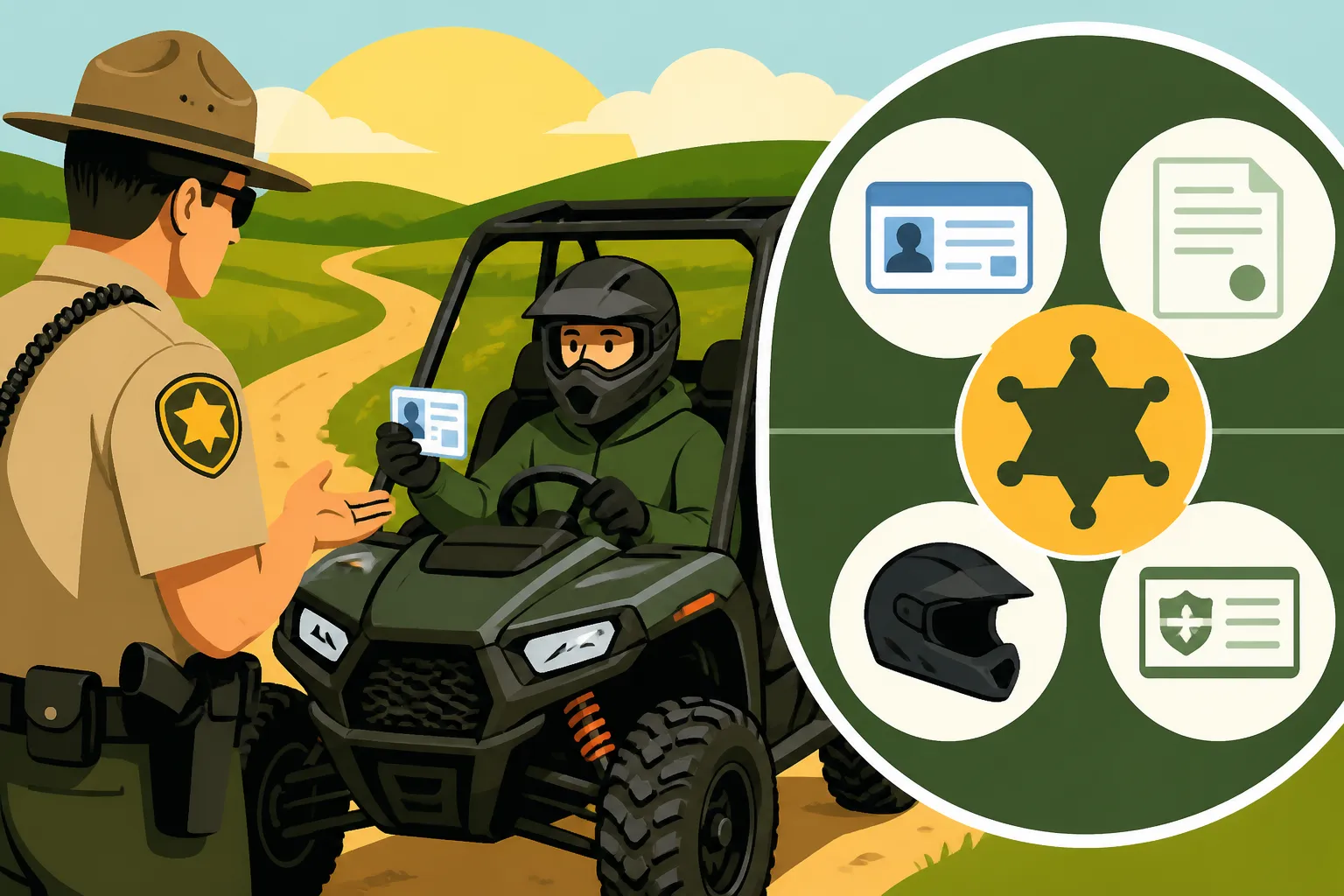
What a County Sheriff Can Ask a Rider to Show
There’s a unique sense of freedom that comes with exploring Kansas backroads, pastures, and trails on your ATV or UTV. But that feeling can quickly turn to anxiety if you see flashing lights in your rearview mirror. Many riders wonder, "What exactly can a county sheriff ask me to show when I’m out riding?" It’s a valid concern, and navigating these interactions requires understanding your rights and responsibilities. This guide will walk you through what to expect, what documentation you should have on hand, and how to handle a stop with a county sheriff in the Sunflower State, helping you ride with more confidence and less worry.
Understanding the Authority of a County Sheriff in Kansas
County sheriffs in Kansas play a crucial role in maintaining order and enforcing state laws, as well as any applicable local ordinances within their jurisdiction. When you’re out on your off-road machine, whether it's a quad, a side-by-side, or a utility vehicle, their authority extends to you, just as it would to any other motorist or citizen. It’s not uncommon for riders to feel a bit out of place when stopped by law enforcement, especially if they’re accustomed to riding solely on private land. However, understanding the basis of a sheriff’s actions can help demystify the process.
Why a Sheriff Might Stop an ATV/UTV Rider
A county sheriff might initiate a stop for a variety of reasons, many of which are centered on public safety, property protection, or simply ensuring compliance with the law. One of the most common reasons involves perceived violations of road rules. Kansas state law has very specific regulations about where ATVs and UTVs can and cannot be operated, particularly on public roads and highways. If an officer observes you operating your machine on a prohibited roadway, or in a manner that seems unsafe or illegal, they have every right to pull you over. This could include anything from riding on a state highway to operating without proper lighting after dark.
Beyond road-related infractions, a sheriff might stop a rider due to suspicious activity. Perhaps they’ve received a complaint about noise, or there's a report of trespass on private property in the area. If your machine matches a description or you're riding in an area where such complaints are frequent, an officer might stop you to investigate. Safety concerns are another big one; if an officer notices a rider, especially a young one, operating a machine in an apparently unsafe manner or without appropriate safety gear (even if not explicitly mandated by state law, it can still raise questions), they might conduct a stop to ensure everyone’s well-being. Finally, sometimes it’s a proactive check, especially in areas known for off-road riding, to ensure that riders are properly licensed, the machines are titled, and all equipment is in order. It’s always best to assume any interaction is for a legitimate reason.
The Difference Between State Law and Local Ordinances
One of the biggest sources of confusion for ATV and UTV riders in Kansas is the complex interplay between state laws and local ordinances. State law provides the overarching framework for off-road vehicle operation in Kansas, dictating things like titling requirements and general prohibitions on public road use. For example, [Kansas Has No OHV Registration] at the state level, but that doesn't mean you can just ride anywhere. These state statutes are applied statewide by county sheriffs and state troopers.
However, many cities and even some counties in Kansas have passed their own specific ordinances that either restrict or, in some cases, permit the use of ATVs and UTVs on certain public roads within their boundaries. These local ordinances can add layers of requirements, such as mandating specific equipment, requiring liability insurance, or even requiring a special city-issued tag to operate on city streets. A sheriff might be enforcing a county-level rule, or a deputy might be assisting a city police department with an ordinance that applies only within that municipality. This means that what's perfectly legal in one part of the state or even one small town might be strictly prohibited just a few miles down the road. It creates a challenging environment for riders who might cross jurisdictional lines, highlighting the importance of doing your homework and knowing the rules for your specific riding area. Checking local city or county government websites for ordinances is a wise first step before you trailer your machine to a new riding spot.
Documents and Information a Sheriff Can Legally Request
When a county sheriff stops you while riding your ATV or UTV in Kansas, they have the authority to ask for certain documents and information. Being prepared with these items can make the interaction much smoother and quicker. It's not about being guilty of anything, but simply about demonstrating compliance with the law. Think of it like a routine traffic stop for a car; similar principles apply, although the specific documents for an off-road machine might differ.
Proof of Identity and Operator Status
The very first thing any law enforcement officer will ask for during a stop is your identification. This is standard procedure to confirm who you are. If you’re operating an ATV or UTV on any public road where it might be permitted (such as for agricultural purposes or in a city that allows UTVs with a special tag), you will almost certainly be asked for your driver’s license. Even if you're riding entirely on private land, an officer may still ask for identification if there's a question of trespass or other legal matters. Always have a valid driver's license or a state-issued identification card on you.
For younger riders, age verification is critical. Kansas has specific [Kansas ATV Age Requirements] that dictate who can operate these machines and under what conditions. If a sheriff stops a youth rider, they may ask for identification to verify their age against these regulations. It’s important for parents and guardians to be aware of these rules and ensure their children are riding legally and safely. Having a school ID or other form of identification can be helpful for younger operators.
Proof of Ownership and Titling
Next, a sheriff will likely want to verify ownership of the machine you are operating. In Kansas, most ATVs and UTVs are classified as nonhighway vehicles and are required to be titled. This means you should have proof of title, or at least a temporary document indicating your ownership. The state issues a [Kansas Nonhighway Title Explained], which is distinct from a standard vehicle title because it explicitly states the machine is not street legal.
When an officer asks for proof of ownership, they'll be looking for your title. If you've recently purchased the machine, especially through a private sale, you might still be within the [Kansas Gives You 60 Days to Apply] for a new title. In such cases, a detailed bill of sale can serve as interim proof of ownership. Make sure your bill of sale includes the buyer's and seller's names, date of sale, purchase price, and the machine's VIN. Services like LawDepot can help you generate a professional and legally sound bill of sale, which can be invaluable in a pinch. It's all part of demonstrating that the machine isn't stolen and legitimately belongs to you. Always keep these documents, or clear copies, securely stored and readily accessible when you're riding. Reviewing the details in [Kansas Titles After a Private Sale] and [Kansas Title Paperwork Explained] can help you understand what you need to have.
Machine-Specific Documentation and Equipment Checks
Depending on where and how you’re riding, a sheriff might also inquire about specific machine documentation or conduct equipment checks. If you're operating a UTV within city limits that has adopted an ordinance allowing such use, the city often requires you to carry proof of specific insurance coverage and display a city-issued tag. Therefore, an officer might ask for your [Kansas City Insurance Requirements] documentation or to see your [Kansas City Tag Fees for a UTV] sticker. Without these, you could face a citation even if your machine is otherwise in perfect working order.
Beyond paperwork, deputies often conduct [Kansas Equipment Checks by Deputies]. These checks are usually focused on safety and compliance with road-use requirements, even if you’re just crossing a short section of road. This might include checking for working headlights and taillights, especially if you’re riding near or after dark (refer to [Kansas Sunset to Sunrise Lighting Rules] for specific guidance). They may also check for a slow-moving vehicle emblem if required for certain road travel, as outlined in [Kansas Slow-Moving Emblem Rules]. In some riding areas, particularly private parks or public lands with specific rules, a spark arrester might be a requirement to prevent wildfires. While not typically a statewide requirement for all private land use, it's something to be mindful of.
Here's a quick overview of what a sheriff might ask to see, depending on the circumstances:
| Document/Item | When a Sheriff Might Ask for It | Importance |
|---|---|---|
| Driver's License/ID | Operating on public roads, suspicious activity, general identification | Proves identity, age, and legal ability to operate on public ways. |
| Nonhighway Title/MCO | Verifying ownership, after a collision, sale disputes, machine theft | Establishes legal ownership and compliance with titling laws. |
| Bill of Sale | If title is pending, private sale, verifying recent purchase | Interim proof of ownership before a title is issued. |
| Proof of Insurance | Required by specific city ordinances (e.g., for city-tagged UTVs) | Avoids fines and liability issues where insurance is mandatory. |
| Landowner Permission | Riding on private land not your own | Prevents trespass charges; crucial for access to hunting or recreational land. |
| Machine Equipment | Operating at night, on roads, or in areas with specific rules | Ensures safety and compliance with lighting, safety, and sound regulations. |
Navigating the Interaction: Your Rights and Responsibilities
When a county sheriff stops you on your ATV or UTV, it’s natural to feel a bit apprehensive. However, knowing your rights and understanding your responsibilities can make the interaction less stressful and generally more positive for everyone involved. The key is to remain calm, respectful, and cooperative, while also being aware of what law enforcement can and cannot do.
Your Rights During a Stop
First and foremost, you have the right to remain silent, but you must provide your identification when asked. You are not generally required to answer questions beyond providing your name and showing your ID. However, being overly silent or uncooperative can sometimes prolong a stop. You also have the right to know why you have been stopped. Politely ask, "Officer, could you please tell me why I've been stopped?" This can help clarify the situation immediately.
Regarding searches, an officer generally cannot search your person or your machine without your consent, probable cause, or a warrant. If an officer asks to search your machine or your person, you have the right to refuse, stating clearly, "Officer, I do not consent to a search." However, if they state they have probable cause, they may proceed. Always remain calm and do not physically resist, even if you believe your rights are being violated. Your recourse for an unlawful search would be in court. Remember, a polite and respectful demeanor goes a long way in ensuring a professional interaction, even when asserting your rights.
Best Practices for ATV/UTV Riders
To make any interaction with law enforcement as smooth as possible, proactive preparation is key. Always stop immediately and safely when signaled by an officer. Turn off your engine, remove your helmet (if wearing one), and keep your hands visible. Have your identification, title, or bill of sale, and any required insurance cards (if riding where it's mandated) handy and protected in a waterproof bag. This not only makes it easier for you but also shows the officer you’re prepared and respectful of the law.
Beyond documentation, knowing the rules of the specific area you're riding in is crucial. Before you even head out, take the time to research [Kansas Ordinance Lookups Before You Ride]. Many local governments have their ordinances available online. If you're on private land, ensure you have explicit permission from the landowner, and ideally, have it in writing. This is where a document created through services like LawDepot can really come in handy, serving as clear proof you have the landowner's blessing. This small step can prevent a simple misunderstanding from escalating into a trespass charge. Being knowledgeable and prepared demonstrates responsibility, which officers appreciate.
Consequences of Not Having Required Documentation or Equipment
Ignoring the rules or failing to carry the necessary documents when riding your ATV or UTV in Kansas can lead to more than just a stern talking-to. The consequences can range from minor inconveniences to significant financial burdens or even loss of your machine. It’s a good reminder that the "wild west" days of off-road riding without accountability are long gone, especially on or near public access points.
Potential Fines and Citations
If a county sheriff pulls you over and you don't have the required documentation, or your machine is missing essential equipment for the area you're riding, you could face fines and citations. The exact penalty will depend heavily on the specific infraction and the jurisdiction. For instance, operating on a prohibited roadway could result in a significant traffic ticket, especially if it's considered illegal road riding, as outlined in [Kansas Penalties for Illegal Road Riding]. Failure to have your machine properly titled, or inability to prove ownership, can lead to fines related to administrative non-compliance.
If you’re riding in a city that requires insurance for UTVs on its streets and you don’t have it, that’s another potential citation. Each citation will come with its own fine, and often, additional [Kansas Court Costs for a Citation] if you have to appear in municipal or district court. These costs can add up quickly, far exceeding the small effort it takes to ensure you’re compliant before you ride. It’s always cheaper and less stressful to follow the rules than to deal with the aftermath of a ticket.
Impoundment and Other Actions
In more serious circumstances, not having the required documentation or having significant equipment violations could lead to your ATV or UTV being impounded. This is a particularly frustrating and expensive outcome. For example, if an officer determines your machine is stolen, it will immediately be impounded. Similarly, if you are found to be operating under the influence, your machine will be impounded as part of the arrest for a [Kansas DUI Law and Off-Road Machines] violation. In some cases, repeated or severe equipment violations, or operating an unsafe machine, could also lead to impoundment until the issues are rectified.
Retrieving an impounded machine involves substantial fees, including towing costs, daily storage fees, and administrative charges. These costs accrue rapidly, and you'll typically need to prove ownership and show that any violations have been corrected before the machine is released. This process can be a bureaucratic nightmare and a major hit to your wallet. It underscores the importance of not only having your paperwork in order but also ensuring your machine is always in safe, legal operating condition. If you ever loan out your machine, consider using a formal agreement, which you can easily draft using a service like LawDepot, to outline responsibilities and prevent misunderstandings that could lead to such drastic measures.
Importance of Landowner Permission
Beyond official documents and machine requirements, one of the most critical "documents" a county sheriff can inquire about—especially if you're riding on private property—is proof of landowner permission. Trespassing is a serious offense in Kansas, and sheriffs are well within their rights and duties to enforce property laws. If you're riding on land that doesn't belong to you, and you don't have explicit permission, you could face a trespass charge.
This is where proactive communication and documentation really shine. If you’re riding on a friend’s farm, a relative’s ranch, or a leased hunting property, always make sure you have direct, unequivocal permission. Ideally, get it in writing. A simple written note signed by the landowner, stating who has permission to ride, on what dates, and on which specific property, can save you a world of trouble. Again, resources like LawDepot can provide templates for [Getting Written Permission From a Landowner Before You Ride], making it easy to formalize these agreements. Presenting such a document to a sheriff immediately clarifies your presence and can prevent a potentially awkward or legally compromising situation from escalating. It's about respecting private property rights and showing you're a responsible rider.
Disclaimer
This article is for general informational purposes only and does not constitute professional advice. Laws, prices and regulations vary by location and change over time. Consult a qualified professional for guidance on your specific situation.