Kansas WSUV Width of 48 Inches
When you're looking at purchasing a utility vehicle for work around your Kansas property, or maybe for some light recreational use that might involve crossing a paved road, you’ve probably stumbled upon the term "Work-Site Utility Vehicle" or WSUV. It sounds official, and it is! But the specific dimensions, especially that crucial 48-inch width, can cause a lot of confusion. Many folks assume all side-by-sides are the same in the eyes of the law, only to find out that a few inches can make a world of difference in what you can and can't do with your machine. This guide will meticulously break down the 48-inch width requirement for WSUVs in Kansas, explaining what it means for you and your machine, and how it fits into the broader picture of off-road vehicle classifications in the Sunflower State.
Understanding Kansas's WSUV Classification
Kansas law has some very specific definitions when it comes to off-road vehicles, and the Work-Site Utility Vehicle (WSUV) is a prime example of a class that often gets misunderstood. It's not just a fancy name; it carries distinct legal implications for titling, road use, and even insurance. Getting this classification right is the first step to ensuring you're operating your machine within the bounds of the law and avoiding any unexpected headaches down the road.
What Exactly is a Work-Site Utility Vehicle (WSUV) in Kansas?
Let's cut through the jargon. In Kansas, a Work-Site Utility Vehicle isn't simply any UTV you see cruising around a farm or construction site. It's a precisely defined class of vehicle with a specific set of characteristics that distinguish it from, say, a recreational side-by-side, an ATV, or even a golf cart. The state legislature carved out this category to allow certain compact, utilitarian machines limited road access, primarily for agricultural, construction, or maintenance purposes, without them being fully street-legal like a car or truck. Think of it as a middle ground: more capable than a golf cart, but not as freely operable on public roads as a conventional vehicle.
The essence of a WSUV lies in its design and intended use. These are typically smaller, nimbler utility vehicles built for specific tasks. Their definition helps differentiate them from larger, wider "recreational" side-by-sides that often exceed these specified dimensions. This distinction is paramount because it dictates everything from how your machine is titled to where you can legally drive it. Without meeting these criteria, your machine simply isn't a WSUV in Kansas, regardless of what the manufacturer might call it.
The Critical Role of Dimensions in Classification
When it comes to categorizing your utility machine as a WSUV in Kansas, dimensions are not just a suggestion; they are a critical legal threshold. The 48-inch width is perhaps the most well-known, and often the most challenging, criterion for many owners. It’s a hard stop, a measurement that immediately qualifies or disqualifies a machine from this specific class. If your UTV, no matter how much it looks like a WSUV, measures wider than 48 inches, it simply cannot be titled or operated as one.
This narrow width requirement serves a purpose: it helps ensure these vehicles are compact enough for specific work environments, like navigating tight rows in a field, moving through construction sites, or operating on maintenance paths. It also differentiates them from broader recreational UTVs that might share some characteristics but are designed for a different kind of performance and space. Alongside width, other dimensions and features like unladen weight, seating configuration, and steering type all combine to create the complete picture. Ignoring any of these could lead to misclassification, which then opens the door to potential fines or legal issues if you're ever stopped while operating your machine.
Why the WSUV Classification Matters for Owners
Understanding whether your machine fits the WSUV definition isn't just an academic exercise; it has very real, tangible consequences for owners in Kansas. First and foremost, it directly impacts the titling process. A machine that meets the WSUV criteria will receive a specific [Kansas Nonhighway Title Explained] that differentiates it from an ATV title, or from a full highway vehicle title. This title is crucial for proving ownership and is required for all new and used WSUVs in Kansas. Attempting to title a machine that doesn't fit the WSUV definition as one could lead to complications at the county treasurer's office.
Beyond titling, the WSUV classification significantly dictates your vehicle's road use privileges. While most off-road machines are banned from public roads by default, WSUVs are granted specific, albeit limited, exceptions. These exceptions typically allow for crossing highways, operating on certain public roads within city limits (if authorized by local ordinance), or for agricultural purposes. If your machine is not a WSUV, these exceptions generally don't apply, and you could face penalties for illegal road riding. Finally, the classification can even influence insurance options and requirements, as insurers often have different policies for different vehicle types based on their legal definitions and allowed uses. It's all connected, making a clear understanding of the WSUV classification absolutely essential.
Deconstructing the 48-Inch Width Requirement
That 48-inch width rule for Kansas Work-Site Utility Vehicles often sparks a lot of head-scratching and measuring tapes. It's a precise measurement, and getting it wrong can mean your otherwise perfect utility vehicle doesn't qualify. Understanding exactly how this measurement is taken and what it truly encompasses is key to avoiding missteps when buying or operating a WSUV in Kansas.
How Kansas Law Measures Width
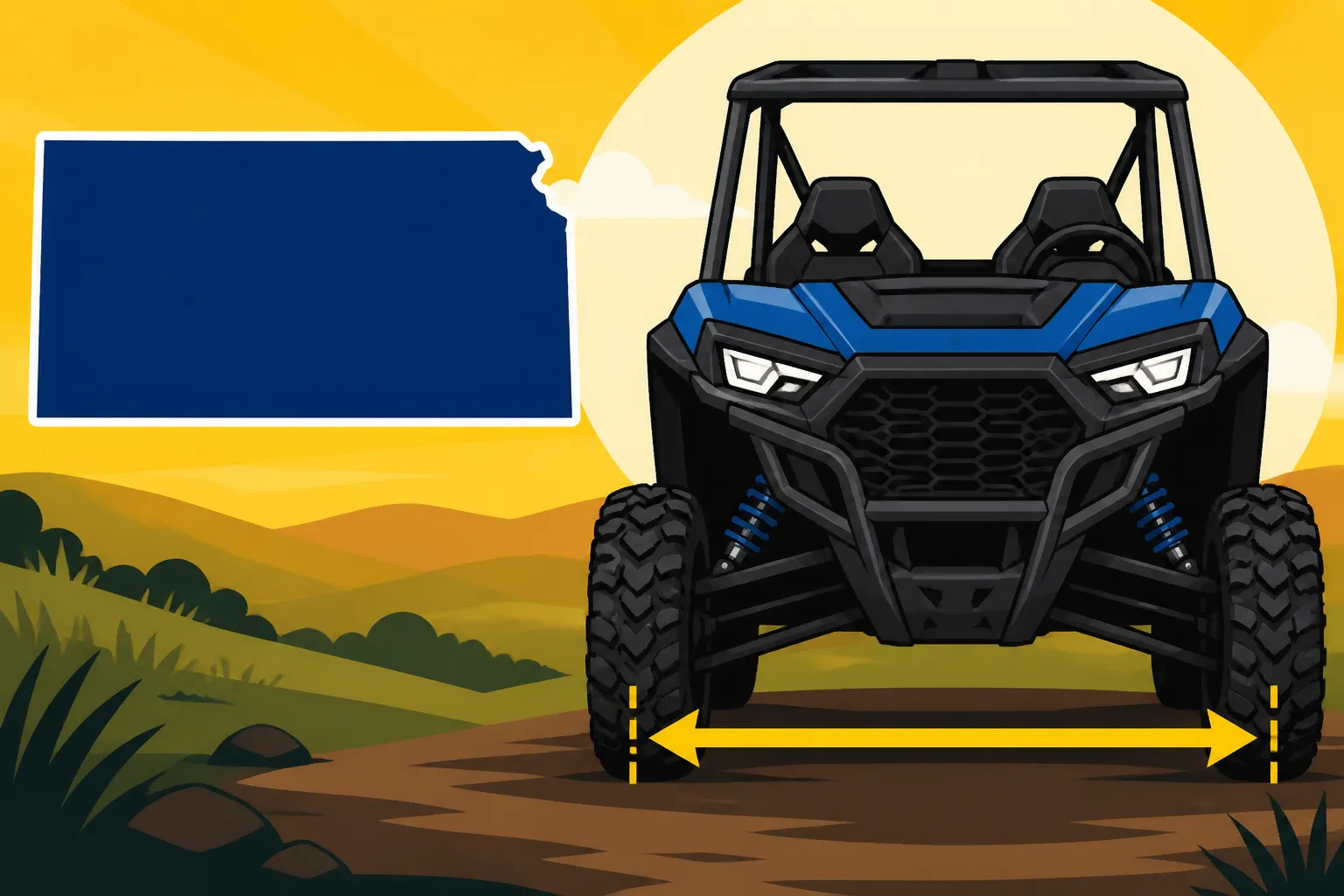
When Kansas law specifies a maximum width of 48 inches for a Work-Site Utility Vehicle, it's generally referring to the widest part of the machine, excluding mirrors but including tires or any fixed body parts that project furthest. This is crucial because many side-by-sides are designed with robust wheel wells, tires that might stick out a bit, or even wider suspension components. You can't just measure the chassis and call it good; you need to consider the outermost projections. Imagine taking a giant caliper and measuring from the furthest point on one side of the machine to the furthest point on the other. That's your legal width.
This measurement is typically taken at the widest point, which is almost always across the tires or the fender flares protecting them. It's not uncommon for a manufacturer to list a "body width" that is less than the true overall width when tires are mounted. Therefore, relying solely on manufacturer specifications without actually breaking out the tape measure yourself can be a risky move. Always measure your specific machine, or the one you intend to purchase, from the widest point across the front or rear axles, making sure to account for any part of the tire that extends beyond the frame or bodywork. This meticulous approach ensures you're in full compliance with the [48 Inches Measured How] rule.
Common Misconceptions About the 48-Inch Rule
There are quite a few misunderstandings floating around about the 48-inch width rule, and these misconceptions can lead to trouble. One of the most common is believing that certain aftermarket accessories, like wider tires or fender extensions, don't count towards the official width. However, if these additions make your vehicle wider than 48 inches at its outermost projection, then it no longer qualifies as a WSUV. The law doesn't make exceptions for "just a little bit wider" or "it's only the tires." The measurement is absolute.
Another misconception is that the rule only applies to the main body of the machine, ignoring things like steps, cargo racks, or even the handles of certain tools mounted on the side. While mirrors are generally excluded from width measurements for highway vehicles, for a WSUV, any fixed part that contributes to the widest point will be considered. This includes anything permanently attached or bolted on. So, if you've added a custom bed or a tool rack that protrudes beyond 48 inches, your machine might inadvertently lose its WSUV classification. It's vital to assess your machine's entire profile, not just its core chassis, to ensure it adheres to the strict width limitation.
Practical Implications for Machine Selection
The 48-inch width requirement has significant practical implications, especially when you're in the market for a new or used utility vehicle in Kansas. If you specifically need your machine to qualify as a WSUV for its limited road use privileges or ease of titling, you'll need to be very selective. Many popular side-by-sides, particularly multi-passenger models or those designed for aggressive trail riding, easily exceed 48 inches in width. These machines, while excellent for their intended purposes, will not be considered WSUVs under Kansas law.
This means you might need to lean towards more compact, often two-seater, utility-focused models. When browsing dealerships or private sales, specifically ask if the machine meets the [48 Inches and 800 Pounds] criteria for WSUVs in Kansas. Don't just take a salesperson's word for it if the machine looks borderline; bring your tape measure! For those who already own a machine that's close to the limit, any modifications like wider wheels, off-set rims, or large aftermarket fender flares could push it over the edge. It's a critical consideration for anyone who wants to ensure their utility vehicle can be legally titled and operated as a Work-Site Utility Vehicle within the state.
Beyond Width: Other Key WSUV Criteria in Kansas
While the 48-inch width is a significant hurdle for many utility vehicles trying to fit into the Work-Site Utility Vehicle (WSUV) classification in Kansas, it’s far from the only requirement. Kansas law lays out a comprehensive list of features that, when combined, truly define a WSUV. These criteria work together to distinguish these machines from ATVs, golf carts, and other off-road vehicles, ensuring they meet the specific parameters for their intended, limited-road use.
The 800-Pound Unladen Weight Requirement
Just as critical as the width is the unladen weight of the machine. To qualify as a WSUV in Kansas, your utility vehicle must have an unladen weight over 800 pounds. "Unladen" is the key term here: it means the weight of the vehicle itself, without any passengers, cargo, or additional accessories that aren't considered standard equipment. So, if you load up your machine with tools, a full tank of gas, or aftermarket parts like a heavy winch or snowplow, that doesn't count towards the unladen weight. It's purely about the factory weight of the bare machine.
This 800-pound floor is designed to exclude very small, lighter utility vehicles that might otherwise meet the width requirement but don't possess the robust construction expected of a work-site machine. It ensures a certain level of durability and capability, distinguishing WSUVs from lighter-duty machines like some golf carts or compact electric utility vehicles. Always check the manufacturer's specifications for the "dry weight" or "curb weight" (without fuel/fluids) to get the most accurate unladen weight figure. This, combined with the width, forms the foundational physical requirements for the [Kansas WSUV Weight Over 800 Pounds].
Seating Arrangement: Side-by-Side Bench or Bucket Seats
The way passengers sit in your utility vehicle is another defining characteristic for WSUVs in Kansas. The law specifies that a WSUV must be designed to carry its operator and passengers in a "side-by-side seating arrangement" on a bench seat or on individual bucket seats. This is a crucial differentiator from traditional ATVs, which are designed for a straddle-style seating position, much like a motorcycle. The side-by-side seating makes a WSUV feel more like a mini-car or truck cab, accommodating two or more people sitting next to each other.
This requirement immediately excludes all single-seat ATVs and even most two-up ATVs where the passenger sits behind the driver. The [Kansas WSUV Seating Requirements] highlight the multi-passenger, car-like configuration inherent in the WSUV definition. It’s a clear indication that these vehicles are designed for a different kind of utility and passenger carrying than their ATV counterparts. So, if your machine requires you to sit astride it, no matter how wide or heavy it is, it won't qualify as a WSUV.
Steering Wheel vs. Handlebars
The steering mechanism is another simple, yet decisive, characteristic that helps categorize utility vehicles in Kansas. A Work-Site Utility Vehicle must be equipped with a steering wheel. This, again, sets it apart from an ATV, which is universally operated with handlebars. The presence of a steering wheel reinforces the car-like operation and control often associated with utility vehicles, as opposed to the more motorcycle-like experience of an ATV.
This detail, though small, is non-negotiable. If your machine has handlebars, it's not a WSUV in the eyes of Kansas law, regardless of its width, weight, or seating. This distinction is part of the state's effort to create clear, easily identifiable categories for off-road vehicles, each with its own set of rules and limitations. For more on how this impacts classification, consider the information in [Why a Steering Wheel Changes Your Title Class]. So, if you're looking for a WSUV, make sure it has a steering wheel, not handlebars.
Four or More Low-Pressure Nonhighway Tires
Finally, the tires on your machine also play a role in its WSUV classification. Kansas law requires a Work-Site Utility Vehicle to have "four or more low-pressure nonhighway tires." Let's break that down. "Four or more" simply means it needs to be a multi-wheeled vehicle, not a two-wheeled dirt bike. "Low-pressure" refers to the specific design of off-road tires, which are typically larger, wider, and run at lower air pressures than conventional highway tires, providing better traction and flotation on varied terrain. "Nonhighway" is perhaps the most important part: these tires are not designed, tested, or approved for sustained high-speed use on paved roads.
This tire specification reinforces the off-road, utility nature of the WSUV. It clearly distinguishes these machines from street-legal vehicles that require DOT-approved highway tires. The combination of these tire characteristics ensures the machine is purpose-built for the types of environments where a WSUV is expected to operate, while also signaling its limitations regarding highway speeds and sustained road use. This criterion, alongside the others, creates a complete profile for what Kansas recognizes as a [Four or More Nonhighway Tires].
Titling and Operating a 48-Inch WSUV in Kansas
Once you've confirmed your utility vehicle meets all the specific criteria to be classified as a Work-Site Utility Vehicle in Kansas – including that crucial 48-inch width – you're ready to navigate the next steps: titling and understanding its operational boundaries. This classification opens certain doors that are closed to other off-road machines, but it also comes with its own set of rules and limitations, especially concerning public roads.
The Titling Process for a Kansas WSUV
Titling a WSUV in Kansas is a relatively straightforward process, but it's essential to follow the correct steps to ensure your machine is legally recognized. Unlike highway vehicles, WSUVs receive a [Kansas Nonhighway Title Explained], which signifies its off-road primary use and limited road privileges. You won't be getting a traditional license plate or annual registration tags like a car or truck, because [Kansas Has No OHV Registration] in the conventional sense. Instead, the nonhighway title is your proof of ownership and classification.
The process typically involves visiting your local [Kansas County Treasurers Handle Titles] office. You'll need to bring several key documents, including proof of ownership (like a manufacturer's certificate of origin for a new machine, or a properly assigned title and bill of sale for a used one), proof of identification, and funds for the titling fee and any applicable sales tax. The clerks at the treasurer's office are usually quite familiar with the WSUV requirements, but it helps to be prepared and understand your machine's classification beforehand. If you’re dealing with a private sale, ensuring you have a solid bill of sale, perhaps drafted with a template from a resource like LawDepot, can smooth the transfer process considerably.
Road Use Privileges and Restrictions for WSUVs
This is where the WSUV classification truly pays off, offering distinct advantages over other off-road vehicles. By default, most ATVs and recreational UTVs are strictly prohibited from public roads in Kansas. However, WSUVs are granted specific exceptions. These typically include the ability to cross highways (though not drive on them for extended periods), and, perhaps most importantly, to be operated on certain public roads within city limits, if the local municipality has passed an ordinance explicitly allowing it. It's a patchwork of local rules, so knowing your city's stance is crucial.
For instance, you might be able to drive your WSUV on city streets in Andover or Louisburg, provided you adhere to local regulations regarding speed, insurance, and possibly a city-issued tag. However, simply owning a WSUV doesn't automatically grant you access to every city street. Always check with your local city hall or municipal clerk for their specific ordinances. For agricultural use, WSUVs might also have slightly broader permissions for operating on specific county roads, especially when moving between fields or farm properties. Understanding these nuanced rules is essential to avoid potential citations; a WSUV can be used legally on certain roads, but it's not a free pass. [Kansas Work-Site Utility Vehicle Road Rules] provides more detail on these specific permissions.
Comparing WSUVs to Other Off-Road Vehicles
To truly appreciate the WSUV classification, it helps to understand how it stacks up against other types of off-road machines in Kansas. Here's a quick comparison:
| Feature | WSUV (Work-Site Utility Vehicle) | ATV (All-Terrain Vehicle) | Golf Cart | Micro Utility Truck |
|---|---|---|---|---|
| Max Width | 48 inches | Varies, typically 48-50 inches | Varies, often 48-60 inches | Varies, often highway legal |
| Min Unladen Weight | Over 800 lbs | No specific minimum | No specific minimum | No specific minimum |
| Seating | Side-by-side bench/bucket | Straddle | Side-by-side bench | Side-by-side, enclosed cab |
| Steering | Steering wheel | Handlebars | Steering wheel | Steering wheel |
| Tires | 4+ low-pressure nonhighway | 3-4 low-pressure nonhighway | 4+ non-highway | Highway legal or nonhighway |
| Titling | Kansas Nonhighway Title | Kansas Nonhighway Title | Often exempt, but check local rules | Depends on highway legality |
| Road Use | Limited, city ordinance specific | Generally prohibited | Limited, city ordinance specific | Varies, often highway legal |
| Primary Use | Work, agriculture, maintenance | Recreation, sport, light utility | Golf courses, short distance travel | Light hauling, campus/local |
This table clearly illustrates the unique position of the WSUV. It's distinct from an ATV because of its seating and steering, and generally more robust than a golf cart due to its weight requirement and intended use. The [Kansas Work-Site Utility Vehicles Explained] further elaborates on these differences. Understanding these distinctions is critical for both purchasing the right machine for your needs and ensuring you remain compliant with Kansas law, especially if you plan any sort of road use.
Navigating Challenges and Ensuring Compliance
Even with a clear understanding of the Kansas WSUV definition and its 48-inch width requirement, challenges can still arise. Whether you're dealing with a machine that's just a hair too wide, or you're trying to make an informed purchase, knowing how to navigate these situations and ensure full compliance is crucial for any owner or prospective buyer in Kansas.
What Happens If Your Machine Exceeds 48 Inches?
So, you've measured your beloved utility vehicle, and to your dismay, it's 49 inches wide. What now? If your machine exceeds the 48-inch width, it simply cannot be legally classified as a Work-Site Utility Vehicle in Kansas. This means it won't be eligible for the specific [Kansas WSUV Title Requirements] and, more importantly, it will not qualify for the limited road use privileges afforded to WSUVs. In the eyes of Kansas law, it would likely fall into a broader category of "recreational off-highway vehicle" or simply a "utility vehicle" without the WSUV designation.
The practical implications are significant. You might face difficulties at the county treasurer's office if you try to title it as a WSUV. More critically, if you're caught operating a non-WSUV machine on a public road where a WSUV would typically be allowed (even with a city ordinance), you could be cited for illegal road use. Penalties can range from fines to impoundment, depending on the circumstances and local jurisdiction. Modifying a machine to try and fit the width requirement is generally not recommended, as it can affect stability and safety. If your machine is too wide, it's best to accept its classification and limit its use to private property or designated off-road riding areas like [Tuttle Creek ORV Area in Kansas], where the WSUV width restriction doesn't apply.
Verifying WSUV Specifications Before Purchase
Buying a utility vehicle is a significant investment, and for those in Kansas who need their machine to be a WSUV, due diligence before purchase is non-negotiable. Don't rely solely on online descriptions or a salesperson's casual assurance. As we've discussed, a few inches or pounds can change everything. Always make verifying the WSUV specifications a critical part of your pre-purchase checklist.
When looking at a machine, especially a used one, insist on taking your own measurements for width and checking the manufacturer's plate for the unladen weight. Examine the seating style and confirm it has a steering wheel. Ask for the Manufacturer's Certificate of Origin (MCO) or the current title to verify the vehicle's model and year. If buying from a private seller, you might even consider asking for a specific statement in the bill of sale, perhaps generated through a service like LawDepot, confirming the seller's understanding that the machine is being sold as a Kansas WSUV. This level of verification can save you immense frustration and potential legal issues down the line. It's much easier to confirm compliance before you sign the paperwork than to try and rectify a misclassified machine after the fact.
Seeking Professional Guidance for Complex Cases
Sometimes, despite your best efforts, you might encounter a situation that's not entirely clear-cut. Perhaps you have a unique utility machine, an older model with unclear documentation, or you're facing a specific challenge with titling or local ordinances. In these instances, don't hesitate to seek professional guidance. Your local Kansas county treasurer's office is an excellent first resource; they deal with these classifications daily and can often provide specific advice on titling requirements. You can reach out to them for [Kansas Title Questions Treasurers Hear].
For more complex legal interpretations, especially concerning road use or if you're dealing with a dispute, consulting with an attorney who specializes in vehicle law can be invaluable. They can help you understand the nuances of state statutes and local ordinances. Additionally, for clear and legally sound documentation, such as drafting a comprehensive bill of sale for a private sale, resources like LawDepot offer templates that can ensure all necessary details, including WSUV compliance statements, are properly included. Taking the time to get expert advice can prevent costly mistakes and ensure you’re fully compliant with all Kansas regulations for your Work-Site Utility Vehicle.
Disclaimer
This article is for general informational purposes only and does not constitute professional advice. Laws, prices and regulations vary by location and change over time. Consult a qualified professional for guidance on your specific situation.