Signing a Waiver at the Gate Before You Unload
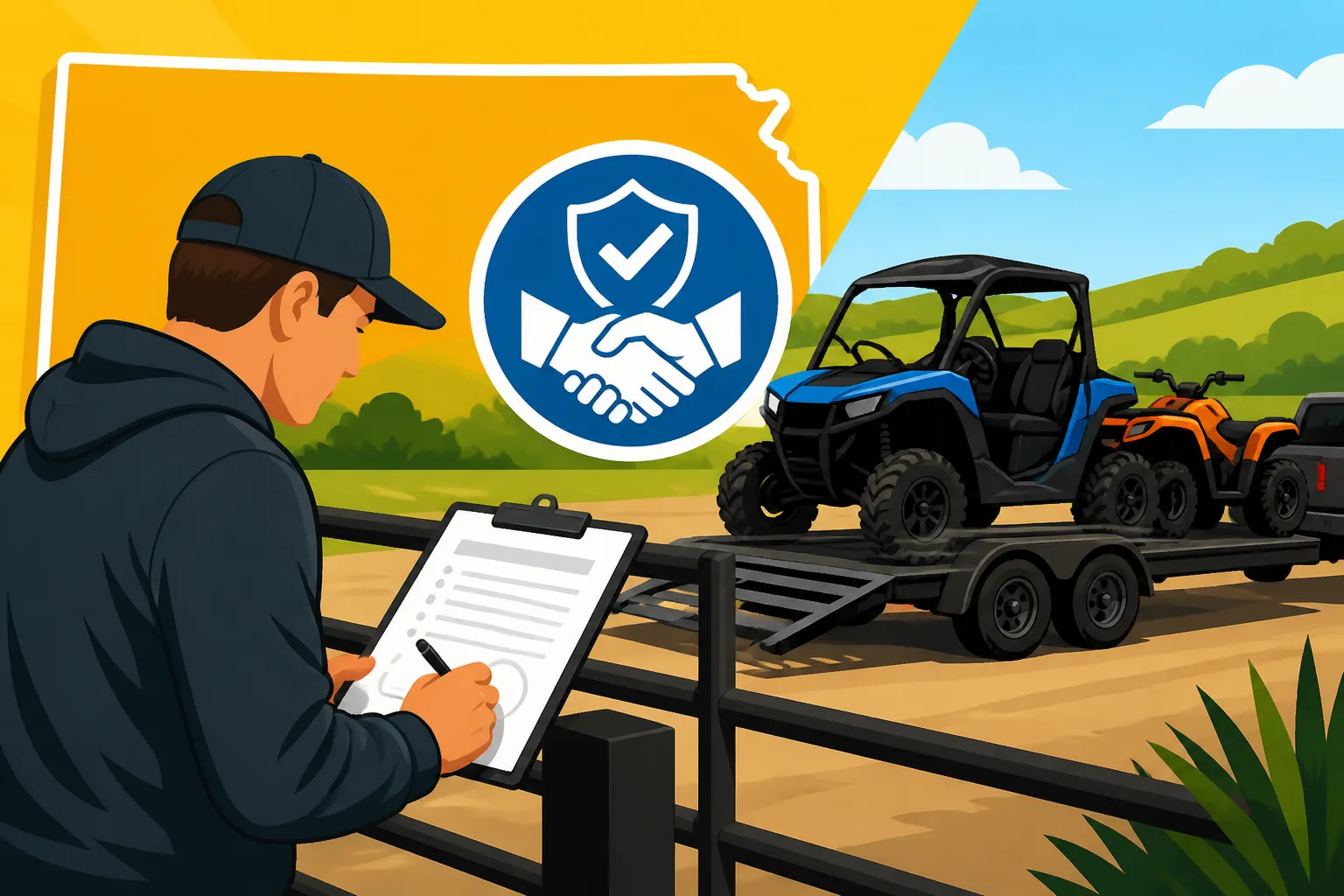
Signing a waiver at a Kansas riding park can feel like one more gate form between you and the trail. But a waiver is a private park’s agreement, not a state permit, and its terms can matter after you unload. Here’s what to check, what to ask about minors and insurance, and how to avoid signing before you understand the rules.
What a waiver at a Kansas riding park does
Private parks set their own entry conditions. A waiver may describe risks such as collisions, uneven terrain, changing trail conditions, equipment failure, or actions by other riders. It may also ask you to acknowledge those risks and agree to certain terms before you ride. The wording and process can differ from one property to another, so don’t assume a form you signed at one park covers your visit somewhere else.
A waiver is not the same thing as a state permit, an out-of-state registration, or proof that a machine is legal to ride on public roads. It is part of the park’s private entry process. Kansas’s state rules and a private park’s requirements are separate matters; see Kansas Has No State OHV Permit for the state-permit distinction and Kansas Private Park Waivers and Rules for the role park policies can play.
Nor should you treat a waiver as a guarantee that the park has no responsibilities or that you have given up every possible right. The legal effect of a particular form can depend on its language and circumstances. If a clause is unclear or the consequences could be significant, ask the park what it means or get qualified legal advice rather than guessing at the gate.
| Gate requirement | What it usually concerns | What to confirm |
|---|---|---|
| Waiver or release | Acknowledging risks and agreeing to stated terms | Who must sign, which activities it covers, and whether every rider needs a separate form |
| Park rules | Conduct, vehicle, passenger, and trail requirements | Whether there are posted rules beyond the waiver |
| Insurance requirement | Whether the park asks for proof of coverage | Which riders or machines need proof and what documents are accepted |
| Age or guardian form | Entry by a minor and the adult responsible for them | Who must be present and sign before the minor rides |
| Permit or sticker | A park-specific admission or identification requirement | Whether it is separate from the waiver and how to obtain it |
A signature does not automatically substitute for other conditions of entry. The park may separately require an admission pass, a particular safety item, proof of insurance, or compliance with vehicle and age rules. The state permit rules also do not replace a private park’s own conditions. If you’re visiting from another state, confirm what this specific park requires rather than assuming that a sticker or paperwork accepted elsewhere will be enough.
Read the form before you sign
At a busy entrance, it is tempting to sign quickly while other riders are waiting. Take a moment to read the complete form, including any rules incorporated by reference. If the waiver points to a separate rule sheet or a sign at the entrance, ask to see it before signing. You should know which activities, people, and machines the document covers.
Pay attention to language about risk, release of claims, responsibility for damage, and responsibility for other people in your group. Some forms may also cover activities beyond riding, such as using facilities or camping. Don’t assume the same terms apply to every activity; look for the form’s stated scope and ask if it is not clear.
Check that the names and details are accurate. If the form asks for each participant, don’t sign for people who are not included or assume one adult’s signature covers an entire group. If you are signing as a parent or guardian, make sure the form clearly identifies the minor and the adult signing for them. Ask the park how it handles a group arriving in separate vehicles or at different times.
Useful questions include:
- Does every rider need to complete a waiver, including passengers?
- Does the waiver cover only riding, or also camping and other park activities?
- Are there separate rules that I need to read before entering?
- If we leave and return, does the same waiver or admission process apply?
- Can I get a copy or take a photo of the completed form and posted rules?
A staff member may be able to explain the park’s process, but don’t ask staff to interpret the legal effect of a clause. If the form includes wording you do not understand, ask for a plain-language explanation of the park’s expectation. If you still cannot tell what you are agreeing to, pause before signing. You can decide whether to seek independent advice or skip the visit.
Keep a copy of anything you sign if the park allows it. A photo can help you recall the rules later, but it does not replace reading them at the entrance. Make sure you also note any verbal directions that affect where you may ride, park, or unload.
Check age, insurance, and riding rules for your group
A waiver for an adult does not necessarily satisfy the park’s requirements for a child. Parks may set their own minimum ages, supervision conditions, helmet policies, passenger limits, and forms for minors. Before leaving home, check the current requirements with the specific park. The linked pages on Kansas Private Park Age Minimums and Kansas Private Park Helmet Rules can help frame the questions to ask, but the park’s current rules control its entry process.
For a minor, confirm who must be present to sign and whether the park requires a parent or legal guardian rather than another accompanying adult. Ask whether the child needs a separate form, whether the adult must remain on site, and whether age requirements differ by machine or activity. Do not assume a child may ride simply because an adult has completed a waiver.
The same care applies to passengers. A machine may have a passenger seat but still be subject to park-specific rules about who may ride, the rider’s age, or required protective gear. Confirm that the machine is designed for the number of people on it and that the park allows that arrangement. Kansas Private Park Insurance Rules is a useful starting point for understanding why insurance questions can differ between parks.
If insurance is requested, ask what document will satisfy the requirement and whether it applies to every machine or rider. A policy card may not answer every question about exclusions or off-road use, so check directly with your insurer about the activity and location. Do not assume a waiver provides insurance, or that having insurance means the park will waive its own form.
Before unloading, match the waiver and park rules to the actual people and machines in your group. A change in plans—such as adding a passenger, swapping machines, or letting another person ride—can raise a new question about eligibility or coverage. Ask staff before making that change.
A practical gate checklist before unloading
You can make the entrance process less stressful by checking requirements before the trip and reviewing them again at the gate. Park policies can change, and a saved note from a previous visit may not reflect the current rules. Check the park’s official information or contact it directly before you tow, especially if you are bringing minors, passengers, or a machine that may be near a size or class limit.
Use this order when you arrive:
- Ask what is required for entry. Confirm whether the park wants a waiver, admission payment, insurance documentation, or any park-specific sticker or permit. Keep these requirements separate in your mind: a waiver is not a state permit.
- Review the waiver and rule sheet. Read the full form and any rules it incorporates. Check the people and activities covered, plus terms about risks, claims, damage, and responsibilities.
- Confirm the rules for every rider. Ask about minors, supervision, passengers, helmets, and any other safety requirements. Don’t assume one adult form covers all participants.
- Check vehicle and trail limits. Confirm that each machine is allowed and ask about designated areas, trail restrictions, and operating rules. For current conditions and access details, review Kansas Trail Conditions Before You Tow.
- Ask about insurance if the policy is unclear. Find out what proof the park accepts and check with your insurer about whether the policy applies to riding at that location.
- Keep the paperwork accessible. Save a copy of the waiver and any park instructions, and make sure the person operating each machine knows the relevant rules before leaving the staging area.
If you have a concern, raise it before unloading rather than after the machines are off the trailer. Staff may be able to answer practical questions about entry, routes, or age requirements. If the answer changes what you are agreeing to, take time to consider it. You are not required to treat a long line or an eager group as a reason to sign without reading.
Remember that a park waiver does not grant permission to ride on land outside the park. Public roads, state-managed land, private property, and the park’s own trails can have different rules. A waiver also does not prove ownership of your machine; keep relevant ownership documents with you as appropriate, and review Kansas Proof of Ownership on the Trail for that separate issue.
The simplest rule is to handle the waiver like any other agreement: understand the park’s requirements, check that the form accurately covers your group, and ask questions before you sign. If the park’s terms are not acceptable to you, the practical choice may be to leave the machine on the trailer and choose another riding option.
Disclaimer
This article is for general informational purposes only and does not constitute professional advice. Laws, prices and regulations vary by location and change over time. Consult a qualified professional for guidance on your specific situation.