Signs That Post an Exception
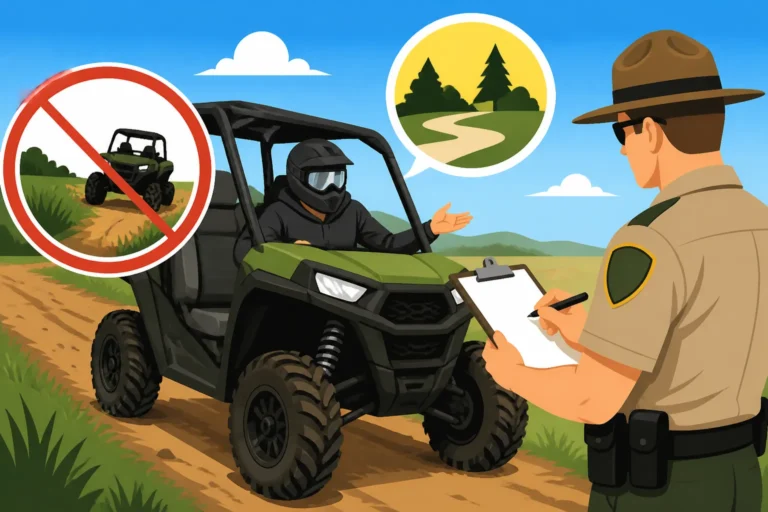
A sign at a Kansas park can look like permission to take an ATV or UTV somewhere beyond the usual road-and-parking-area limits. But the wording, location, vehicle type, and park rules all matter. Here’s how to read a posted exception, what it does not automatically allow, and what to confirm before you unload.
What a posted exception can mean
At a Kansas state park, an ATV or UTV permit should not be treated as an all-access trail pass. Permission to operate a machine may be limited to certain roads or parking areas, and a sign can identify a specific exception to a general restriction. The exception is only as broad as the authorized area and conditions it describes.
A sign might identify an approved route, allow a particular kind of vehicle to use a road, or set out conditions for access to a location. It might also do the opposite: close a route, prohibit a vehicle class, or limit use to a specific purpose. Read the complete message rather than relying on a word such as “open,” “access,” or “vehicles.”
The practical distinction is between a posted, authorized exception and an assumption. Seeing tire tracks, another rider, or an unsigned path is not the same as seeing an official sign that permits your machine to go there. And a sign that allows access to one road or area does not automatically authorize riding on adjoining trails, across grass, or through a closed section.
Kansas park permits and trail access are separate questions. The permit discussed in Kansas Park Permit vs Trail Permit is not a general trail pass. In areas where a park permit applies, it does not by itself mean you can leave designated roads and parking areas. A posted exception may change what is allowed in a particular place, but it does not erase other park rules or conditions attached to the permit.
| What you see | What it may tell you | What to check before riding |
|---|---|---|
| A sign naming a road or route | A specific route may be open to some vehicle use | Whether your machine is included and whether the route is open now |
| A sign naming a vehicle type | Access may be limited to that class or equipment | Whether your ATV or UTV fits the description |
| A sign with hours or dates | Permission may apply only during a set period | Whether the current time or season falls within those limits |
| A closure or “no vehicles” sign | The area or route is restricted | Whether another sign clearly establishes a valid exception |
| An unsigned track or worn path | It may be a maintenance route or informal track | Do not treat it as permission without confirmation |
The basic rule remains important even when you find a sign. Where a Park Road Permit Actually Lets You Drive explains the limited scope of road access, while Machines Must Stay on Wildlife Department Roads covers the difference between a designated road and open ground. If the sign’s meaning is not clear, stop and ask park staff before riding farther.
How to read the sign without overreading it
A useful way to interpret a sign is to identify its scope in four parts: who posted it, what area it covers, which vehicles it applies to, and what conditions it sets. If any part is missing or confusing, do not fill in the gap with a guess.
Identify who posted it
Look for the agency or park identification and whether the sign appears to be an official traffic or access sign. A sign placed by a landowner, event organizer, contractor, or private park may govern that property or activity, but it does not necessarily change rules on nearby public land. Likewise, a direction from a staff member about a temporary closure is not permission to ignore a posted restriction elsewhere.
If the sign is damaged, hidden, or appears inconsistent with another sign, treat that as a reason to pause. Do not assume that the more permissive sign wins. Ask the park office or staff member responsible for the area which instruction applies.
Find the precise area covered
A posted exception may apply only to the stretch of road immediately beside the sign, a named route, or an area marked on a map. It may not cover the entire park. Check for additional signs at intersections, gates, bridge approaches, parking areas, and route ends. A route that begins as permitted can become restricted after a junction.
Be especially careful where a road meets an unpaved track or open ground. Permission to travel along a road does not necessarily let you turn off onto a field, shoreline, utility path, or informal trail. If the route has no clear boundary, ask staff to identify where the permission ends.
Match the vehicle to the wording
A sign can authorize or restrict only certain types of vehicles. “Vehicle,” “off-road vehicle,” “ATV,” “UTV,” and “maintenance equipment” may not be interchangeable descriptions. An ATV and a side-by-side can be treated differently under Kansas rules, and some machines may fall into a distinct vehicle class. For background, see Four Off-Road Classes Kansas Law Treats Differently.
Consider the machine’s actual configuration, not just what you call it. A steering wheel, seating arrangement, width, or other design feature can affect its classification. If a sign names a class you are not sure your machine fits, confirm the classification before relying on that sign.
Check conditions, hours, and closures
A sign might limit access by time of day, season, direction of travel, or purpose. It may require that riders stay on a particular surface or use a route only to reach a designated place. Weather, maintenance, fire danger, or a temporary closure can also affect access. A route that was open on a previous visit may not be open on the next one.
Pay attention to smaller signs and posted notices near the main sign. A route can have a general access sign at its entrance and a temporary closure notice farther along. If signs conflict, the safe choice is to stop before entering the restricted section and ask park staff.
What an exception does not automatically allow
A posted exception is not a substitute for checking every rule that applies to your trip. It may address only one restriction, such as access to a particular road. It does not necessarily waive permit requirements, operating hours, equipment rules, or other limits.
For example, a sign allowing a machine on one park road does not automatically:
- Turn the road into an off-road trail.
- Allow travel beyond the signed route or into adjoining areas.
- Cancel a permit requirement that otherwise applies.
- Make an ATV or UTV street legal outside the park.
- Override a temporary closure or a separate sign prohibiting access.
- Give permission to cross private land or land managed by another agency.
- Establish that another state’s permit or sticker is accepted in Kansas.
Kansas park-road access should also not be confused with riding opportunities at a dedicated off-road area. A road-use permit and a riding-area pass serve different purposes; check the rules for the specific property you plan to visit. Kansas Has No State OHV Permit and Kansas Park Permit for a UTV provide related context, but the property’s current instructions still matter.
An exception is also not necessarily a right to ride at any time. If park access is limited to certain hours, a route sign does not automatically extend those hours. Check Kansas Park Road Use Sunrise to Sunset for the general timing issue, then confirm whether the location has a specific posted schedule.
Finally, do not assume that a sign on one property carries over to a neighboring one. State parks, wildlife areas, federal recreation land, county properties, and private riding parks can have different access systems. A sign authorizing use in one jurisdiction does not create permission in another.
What to do before you ride
When a sign seems to allow an exception, verify the details before unloading or entering the route. A short check can prevent a citation, a forced turnaround, or a long return trip with a trailer.
- Read every sign at the entrance. Look for the route name, vehicle type, restrictions, hours, and closure notices. Check both sides of a junction if the route divides.
- Confirm the machine’s classification. Use the manufacturer’s description and the applicable Kansas definitions rather than relying only on a familiar nickname.
- Check whether a permit applies. Do not assume the sign replaces a park permit or that an out-of-state sticker is accepted. Ask the office what applies to your machine and the specific property.
- Ask where the exception ends. If the sign is vague about the route boundary, have staff point out the permitted segment or show it on a park map.
- Check for temporary changes. Ask about maintenance work, closures, weather restrictions, and operating hours before you travel.
- Keep the answer specific. If staff confirms access, make sure the answer covers your vehicle, route, date, and intended use—not just whether “ATVs” are allowed somewhere in the park.
A photo of the sign can help you explain what you saw when calling the park office, but it is not a permit and does not prove that access is currently open. If the sign is unclear or contradicts information you received, do not ride into the uncertain area while waiting to sort it out. Follow the most restrictive instruction until park staff clarifies the rule.
For a permit question, Buying an Unconventional Vehicle Permit at a Park Office explains where to get guidance. You can also use Calling a State Park Office Before You Load Up to plan what to ask. Describe the exact location and the wording on the sign, and give staff the machine’s type and configuration. Those details are more useful than asking whether Kansas generally allows UTVs on trails.
The safest reading is straightforward: a posted exception may authorize a specific use in a specific place, but it is not a blanket invitation to ride anywhere nearby. Follow the sign’s exact limits, keep to the route it identifies, and confirm any uncertainty with the property manager before proceeding.
Disclaimer
This article is for general informational purposes only and does not constitute professional advice. Laws, prices and regulations vary by location and change over time. Consult a qualified professional for guidance on your specific situation.