Machines Must Stay on Wildlife Department Roads
Kansas’s unconventional-vehicle permit can be easy to misread: permission to use a road does not mean permission to ride off-road. If you are taking an ATV, UTV, or other machine onto Kansas Department of Wildlife and Parks land, the key is to identify which routes are open to your machine—and stay on them. This article explains how to check access before unloading.
What “Department Roads Only” Means
When a rule says machines must stay on wildlife department roads, treat “road” as a specific, authorized route—not a general invitation to travel wherever a vehicle can fit. A department road is one the Kansas Department of Wildlife and Parks (KDWP) has designated or made available for vehicle use on the property in question. A path, mowed strip, trail, field edge, or opening between trees does not become a road simply because it looks passable.
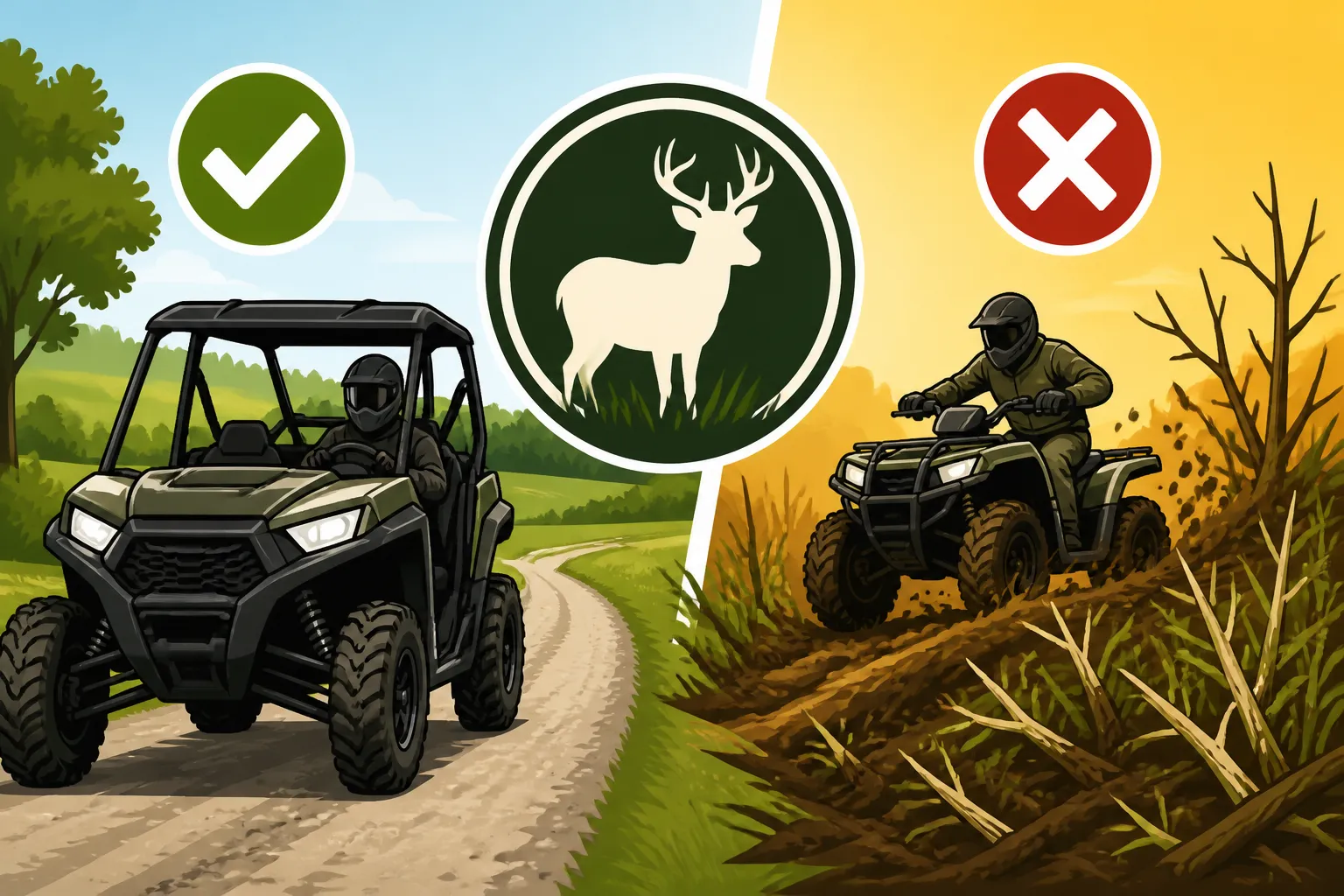
The practical boundary is straightforward: operate on a road that is open to your type of machine, and use designated parking areas when you stop. Do not leave the route to follow a shortcut, reach a picnic spot, avoid a muddy section, or explore a nearby trail. If a road ends or a sign closes it, do not continue across the grass or onto a path to get around the restriction.
That distinction matters because public access does not mean unrestricted motorized access. A wildlife area, fishing access site, or state park may be open to visitors while still restricting where vehicles can travel. The land manager may need to protect habitat, control erosion, keep access clear for other visitors, or close roads in certain conditions. Those purposes are not always obvious from the driver’s seat.
Roads, trails, and vehicle access are different things
A route can look like a road and still be closed to motor vehicles. It may be a maintenance route, a footpath, a firebreak, or an access lane reserved for department staff. Conversely, a road that appears rough or lightly used may still be the designated route for permitted vehicles. Follow signs, barriers, and current property information rather than judging access by tire marks or surface condition.
A trail is not automatically a road, even if it is wide enough for a UTV. Nor does a route become legal for machines because another rider used it. The same caution applies to parking: pull into an established or signed parking area rather than creating a place to stop on vegetation or blocking a road.
The rule also applies when there is no obvious alternative. If a route is blocked by standing water, a fallen tree, a locked gate, or a washout, do not leave the road to get past it. Turn around if it is safe, then contact the land manager for guidance. A rough or inconvenient road is not permission to use an unauthorized route.
For broader context on where machines are allowed on public property, see Kansas KDWP Land Rules for Machines and Kansas Department Road Riding Rules. Those distinctions are useful because road access, trail access, and general land access are separate permissions.
A permit is not a map of every open road
A permit can establish that a machine is eligible for certain use, but it does not necessarily identify every road that is open or override a closure. You still need to confirm the rules for the particular property and route. The sign at a gate, a posted closure, or a land manager’s current instruction can limit access even when you have a valid permit.
That is the central point of The Park Permit That Covers Roads, Not Trails: a permit should be understood by its actual scope. It is not a trail pass, an all-access pass, or permission to cross land wherever a route would be convenient.
How the Permit Fits With Road Access
Kansas does not have a single statewide OHV trail pass that automatically grants access to every public riding area. Permits, road rules, and land access are distinct questions. Before a trip, establish which agency manages the property, what permit applies to the machine and activity, and which roads are open.
A permit associated with unconventional vehicles on department property may apply to particular roads or areas, not to every KDWP property and every route. Do not assume that a permit bought for one state park covers a wildlife area, or that permission to drive a park road lets you ride a nearby trail. Confirm the permit’s current terms and the property’s restrictions with KDWP or the office responsible for the site. Kansas Unconventional Vehicle Park Permits explains the permit category; Kansas Park Permit vs Trail Permit helps separate road permission from trail access.
The machine’s classification also matters. An ATV, UTV, golf cart, and other unconventional vehicle may not be treated identically under Kansas rules or a property’s local restrictions. A permit for one category does not necessarily cover another. If you are unsure which category fits your machine, confirm the classification before you travel; Four Off-Road Classes Kansas Law Treats Differently provides a useful overview.
| Question | What to verify before riding |
|---|---|
| Who manages the property? | Confirm whether it is a state park, wildlife area, or another type of public or private land. |
| Is a permit required? | Check the current requirement for that property, machine, and use. |
| Which routes are open? | Identify roads open to your type of machine; do not assume trails are included. |
| Is the route currently available? | Check signs, closures, gates, and current instructions from the land manager. |
| Does your machine qualify? | Confirm its class and any property-specific limits. |
| Where can you stop? | Use designated parking areas and avoid blocking roads or access points. |
Reciprocity does not create access
A sticker, permit, or registration from another state does not by itself authorize riding on Kansas department roads. Nor does a Kansas permit grant permission to ride on land managed by another state or agency. Access depends on the rules for the specific property and the machine being used.
Visitors should check the property’s requirements rather than treating an out-of-state document as a substitute. Kansas’s approach to visitors and permits is covered in Kansas Requires No Sticker of Visitors, while the broader question of what Kansas does and does not require is discussed in Kansas Has No State OHV Permit. Neither point should be read as open access to department roads: road and land restrictions still apply.
Check before you head to the property
A quick phone call or review of current property information can prevent a wasted drive. Ask a focused question: “Is this machine allowed on the roads at this property, and which roads are open today?” Give the staff the machine type and the specific location you plan to visit. If you are asking about an unconventional-vehicle permit, ask whether it applies to that location and route.
For a park permit, do not rely on an old receipt, a sign remembered from a previous trip, or another rider’s description. Permit requirements and access conditions can change. Buying an Unconventional Vehicle Permit at a Park Office describes the permit process, and Calling a State Park Office Before You Load Up is a helpful reminder to confirm details before towing.
How to Plan a Legal Route
Good route planning starts before the machine comes off the trailer. A map can help you understand the property, but the map is not permission to ride every line shown on it. Combine current property information with posted signs and directions from the land manager.
Use this sequence:
- Identify the property and its manager. Confirm the exact location, not just the nearest lake, town, or recreation area. Different properties can have different rules even when they are close together.
- Ask which permit or authorization applies. Describe your machine accurately and explain what you intend to do. Ask whether the permit covers the property and the type of road use planned.
- Confirm the open routes. Find out which roads are open to the machine and whether any closures, seasonal restrictions, or local instructions apply.
- Plan a route that stays on those roads. Note where the road begins, where it ends, and where you can turn around or park without leaving the authorized route.
- Check signs when you arrive. A posted sign or barrier may reflect a restriction that is not obvious on an older map. Follow it even if a route appeared open during planning.
- Recheck conditions during the visit. If a road is closed, blocked, or unsafe, do not invent a detour. Stop and contact the land manager if you need help.
Use maps as planning tools, not permission
A property map may show roads, access points, parking areas, water, and boundaries. It can help you avoid getting lost and recognize when you are approaching a restricted area. But a line on a map does not always mean that the road is currently open to your machine. Maps may also include routes intended for staff or other users.
If phone service may be limited, save or print the map before leaving home. A paper copy can be useful when a phone battery dies or a signal drops. A waterproof map sleeve from an outdoor retailer such as Amazon can help protect a printed map from dust or rain, but it does not replace signs or current access information.
Mark the authorized route, the place where you plan to park, and a sensible turnaround point. Avoid planning a loop that depends on crossing an unverified trail or using an unmarked connector. If the map does not make the route clear, ask the property office before unloading.
Treat signs and closures as controlling instructions
Signs can indicate that a road is closed to all vehicles, open only to certain users, or restricted for a particular period. A barrier is not an invitation to find another way around it. Never ride beside a gate, through a gap in a fence, or over vegetation to reach the other side.
Closures may be temporary. Weather, maintenance, habitat protection, construction, or safety concerns can affect access. A road that was open during an earlier visit may not be open now. If a sign conflicts with an old map or an online description, follow the sign and seek clarification from the property manager.
Do not assume that an unsigned route is automatically open. Where the allowed route is unclear, stop before entering and confirm. That is especially important at junctions where a department road meets a trail, private access lane, or route that continues beyond the property boundary.
Keep the machine and papers ready
Carry any permit or proof the property requires, and keep ownership documents accessible if the rules or circumstances call for them. Do not assume the presence or absence of a tag determines whether a road is open. A permit, title, registration document, and land-access authorization serve different purposes.
Before departure, make sure the machine is suitable for the planned route and can be operated safely. Check tires, steering, brakes, lights, fuel, and any essential safety equipment. If the route is narrow or uneven, confirm that the machine can turn around without leaving the road. The goal is not just to reach a destination; it is to remain within the authorized route throughout the trip.
Common Situations That Lead Riders Off the Road
The rule is easiest to follow when the route is clear and the road is in good condition. Problems arise when riders improvise. Thinking through common situations beforehand helps prevent a small inconvenience from turning into an access violation.
The road is muddy or flooded
A muddy road does not make the adjacent grass a legal bypass. If the surface is unsafe, stop where it is safe to do so and assess whether you can turn around on the road. Do not drive across a field, shoreline, or vegetation to avoid a rut. Leaving the road can damage habitat and may put the machine into deeper trouble.
If you cannot proceed safely, turn back or contact the land manager. A closure or hazard is a reason to change plans, not a reason to create a new route.
The road seems to end at a trail
Do not assume a trail is an extension of the road. Stop at the junction and check the signs or map. If the trail is not clearly authorized for your machine, do not enter it. Even if another vehicle has left tracks, those tracks do not establish that the route is open.
When you are not sure whether the route is a road or a trail, take the conservative option: remain on the clearly identified road and ask the property office for direction.
A gate is closed
A closed gate means you should not continue through it or around it. Do not squeeze the machine beside the gate, lift it over a barrier, or use a nearby path to get past. If access is important to your trip, contact the land manager and ask whether another authorized road is available.
A gate may also mark a property boundary. Crossing it without permission could take you onto land with different rules, including private land. Confirm where the boundary lies before proceeding.
You need to stop or turn around
Use a designated parking area where available. If you must stop briefly because of a mechanical problem or safety concern, avoid blocking the road and do not move off-road to find a more comfortable place. When a turnaround is needed, use a wide, safe spot on the authorized road or return to a designated parking area. Do not use a trailhead or open ground as a turning loop unless it is clearly permitted for that purpose.
You are hunting or fishing
A hunting or fishing purpose does not automatically expand where a machine may travel. Access to a department road and access to an off-road location are separate issues. Do not ride across fields, through vegetation, or down an unauthorized path to reach equipment, a blind, a fishing spot, or game. Check the property’s rules for the activity as well as its vehicle restrictions.
Before You Unload: A Practical Checklist
A few minutes of checking can prevent a long drive from ending at a closed road. Use this checklist whenever you plan to ride on KDWP property:
- Confirm the property. Make sure the location and managing agency are clear.
- Check the permit. Verify whether the permit applies to the property, your machine, and your intended use. Do not treat a permit as general trail access.
- Confirm the road. Identify the specific department roads open to your machine.
- Check current notices. Look for temporary closures, restrictions, and posted signs.
- Plan parking and turnaround points. Avoid routes that depend on an unverified trail or an off-road detour.
- Carry needed documents. Keep required permit or ownership paperwork accessible.
- Bring a route backup. Save a map or contact information in case phone service is unavailable.
- Be ready to turn around. If the route is closed, blocked, or unclear, do not continue off-road.
A trip may still be worthwhile if the available road is shorter than expected, but it is better to know that before towing. If the main goal is trail riding, look for a location that explicitly allows motorized trail use instead of assuming department roads provide it. For more detail about permitted areas and the limits of road-only access, see Kansas Wildlife Area Machine Rules and The Trail Pass Kansas Does Not Sell.
Frequently Asked Questions
Does a Kansas permit let me ride trails on wildlife department land?
Not automatically. A permit may authorize particular road use, but it does not necessarily allow trail riding. Confirm the rules for the exact property, machine, and route.
Can I go around a closed road on the grass?
No. Do not bypass a closure by crossing vegetation, entering a field, or taking an unverified path. Turn around or contact the land manager.
If a road is shown on a map, can I ride it?
Not necessarily. Maps help with planning, but current signs, closures, and property instructions determine whether a route is open to your machine.
Does an out-of-state permit authorize riding on Kansas department roads?
Do not assume so. Check the Kansas property’s current requirements and the route’s restrictions. An out-of-state document does not create access where Kansas rules do not allow it.
Disclaimer
This article is for general informational purposes only and does not constitute professional advice. Laws, prices and regulations vary by location and change over time. Consult a qualified professional for guidance on your specific situation.