Kansas Private Park Age Minimums
A child’s age can determine whether a Kansas off-road park will let them ride, drive, or even enter certain areas—but there is no single age rule for every private park. The practical answer is to check the specific park’s current policies and separate its admission rules from Kansas law, machine requirements, and supervision expectations.
Why age minimums vary between Kansas private parks
Kansas private riding parks set their own operating policies. A statewide age rule for one park should not be assumed to apply at another, and a park’s rules can be stricter than the basic legal requirements for operating a machine. Before making plans, check the current rules for the particular property you intend to visit.
That matters because “minimum age” can mean several different things:
- The youngest age allowed on the property
- The minimum age to operate a particular type of machine
- The minimum age to ride as a passenger
- The minimum age to ride without direct adult supervision
- The age at which a participant can sign a waiver
- The age at which a young person can enter or use certain facilities
A park might allow a child on the property with a parent but set separate limits on driving. It might permit a young passenger only on a machine designed for passengers. Another park might use different rules for different machines, trails, or activities. These are examples of the kinds of distinctions to ask about, not claims that every park uses them.
Kansas riding areas include private facilities such as Kansas Rocks Recreation Park and Syracuse Sand Dunes. Each operator’s rules apply at its own property. A rider who has been accepted at one park is not automatically eligible to ride at another. For a broader look at how privately operated sites set conditions for entry, see Kansas Private Park Waivers and Rules.
Age limits are also only one part of eligibility. A park can have separate requirements for helmets, passenger seating, supervision, insurance, waivers, or machine condition. Read the policies as a whole rather than looking for a single age number and assuming it answers every question. Kansas Private Park Helmet Rules and [Kansas Private Park Insurance Rules] cover two other requirements that may affect a youth outing.
If you are comparing destinations, use the park’s own posted rules or contact its staff directly. Online summaries can help you identify what to ask, but a specific policy may change, and a general rule for “Kansas parks” cannot substitute for the operator’s current requirements.
The age question depends on what the young rider will do
When asking about a child’s eligibility, describe the planned activity precisely. “Can my 12-year-old come?” is less useful than explaining whether the child will drive a youth ATV, ride as a passenger in a side-by-side, or accompany an adult without operating a machine.
Driving a machine
Ask whether there is a minimum age for operating the machine the child will bring or rent. If the park has different rules by vehicle type or size, give the staff the make, model, and relevant details. A child’s age alone may not tell the park whether that particular machine is permitted for them.
Do not assume that a youth-sized quad is automatically suitable or allowed for every child. Fit, experience, control of the machine, trail conditions, and the operator’s policies all matter. A child who can reach the controls in a yard may still struggle with uneven terrain, tight turns, traffic on a busy trail, or an emergency stop.
For help thinking through age and supervision questions outside a park’s own policy, see [Kansas Rules for a Ten-Year-Old Rider], [Kansas Rules for a Fourteen-Year-Old Rider], and Kansas Parent Riding With a Child. Those topics can help frame the discussion, but they do not replace the park’s rules.
Riding as a passenger
Passenger eligibility is not simply a younger version of driver eligibility. Ask whether the park permits children as passengers, whether it sets a passenger age or size requirement, and whether the machine must be designed and equipped for passengers.
A passenger should have an appropriate seat, secure handholds or other designed restraints, and a way to keep feet and legs inside the vehicle. Do not carry a child on a machine that was built for only one rider, even if the child seems small enough to fit. The park may have specific passenger policies, and the machine manufacturer’s capacity and seating instructions matter as well.
For side-by-sides, confirm whether the child can use the available seat and restraint properly. A lap belt that does not fit correctly, or a seat too large for the child to sit securely in, is a reason to rethink the ride. Ask whether a child car seat or booster is allowed before bringing one; do not assume that a standard automotive seat is compatible with an off-road vehicle.
Attending without riding
If a child will not operate or ride on a machine, ask whether they may enter the property and where they may go. A park may have rules for children in the staging area, around moving machines, or near a trail. A child who is only watching still needs close supervision around trailers, loading ramps, pits, and busy parking areas.
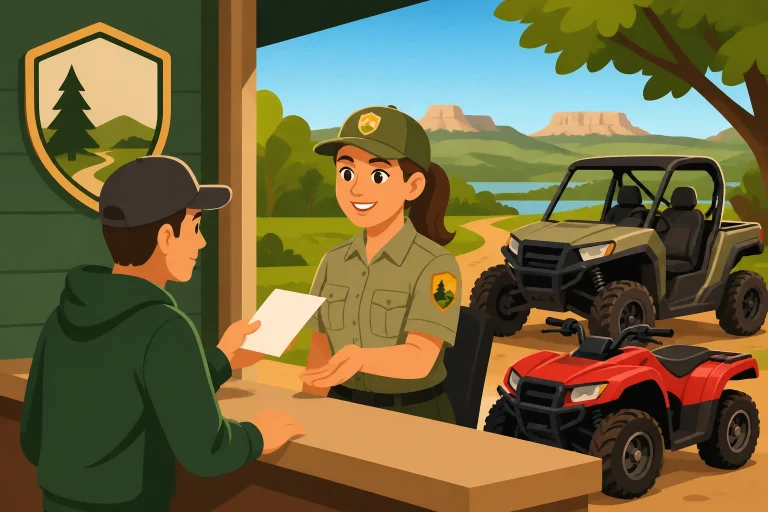
Confirm whether the child must be listed on a waiver or accompanied by a parent or legal guardian. A park’s rules for attending, signing paperwork, and riding may differ, so get an answer for each activity rather than treating admission as permission to participate.
What to confirm before you leave home
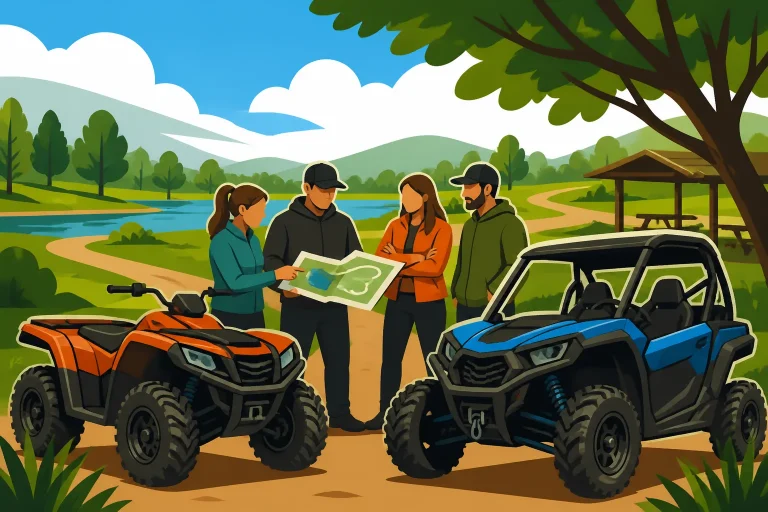
A quick call or message to the park can prevent a long drive with a child who cannot take part. Ask about the child’s planned role, the specific machine, supervision, required documents, and any age-related restrictions. If you receive a general answer, follow up with the details that could change it.
Use this checklist:
- Name the child’s age and activity. Say whether they will drive, ride as a passenger, or attend without riding.
- Identify the machine. Give the type and model, and explain whether it is a youth ATV, adult ATV, dirt bike, or side-by-side.
- Ask about age limits by activity. Check for separate requirements for operators, passengers, and non-riding visitors.
- Confirm supervision rules. Ask whether the parent must ride with the child, stay nearby, or accompany them throughout the property.
- Check waiver and consent procedures. Find out whether a parent or legal guardian must complete paperwork and whether all participants need to be named.
- Ask about safety equipment. Confirm what the park requires and whether a child’s equipment must meet particular standards.
- Check route or machine restrictions. Ask whether certain trails, areas, or vehicle types are off-limits to younger riders.
- Ask whether the rules have changed. Use the park’s current information rather than relying on a previous visit or an old social-media post.
Write down the answer and the date you received it, especially if staff gave guidance over the phone. That is not a substitute for following posted rules at the gate, but it makes it easier to spot a misunderstanding before traveling.
If the child is close to a minimum age, ask how the park applies the rule. Does the child need to have reached that age before arrival? Does the rule depend on the activity or machine? Is there any difference between a supervised ride and independent operation? Do not interpret an unclear answer in the most permissive way. Ask for clarification.
It is also sensible to discuss the child’s experience honestly. Tell staff if the young rider is new to off-road riding, has only used a small machine, or has not ridden on trails. A park’s willingness to admit a rider does not mean every route is appropriate for that rider. Start with a conservative plan and be prepared to stop if the conditions or the child’s confidence make the ride unsafe.
For preparation beyond age limits, Kansas Safety Course Options can help families consider structured instruction. A course does not override a park’s minimum age or admission policy, but it may help a young rider build skills before attempting a more demanding setting.
Parents, waivers, and out-of-state visitors
A parent’s presence does not automatically waive a park’s age minimum. Supervision may be required, but it is not a guarantee that the child can drive or ride. Ask whether the park’s age policy has a supervision exception, and get the answer from the operator rather than relying on another visitor’s experience.
The parent or legal guardian may also need to handle paperwork for a minor. Ask who must sign, whether the minor needs to be named, and whether the parent must be present at check-in. If a relative, family friend, or coach is bringing the child, do not assume that an informal permission note will meet the park’s requirements. Confirm in advance what authorization the operator accepts.
For out-of-state families, the same practical step applies: check the Kansas park’s own requirements before traveling. A rule at a riding facility in a neighboring state does not establish what a Kansas operator will allow. Likewise, permission to ride at a Kansas private park does not create a general right to ride elsewhere in Kansas.
A private park’s rules govern participation on that property, while other laws and access rules may apply outside it. A park admission or waiver does not make a machine street legal, open public land to riding, or replace any permit that may be required for a separate location. Kansas does not offer a general state OHV trail pass; the scope of any permit depends on the place and activity. For the distinction between public-land permissions and park entry, see Kansas Park Permit vs Trail Permit and Kansas Has No State OHV Permit.
Before crossing state lines with a machine, check what documents and equipment the park expects and how you will transport it. Confirm the machine is allowed at that property, and do not rely on a vehicle’s title or a permit from another place as evidence that a child meets the park’s participation rules.
If the child is not allowed to ride, ask whether the park offers a spectator option or whether the whole group should choose another activity. Do not bring a child expecting to work around a rule at the gate. A clear answer in advance is easier on the family and the park staff.
If your child does not meet the park’s minimum
If the answer is no, treat it as a firm limit unless the operator clearly explains an applicable exception. Do not try to solve the problem by putting the child on a different machine, calling them a passenger, or having an adult sign paperwork without the park’s approval. Those changes may create safety and liability problems without making the activity permissible.
Consider these alternatives:
- Choose a park that confirms the child is eligible for the planned activity.
- Ask whether the child may attend as a spectator under the park’s supervision rules.
- Use a suitable private property only with the landowner’s permission and appropriate safety planning.
- Wait until the child meets the age requirement, while building skills in an appropriate setting.
- Plan a separate outing for the child and adult riders rather than leaving eligibility uncertain.
When comparing parks, ask the same questions of each operator. Do not compare only the minimum age: check passenger rules, machine restrictions, supervision, protective equipment, waivers, and trail difficulty. A park with a lower stated age limit is not necessarily the best choice for a beginner or for a child whose machine does not fit the available terrain.
If a child is permitted to ride, set expectations before reaching the trail. Agree on how the family will communicate, when to stop, and what to do if the child feels tired or overwhelmed. Keep the first outing modest, use routes that match the child’s ability, and avoid treating an age minimum as proof of readiness. The park’s permission is a starting point, not a substitute for judgment.
Policies are ultimately property-specific. Confirm the latest age and participation rules with the park before every visit, particularly if you have not been there recently or are bringing a different machine.
Frequently Asked Questions
Is there one minimum age for every Kansas private riding park?
No. Private parks set their own policies, and rules may differ by activity, machine, and supervision. Confirm the current requirements with the specific operator.
Can a parent’s supervision let a child ride below the posted minimum age?
Not unless the park explicitly allows that arrangement. A parent should ask the operator rather than assuming supervision creates an exception.
Does a child passenger have to meet the same age rule as a driver?
Not necessarily. Parks may distinguish between driving and riding as a passenger. Ask about both, and make sure the machine is designed to carry a passenger safely.
Does an out-of-state rider follow their home park’s age policy in Kansas?
No. Check the Kansas private park’s rules for the activity you plan to do. A policy from another state or facility does not determine eligibility at that property.
Disclaimer
This article is for general informational purposes only and does not constitute professional advice. Laws, prices and regulations vary by location and change over time. Consult a qualified professional for guidance on your specific situation.