Getting Cited for Leaving a Kansas Park Road
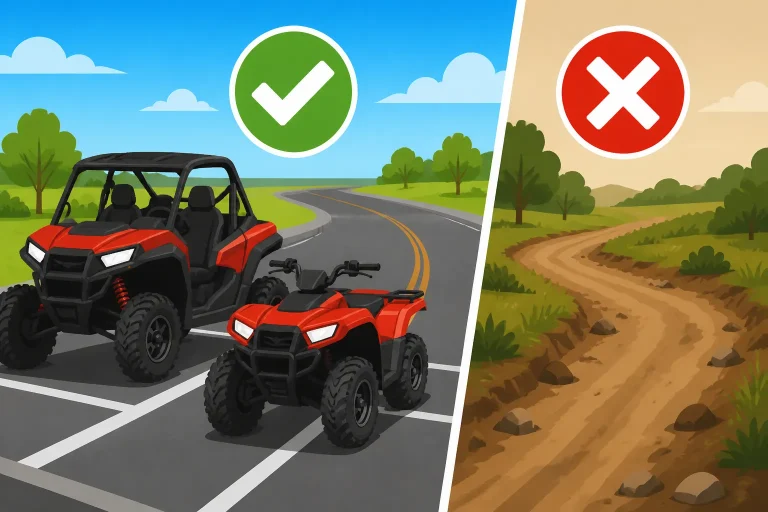
A Kansas park permit can be easy to misunderstand: it may allow a covered machine on designated park roads without opening the trails, shoreline, or grass beside them. If you’re cited after leaving a road, the next steps are to understand what route was authorized, preserve the details of the stop, and respond by the deadline on the citation. Here’s how to do that—and how to avoid a repeat.
What “Leaving the Park Road” Can Mean
A park road may feel like one part of a larger riding area, but permission to drive on a road is not automatically permission to ride anywhere inside the park. For a covered unconventional vehicle, a permit may allow use of specified roads and parking areas, subject to posted restrictions and park rules. It does not turn the entire property into an OHV trail system.
That distinction matters when you pull onto a grassy shoulder, cut across a field to reach a campsite, follow a track toward the water, or continue along a path that looks like a trail. Even a short detour can be treated differently from travel on an authorized road. The fact that the ground is open, a tire track is visible, or another rider has used the route does not necessarily mean it is approved for your machine.
The central question is usually not whether you had a park permit at all. It is whether your machine was allowed on that particular route, at that time, under the signs and rules in force. A permit may cover a vehicle category and a limited kind of park access, while the actual route still determines whether the ride is permitted. The Park Permit That Covers Roads, Not Trails explains that distinction in more detail.
Common ways riders stray from an authorized route
A rider may leave the road deliberately, or without realizing that a route has ended. Common situations include:
- Cutting across grass to avoid a longer road route
- Driving on a trail that appears to connect two roads
- Using a maintenance road or access track that is not open to public vehicle use
- Riding on a shoreline, beach, or grassy area near a lake
- Taking a shortcut to a boat ramp, fishing spot, or campsite
- Continuing past a closure sign, gate, or barrier
- Following another vehicle onto a route without checking whether it is authorized
- Parking off the paved or marked area and riding away from the vehicle
The route can be confusing when a park has multiple types of users. A path used by hikers, bicycles, maintenance crews, or other authorized vehicles does not necessarily qualify as a route for your ATV or UTV. Similarly, a road that is physically passable may still be closed to your machine or restricted to a particular purpose.
A park permit is not a trail pass
Kansas does not generally operate state-park OHV trails in the way many riders expect from a dedicated riding park. Park-road access, where allowed, is a different thing from trail access. A permit for use on roads does not by itself authorize riding across a wildlife area, off the marked route, or onto a trail that is not open to your vehicle.
Before you unload, check the rules for the specific park and machine. The permitted route may be narrower than you assume, and rules can differ by location. Kansas Park Permit vs Trail Permit and Kansas Wildlife and Area Machine Rules are useful starting points for separating park-road permission from other types of access. For the road-use limits themselves, see Kansas Department Road Riding Rules.
What to Do If You Receive a Citation
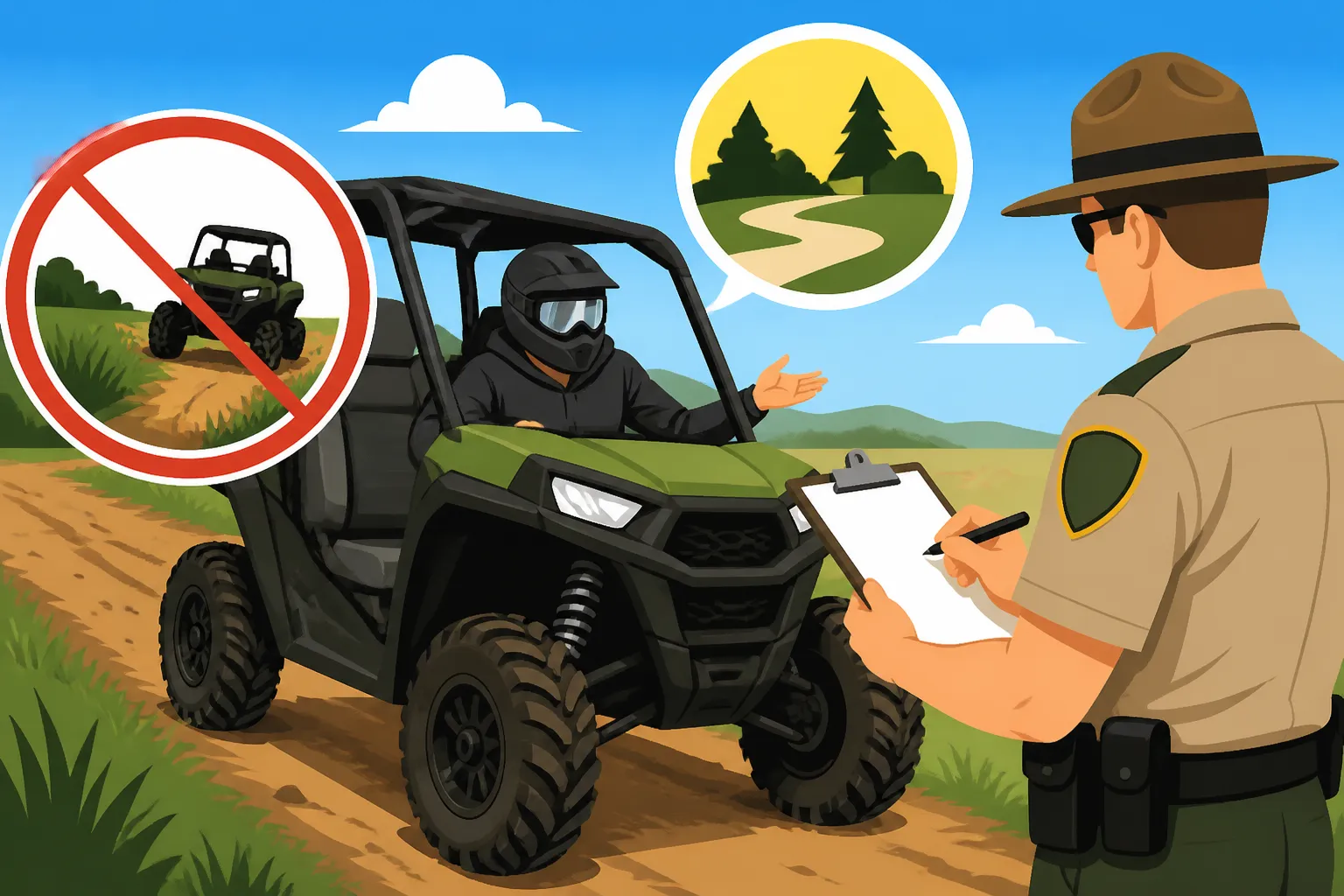
A citation is stressful, particularly if you thought you were following the rules. Try to keep the discussion at the roadside calm and factual. You do not need to settle every disagreement during the stop. Your priority is to understand what you are being accused of and preserve information that may help you respond later.
At the stop
Ask politely which rule or restriction the officer believes was violated. If the officer points to a sign, gate, road, or location, take note of its position and wording. If it is safe and allowed, record the details while they are fresh:
- The date and approximate time
- The park and the location of the stop
- The road or route you were using
- Where the officer says you left the authorized route
- The sign, barrier, or boundary involved
- The name or identifying information of the issuing agency
- Any witnesses who saw the route or the stop
- Any directions the officer gave you about the citation or next steps
Read the document before you leave. Check the stated violation, the court or agency named on it, the response deadline, and the instructions for payment or contesting the charge. Do not assume that paying is the only way to close the matter, or that a conversation with a park office replaces the response required by the citation. The document and the court or issuing authority’s instructions control what you need to do next.
If you cannot understand a direction or a deadline, contact the number or office listed on the citation promptly. Keep a record of who you spoke with and when. Avoid relying on an informal assurance from someone who is not responsible for processing the citation.
Preserve the route evidence
As soon as practical, write down exactly where you were and how you got there. A route that felt obvious at the time can be hard to reconstruct later. Use a map, saved navigation track, photographs, or notes to identify the road, turn, and location of the stop. Keep the original files when possible, rather than editing or cropping them.
Photograph signs and barriers from a safe, lawful location. Capture the sign itself and enough surrounding detail to show where it stands in relation to the road. A close-up that shows the wording but not the location may be less useful than a wider photo that provides context. Do not trespass, pass a barrier, or return to a closed area just to take pictures.
If other people were with you, ask them to make their own notes while they remember what happened. Do not coach them to use the same wording. Independent accounts are more useful than a shared story assembled later.
Follow the citation’s process
The response options and consequences depend on the specific citation and the authority handling it. Read the instructions carefully, respond by the stated deadline, and keep copies of anything you submit. If the citation involves a court appearance, a substantial potential consequence, a disputed boundary, or a possible impact on your record, consider getting advice from a qualified attorney.
A park employee may be able to explain where a route is open or how the park manages its roads, but that conversation does not necessarily dismiss a citation. If you want to challenge the allegation, follow the process identified on the citation. Appealing a Citation Written Inside a Park covers the practical questions to sort out before you decide how to respond.
How to Check Whether a Route Was Authorized
The most useful check is the route information for the particular park, not a general assumption about what a permit allows. Rules can depend on the park, vehicle type, road status, signs, and any approved exception. A permit or a conversation at the entrance does not necessarily override a closure or a route-specific restriction.
Check before unloading
Before your trip, identify where the machine may be driven and where it must stay parked. If the park’s information is unclear, contact the park office and describe the machine accurately. An ATV, side-by-side, golf cart, and other unconventional vehicle may not all be treated alike. Ask about your specific vehicle and the route you intend to use, not simply whether “ATVs are allowed.”
Useful questions include:
- Is this type of machine permitted at this park?
- Does the permit allow travel on all open park roads, or only particular roads?
- Are parking areas included?
- Are there roads or sections closed to this vehicle type?
- Is there a route to the campground, boat ramp, or other destination?
- Are there temporary closures, seasonal restrictions, or posted exceptions?
- Is there a map or written rule I can review before riding?
Make a note of the answer and who provided it. If staff direct you to a particular route, ask whether that direction is an approved exception and whether it applies to your planned trip. Calling a State Park Office Before You Load Up can help you prepare for that conversation.
Read every sign, including signs at junctions
A sign at the entrance may establish general park rules, but it may not describe every restriction farther inside. Pay attention at road intersections, gates, ramps, and places where a paved or gravel road appears to continue as a narrower track. Look for closure notices, vehicle restrictions, one-way directions, and instructions about parking or access.
Do not assume a road remains open because it was open earlier in the day. Conditions and restrictions can change, and a temporary closure may be marked at a junction rather than at the park entrance. If a sign is missing, obscured, or difficult to interpret, stop and seek clarification rather than guessing.
A GPS route or phone map is useful for navigation, but it is not proof that a road is legally open to your machine. Navigation apps may display maintenance roads, hiking paths, private routes, or tracks that are not approved vehicle routes. Treat them as aids to orientation, not as permission.
Ask about exceptions before using one
There may be situations where a park allows a machine to use a route for a specific reason, such as reaching a designated area. Do not assume an exception applies simply because the destination is nearby or the detour seems reasonable. Ask a park official before taking the route and find out exactly where the authorization begins and ends. Getting a Park Manager to Approve an Exception discusses why it is important to get clear permission rather than relying on a casual assumption.
If you are told that an exception is allowed, make sure you understand any conditions. It could apply only to a particular destination, route, time, or task. Permission to reach one location does not necessarily allow riding around the surrounding area.
How to Avoid Another Citation
Good route planning is simpler than trying to explain an avoidable shortcut after the fact. Build the trip around the roads that are clearly open to your machine, and treat anything uncertain as off-limits until the park confirms otherwise.
Plan the route and turnaround points
Before leaving the parking area, identify the road you will follow, the destinations you can reach on it, and where you will turn around. Make sure everyone in your group understands that the permitted route does not include nearby grass, trails, or shoreline. If a rider needs to turn back, agree on a meeting point that is on an authorized road or in a designated parking area.
A printed map can help if cell service drops or a phone battery runs low. A weather-resistant map case can keep a paper route map readable in dust or rain; Amazon is one place people look for that kind of basic accessory. If you use a digital map, download the information in advance and carry a way to recharge your phone. Amazon also carries portable battery packs, but whatever source you use, test the pack and cable before the trip rather than discovering a problem on the road.
Keep a copy of the park’s route information with your other trip documents. A simple folder or clear sleeve can protect it from dirt and water; Amazon is another possible source for a document sleeve if you need one. The important part is not where you buy it, but having the permit and route information available when you need to check them.
Stay on the route even when the shortcut seems harmless
Shortcuts are a frequent source of trouble because they can feel practical: the campsite is just across the grass, the ramp is close by, or a trail appears to reconnect with the road. If the route is not clearly approved, do not use it. Walk to confirm a destination if that is permitted, or ask staff whether there is an authorized vehicle route.
Do not follow another rider just because they appear to know the area. They may have permission you do not have, may be using the route unlawfully, or may have misunderstood the rules themselves. If you are leading a group, take responsibility for checking the route rather than leaving each rider to guess.
If a road is blocked or closed, do not ride around the barrier. Turn back and contact park staff for directions. A closure may be in place for safety, maintenance, wildlife, or environmental reasons, and bypassing it can create a separate problem from simply being off route.
Make the machine easy to identify and control
A clear, readable permit or proof of authorization can help an officer understand what you are doing, though it does not authorize travel beyond the allowed routes. Keep your documents accessible, and make sure the machine’s identifying information is available if asked. What to Show at a Kansas State Park Gate offers related preparation tips.
Ride slowly enough to read signs and respond to people, barriers, and changing conditions. At a junction, stop if you are not sure which way is open. A few minutes spent checking is preferable to crossing a boundary you did not notice.
Finally, remember that access rules apply to the whole group. A passenger who rides off to look around, or a second machine that takes a different track, can create a separate issue even if the lead rider stays on the road. Agree on the boundaries before anyone starts moving.
Different Park Types Have Different Rules
A citation at a state park does not necessarily tell you what is allowed at a nearby riding park, reservoir area, or private property. Each location can have its own access rules, permit system, and designated riding areas. Do not carry assumptions from one place to another.
State-park road access is not the same as riding at a private off-road park, where the operator may designate trails and set additional conditions. Nor does permission at a Corps recreation area automatically apply to adjacent state-managed or private land. Check the land manager and the rules for the exact place you plan to ride.
This is especially important around lakes and reservoirs, where boundaries and land management can be easy to miss. A road may approach a recreation area while the nearby bank, trail, or service route is closed to machines. A route visible on a map can cross between different property managers without an obvious physical boundary.
If you are unsure who manages the road or land, ask before driving onto it. Start with the park office or the agency responsible for the property and give them the road name, access point, or map location. Kansas Wildlife Area Machine Rules can help when you are comparing state wildlife areas with park access, while Kansas Park Permit for a UTV addresses permit questions for a particular vehicle type.
A Practical Checklist After a Citation
Once you are safely away from the stop, use this checklist to keep the response organized:
- Read the citation completely and note every deadline.
- Identify the agency, court, or office responsible for handling it.
- Write down your account of the route and the stop while details are fresh.
- Save photos, navigation tracks, maps, permit information, and messages with park staff.
- Ask witnesses to make their own notes.
- Contact the listed authority if you need to clarify a procedural question.
- Follow the citation’s response instructions rather than relying on an informal conversation.
- Seek legal advice if the allegation or potential consequences warrant it.
- Before riding at that location again, confirm the approved route with the park.
A citation does not by itself establish that every detail of the stop was correct, but a permit does not automatically defeat an allegation that you left an authorized road. The facts that matter may include the exact route, the signs and closures in place, what permission applied to your vehicle, and what the citation says. Preserve those details and use the formal process to address the issue.
For future trips, make the route question part of your pre-ride check. Confirm the machine is allowed, identify the roads and parking areas you may use, and ask about any exception before relying on it. When in doubt, stay on a clearly authorized route or choose a designated riding area instead. Kansas Permit Questions Riders Ask is a useful place to start if you have broader questions about permits and access.
Disclaimer
This article is for general informational purposes only and does not constitute professional advice. Laws, prices and regulations vary by location and change over time. Consult a qualified professional for guidance on your specific situation.