Kansas Permits Sold Only at Park Offices
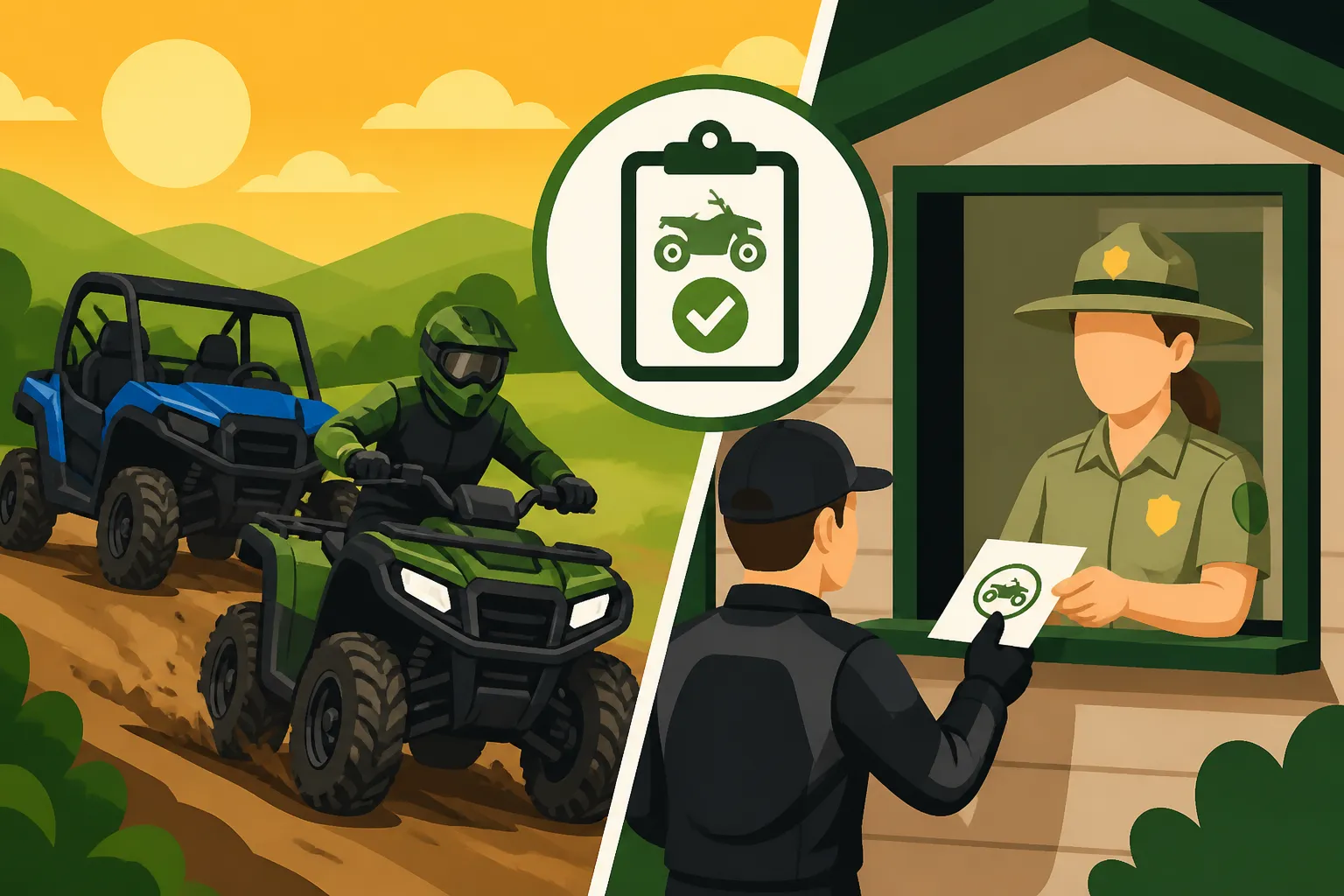
A Kansas park permit can be easy to misunderstand: it is not a statewide trail pass, and you cannot assume you can pick one up wherever you buy or register a machine. If your ATV, UTV, or golf cart needs a permit for use on a Kansas state park road, plan to get it at a park office and confirm the details before you haul out.
What the Kansas park permit is for
Kansas sells an unconventional vehicle permit for certain machine use in state parks. The important distinction is that this permit is connected to permitted use on park roads and parking areas. It does not open a state OHV trail system, create permission to ride across a park, or make a machine street legal elsewhere.
That difference matters because “permit” can sound like a general authorization to ride. It isn’t. Kansas does not offer a statewide OHV trail sticker that turns public land into a trail network. State park rules generally limit these machines to approved roads and parking areas, unless a park posts or grants a specific exception. Before riding, check Kansas Park Permit vs Trail Permit and Kansas Department Road Riding Rules so you know what the permit does—and what it leaves unchanged.
A park permit also does not replace the requirements that apply to the machine itself. A permit does not title or register an ATV, provide insurance, authorize riding on a city street, or give you permission to cross private land. Those questions have separate answers. For example, Kansas does not have general ATV registration in the usual sense, and a title does not function as a road-use permit. See Kansas Has No OHV Registration and Having a Title Does Not Make an ATV Street Legal if you need to sort out those distinctions.
The practical takeaway is simple: treat the permit as a limited park-use authorization, not a universal riding credential. Check the rules for the specific park, the roads you intend to use, and the type of machine you plan to bring.
| Question | Practical answer |
|---|---|
| Is this a statewide ATV trail pass? | No. It does not create a statewide trail system or authorize trail riding wherever you choose. |
| Where is the permit sold? | At Kansas state park offices. Confirm the office’s availability and process before traveling. |
| Does the permit make a machine street legal? | No. Road use beyond the park is governed by separate state and local rules. |
| Does another state’s sticker automatically count? | Do not assume so. Kansas does not generally require visitors to buy a state OHV sticker, but park rules still apply. |
| Can a permit holder ride anywhere inside a park? | No. Use is restricted to allowed roads and parking areas unless an authorized exception applies. |
| Should I call before I go? | Yes, especially if you are unsure whether the machine or planned route is allowed. |
Why the permit is sold at park offices
The state park office is the place to start because the permit is tied to park use, not to an ordinary ATV purchase or title transaction. It is not the kind of item you should expect to find at a vehicle dealer, a county treasurer’s office, or a general outdoor retailer. The official guidance in the park-permit information directs riders to buy it at a park office.
That arrangement can be inconvenient if you are used to buying a trail pass online or picking one up from a dealer. It also means you should build the permit stop into your trip rather than assume you can handle it on the way to a trailhead. If you arrive when the office is closed, do not count on being able to obtain the permit at a gate, from another visitor, or through a third-party seller. Call the park before you load the machine and ask how permits are handled at that location.
A park office can also be a useful place to check that you have understood the boundaries of the permit. Have a clear description of the machine—such as whether it is an ATV, side-by-side, or golf cart—and explain where you expect to drive. Park staff can tell you which rules and routes to check, and whether your plan needs a separate authorization. Do not rely on a casual answer from another rider if the route crosses a different area or uses a road with its own restrictions.
Permit requirements and office procedures can change. Fees can change too, so confirm the current amount with the park rather than relying on an old forum post, an outdated receipt, or a friend’s memory. The cost is only one part of the decision: confirm what the permit covers, how it must be displayed or carried, and whether you need to provide any information about the machine when you purchase it.
If you are planning a visit around a particular park, call ahead with a short list of questions:
- Is a permit required for this type of machine at this park?
- Which roads and parking areas may I use?
- Is the permit available at the office I plan to visit, and when is that office open?
- What current fee applies, and what payment methods are accepted?
- Does the permit need to be displayed on the machine or kept with the operator?
- Are there temporary closures, construction restrictions, or park-specific exceptions?
- Are there additional rules for passengers, children, lighting, or equipment?
The answers may vary with the park and the machine. A phone call is usually a better use of a few minutes than arriving with a trailer and discovering that the office is closed or the road you planned to use is not open to your vehicle.
Where the permit applies—and where it does not
The permit’s limits are as important as its availability. It is not permission to ride cross-country through a state park. The general park-use approach is to keep machines on authorized department roads and in designated parking areas. If a sign, closure notice, or staff instruction limits access, follow it even if you have a current permit.
Think of the permit as one part of a location-specific plan. You still need to identify the road you intend to use, check posted signs, and verify that your vehicle is permitted there. A route that seems like a convenient connection between a campground and a boat ramp may not be authorized for your machine. Do not assume that a road is open to ATVs or UTVs simply because it is wide enough, unpaved, or used by park vehicles.
The permit also should not be confused with an entry permit, camping permit, or a private riding park’s day pass. Each covers a different activity. If you are camping, review the camping rules and permit requirements separately. If you are visiting a private OHV park, that park sets its own admission and riding rules. A private park pass is not a Kansas state park permit, and a state park permit does not get you into a private riding area.
Corps of Engineers sites are another separate case. Some Kansas riding areas on Corps land have their own access arrangements, and they are not the same as Kansas state parks. Do not assume a state park permit covers a Corps area or that a Corps riding location requires the state park permit. Check the site’s own rules before departing. For more context, see Why Corps Riding Areas Need No Park Permit and Kansas Corps Areas That Charge Nothing.
The same caution applies to public wildlife areas and other department-managed land. A park-road permit should not be read as permission to drive on every road managed by the state. Check the rules for the specific property and the specific road. The guidance in Machines Must Stay on Wildlife Department Roads is useful for understanding how restricted that access can be.
A permit is not a trail pass
Kansas has no state-managed OHV trail system in the sense many riders expect when they hear “trail permit.” The park permit does not designate dirt paths, two-tracks, field edges, or informal routes as legal trails. If your main goal is to spend the day riding off-road trails, look for an authorized riding area instead of planning around state park roads.
This is where people can make an expensive or frustrating mistake. They obtain the permit, see a road going toward a recreation area, and assume they can leave the road once they reach the destination. The permit does not grant that extra access. Staying on the authorized route is the safer interpretation unless park staff or official signs say otherwise.
Kansas’s available riding options are a separate subject. Before you tow, use Kansas ATV Trails: Where You Can Actually Ride to distinguish state parks, Corps locations, and private parks. If you plan to ride at a privately operated facility, review that facility’s rules directly; entry, age limits, safety requirements, and route access can differ.
A permit is not a street-use authorization
A machine that is allowed on a particular park road is not automatically allowed on nearby public roads. City ordinances, state highway rules, and local requirements can determine whether a machine may be used on a street or road outside the park. Those rules may depend on the vehicle class and the city or county.
Do not use the park permit as proof that a city has approved your machine. Nor does a title, insurance card, or private park wristband substitute for local street authorization. For that question, start with Kansas UTV Street Legal Rules by City or Can You Drive an ATV on the Road in Kansas?. If your plan involves a public road before or after your park visit, check that route separately.
How to get the permit without wasting a trip
Because the permit is sold at park offices, timing and preparation matter. A straightforward plan can keep the permit stop from becoming the part of the outing that delays everything else.
- Choose the park and route first. Identify the actual state park and the road or parking area you expect to use. A general plan to “ride around the lake” is not specific enough to confirm access.
- Describe your machine accurately. Tell the office whether it is an ATV, side-by-side, golf cart, or another type of vehicle. If you are unsure how Kansas classifies it, explain the machine’s design and ask what information the office needs.
- Call the park office. Confirm that the permit is required for your use, that the office can issue it, and when you can visit. Ask about current fees and accepted payment methods rather than relying on old figures.
- Ask about documentation and display. Find out whether you need ownership paperwork, identification, or other information, and whether the permit must be attached to the machine or carried by the operator.
- Check for separate park requirements. Ask whether there are rules about the route, passengers, helmets, lights, age, or other equipment that apply to your planned trip.
- Get the permit before riding. If you cannot complete the purchase during office hours, ask the park what to do. Do not assume that riding first and sorting it out later will be accepted.
- Keep proof accessible. Follow the park’s instructions for displaying or carrying the permit. A waterproof document pouch can help keep papers readable in dust or rain; if you need one, Amazon is one possible place to look, but any suitable pouch works.
- Recheck conditions before departure. Closures and access instructions can change. Check the park’s current notices or call again if weather, construction, or an event could affect your route.
Bring a note with the park name, machine type, route, and questions. That gives staff enough context to answer something more useful than “Can I ride there?” If you are going with a group, have the details for each machine ready. Do not assume one permit or one vehicle’s approval covers the whole group.
Keep any paperwork in a place where the operator can access it without rummaging through a trailer. Some riders store a copy in a small waterproof pouch on the machine and keep another copy with their travel documents. You could find a pouch through Amazon or a local outdoor shop; focus on keeping the document dry and secure rather than buying a specialized product.
A paper route note can be helpful if cell service is weak. You can print park information or carry a map from a reliable source; Amazon may have general maps and navigation materials, but confirm that any map actually shows the relevant park roads and restrictions. A map is a planning aid, not proof that a route is open to your machine.
Reciprocity and out-of-state visitors
Visitors often ask whether a permit or registration sticker from another state transfers to Kansas. The answer depends on what you mean by “reciprocity.” Kansas does not generally require visitors to buy a state OHV trail sticker, because it does not operate a statewide OHV trail-pass system. But that does not mean another state’s sticker grants extra access in Kansas, or that a visitor can ignore the rules at a Kansas state park.
For state park use, focus on Kansas’s requirements for the specific park and machine. If a park permit is required for your planned use, do not assume an out-of-state permit replaces it. Conversely, do not buy a Kansas permit just because you have an out-of-state registration sticker; first confirm whether the Kansas park permit applies to your machine and route.
The simplest way to avoid confusion is to separate the questions:
- Does Kansas require a general OHV sticker for visiting riders? That is different from a park-specific permit.
- Does the park require a permit for this machine on its roads? Ask the park office.
- Does my home-state paperwork satisfy Kansas ownership or road-use rules? That depends on the activity and location.
- Can I use my home-state permit to ride on a Kansas trail? Do not assume that Kansas has a trail system or that an out-of-state permit creates access.
A visitor using a private riding park should check that park’s rules too. Private parks can set their own entry and equipment requirements regardless of whether Kansas requires a statewide OHV sticker. The state permit is not a replacement for a private park’s admission pass, waiver, or safety requirements.
For a wider view of what Kansas does and does not require, read Kansas Requires No Sticker of Visitors and Kansas Honors No Other State Sticker. Those distinctions help prevent a common misunderstanding: no general visitor sticker does not mean no property-specific rules.
Common mistakes to avoid
The first mistake is driving to a park expecting to buy the permit at the gate or from a retailer. The permit is sold at park offices, so check office hours and the purchase process before setting out. A park entrance and a park office are not necessarily the same place or open on the same schedule.
The second is treating the permit as permission to ride on trails. It is limited park-use authorization, not a trail pass. Stay on the authorized roads and parking areas, and ask staff before taking a route that is not clearly allowed.
The third is assuming all parks operate alike. The permit’s scope, local instructions, road access, and office arrangements may differ. Confirm the details with the park you actually plan to visit.
The fourth is mixing state park rules with local street laws. A machine’s access to a park road does not automatically authorize travel on a town street or highway. If you need to connect to a public road, verify that separate part of the trip.
The fifth is arriving with a group and assuming the lead rider’s paperwork covers everyone. Ask whether each machine needs its own permit and how permits should be displayed. Do not guess based on another park’s practice.
Finally, avoid relying on outdated costs, old social media posts, or an old permit image to plan your trip. The park office is the best place to confirm current fees, hours, purchase requirements, and restrictions. A quick call can answer the specific questions that generic advice cannot.
Disclaimer
This article is for general informational purposes only and does not constitute professional advice. Laws, prices and regulations vary by location and change over time. Consult a qualified professional for guidance on your specific situation.