Kansas Group Ride Planning
A Kansas group ride can unravel quickly when one machine is too wide for the trail, a storm turns clay into slick mud, or riders assume a public road leads to an open riding area. This guide helps you choose a suitable destination, match the route to your group, prepare for Kansas conditions, and coordinate the details before everyone loads up.
Choose a riding area that fits your group
Match the destination to the machines
Before you settle on a date, make sure the riding area allows the machines your group plans to bring. This is especially important when a group includes ATVs, dirt bikes, and side-by-sides with different widths. School Creek ORV Area, for example, is associated with a 50-inch machine limit, so a wider UTV may not be eligible. Check the current rules directly with the riding area before inviting a mixed group.
Destinations such as Tuttle Creek ORV Area near Randolph, School Creek near Milford Lake, Kansas Rocks Recreation Park near Mapleton, and Syracuse Sand Dunes in Hamilton County offer very different kinds of riding. A rocky park may suit riders looking for ledges and uneven terrain, while dunes are a different experience from Kansas clay and wooded trails. Don’t assume that every area has the same terrain, access, or facilities just because it is in the same state.
Make a simple list before choosing:
- Machine type and width for each rider
- Whether passengers are coming
- Riders’ experience levels
- Desired terrain, such as rock, sand, or wooded routes
- Whether the group needs camping, restrooms, or trailer parking
That information can quickly rule destinations in or out. If one rider has a wide side-by-side, for instance, it is better to find out about a width restriction before the group travels than to discover it at the entrance.
For a closer look at where Kansas riders can go, start with [Kansas ATV Trails: Where You Can Actually Ride]. If the group is debating whether to bring side-by-sides, check [Kansas Trails That Allow Side-by-Sides] as well as the destination’s own rules.
Pick a route for the least experienced rider
A group ride is more enjoyable when beginners can keep up without feeling pressured and experienced riders still have room to enjoy the outing. Plan around the least experienced rider, the least capable machine, and the most restrictive area rule—not simply the fastest rider’s preferred pace.
Ask participants privately about their comfort level. Someone who has only ridden a flat farm lane may feel uneasy on rock shelves, deep sand, or a narrow, rutted trail. A newer rider may also need extra time to practice braking, turning, and using four-wheel drive. These details are worth discussing before the group arrives, when nobody is trying to keep up with a line of machines.
Look for an area with options to adjust the ride as you go. A shorter beginner loop or a straightforward route back to the staging area gives the group a way to split up without leaving anyone stranded. At a private park, ask which routes are appropriate for beginners and whether any areas are off-limits to certain machine types. For more route ideas, see [Best Kansas ATV Trails for Beginners] and [Kansas Trail Difficulty Ratings].
A useful group agreement is simple: nobody rides beyond the ability of the person behind them, and nobody leaves a junction without confirming the group is together. That small habit helps prevent the familiar problem of one rider taking a turn while everyone else continues straight.
Plan the route and ride logistics
Confirm access, rules, and conditions
A route visible on a map is not automatically an approved route. Roads, private property, park boundaries, and riding trails can sit close together, and a public-looking track does not prove that motorized riding is allowed there. Before the trip, confirm that the riding area is open to your machine type and that the route stays within permitted riding areas.
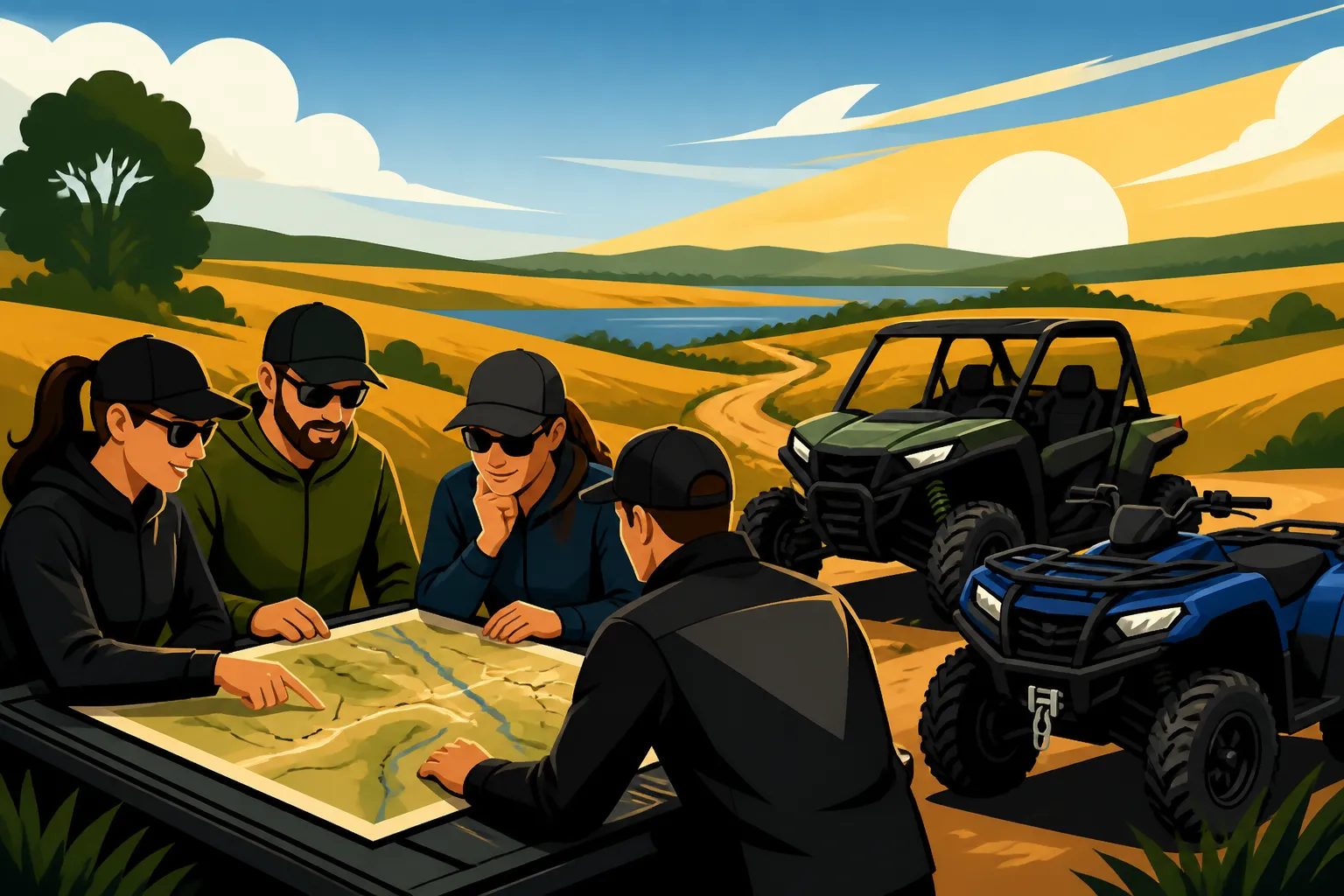
A mapping tool such as onX Offroad can help the organizer review a proposed route and discuss landmarks with the group. Treat it as a planning aid, not permission to ride. Check boundaries and access with the park or land manager, follow posted signs, and do not ride onto private ground unless you have permission. If the route involves public land, read the rules for that specific area rather than assuming that all public land allows off-road riding.
Conditions matter too. Heavy rain can make some Kansas trails difficult or closed, while dry weather can bring dust and reduced visibility. Ask the riding area about closures and surface conditions before you leave. For help building a backup plan, see [Kansas Trail Closures After Rain] and [Kansas Trail Conditions Before You Tow].
Make a pre-trip check-in part of your plan. The organizer can contact the destination, confirm that the group’s machines are allowed, verify access and parking arrangements, and share any restrictions with riders. If there is uncertainty about a trail, skip it or get clear guidance before setting out.
Set the meeting point, schedule, and regroup stops
Give riders one precise meeting location, not just the name of a town or park. A useful meetup message includes the destination’s entrance or staging area, a map pin, the planned arrival window, and a contact person. Share it early enough that people can check their trailer route and leave extra time for fuel stops.
Build a schedule that allows for delays. Loading machines, checking tie-downs, signing park paperwork, and gearing up often take longer than expected. Once riding, plan regular stops at safe, clear locations where the group can pull aside without blocking other traffic or trails. Agree that riders will wait at junctions and regroup points, rather than trying to catch up if the group gets separated.
A navigation app can support planning, but make sure every rider knows the basic route and the planned regroup points. onX Offroad may be useful for reviewing a route together before departure; still, do not make a phone the group’s only navigation plan. Battery life, signal, device damage, and a wrong turn can all become problems. Save relevant maps for offline use where available, carry a paper map if practical, and share the destination’s address or location with someone who is not on the ride.
Here is a planning checklist to keep the logistics manageable:
| Planning item | What to decide before the ride |
|---|---|
| Destination | Confirm the area is open and suitable for every machine |
| Route | Check permitted access, boundaries, and difficulty |
| Meeting point | Share a precise location and arrival window |
| Regroup plan | Choose safe stops and agree to wait at junctions |
| Backup plan | Decide what to do if weather or closures change the plan |
| Emergency contact | Give someone outside the ride the itinerary and expected return |
Prepare riders and machines for Kansas conditions
Pack for dust, heat, wind, and changing weather
Kansas conditions can shift the feel of a ride even when the distance is short. Wind can make an exposed route tiring, dust can reduce visibility between machines, and a quick change in weather can leave riders cold or soaked. Check the forecast shortly before departure, then pack for the conditions you may encounter—not only the pleasant weather at the time you leave.
Each rider should bring water, eye protection, gloves, appropriate clothing, and any needed medication. A first-aid kit, basic tools, tire repair supplies, and a way to contact help belong in the group plan. If a rider has a special medical need, make sure they can access what they need without having to unpack an entire trailer.
Dust calls for extra spacing. If the rider ahead disappears in a cloud, slow down rather than following closely. Keep headlights on when appropriate for visibility, and choose a pace that lets riders maintain control on loose or uneven surfaces. For more practical packing ideas, see [What to Pack for First Aid on a Long Ride], [Packing for a Hot Dry Day], and [Rain Gear for a Thunderstorm That Blows In Fast].
The organizer should also think about the ride home. After a long day outdoors, tired riders may be less attentive while loading trailers and driving. Leave time to secure machines carefully, check that ramps are stowed, and make sure everyone has a safe way home. If the group plans to camp, confirm the campground and riding-area arrangements separately rather than assuming that riding access includes overnight stays.
Inspect the machines and agree on group rules
A quick inspection before the ride can prevent a small issue from becoming a long delay. Check tires, brakes, lights, fuel, fluids, and visible damage. Confirm that tie-downs and trailer equipment are secure before leaving home, and bring the tools needed for basic adjustments or repairs.
Agree on a few riding expectations before the engines start. Riders should know the hand signals or verbal cues the group will use, how to signal a problem, and who is responsible for checking that everyone has arrived at a regroup stop. Set a no-pressure pace: nobody should feel pushed into a hill, water crossing, or trail section they do not want to attempt.
If the group includes different machine types, keep track of limitations that affect the route. A machine with less ground clearance may need to avoid an obstacle that a larger UTV can handle. A passenger, a child, or a rider who is new to the terrain may also change what feels safe. The group should be willing to take an easier route or turn back rather than treating every obstacle as a challenge to conquer.
A simple buddy arrangement helps. Pair riders so each person knows who to check on, but keep the overall group together at stops. If a machine breaks down, move to a safe place when possible, let the organizer know, and avoid sending one person off alone without a clear plan. On longer outings, share the route and expected return time with someone who is staying home.
Keep the ride flexible and respectful
Have a weather and breakdown backup plan
A good plan includes a graceful way to shorten or cancel the ride. If rain makes conditions unsafe, the area closes, or a machine develops a serious problem, the group should not feel obliged to continue just because people traveled a long distance. Decide in advance who will make the call and how updates will reach everyone.
For a breakdown, identify who has a suitable tow strap, basic recovery gear, and enough room or capacity to help. Recovery equipment should only be used by people who know how to use it safely. A stuck machine can create serious hazards if riders rush in, stand in a poor position, or attach a strap to an unsuitable point. When in doubt, stop and ask the park staff for guidance.
Keep the group’s expectations realistic. A day ride may cover less ground than planned because of stops, dust, trail traffic, or a rider who needs extra time. Leave room in the schedule for those normal delays. The goal is a safe, enjoyable outing—not a mileage target.
For a destination-specific checklist, [Kansas Trail Etiquette Locals Expect] is a useful companion to the ride plan. If you are organizing a larger outing, [Kansas Group Ride Planning] can help you think through the details that are easy to overlook when several people are traveling together.
Protect the area and respect other riders
Stay on designated routes and follow posted directions, even when a shortcut looks harmless. Riding outside an approved area can damage vegetation, disturb wildlife, or create access problems for everyone who comes after you. Pack out trash, keep noise considerate, and give other riders space when passing or regrouping.
Be courteous at staging areas and entrances. Keep trailers and parked machines out of travel lanes, follow staff instructions, and avoid blocking access for emergency vehicles or other visitors. If the area uses specific rules for passengers, helmets, sound, or machine dimensions, make sure everyone in your group understands them before unloading.
After the ride, share useful observations with the group: what route worked for beginners, which machines struggled, what equipment was missing, and whether conditions were different from what you expected. That practical debrief makes the next Kansas group ride easier to plan, while leaving the final word on access and current rules with the riding area itself.
Disclaimer
This article is for general informational purposes only and does not constitute professional advice. Laws, prices and regulations vary by location and change over time. Consult a qualified professional for guidance on your specific situation.