Kansas Trail Closures After Rain
Rain can turn a fun Kansas riding weekend into a wasted tow if a trail closes just as you arrive. Wet ground also makes some routes unsafe or easy to damage, even when a gate is open. This guide explains why closures happen, how to check conditions before leaving home, and what to do when rain changes your plan.
Why Kansas trails close after rain
Wet ground can be damaged quickly
Kansas trails can shift from firm to slick in a short time. Soil, slope, shade, drainage and the amount of recent traffic all affect how a route handles rain. A trail that is rideable after a brief shower may stay soft after a longer storm, especially where water collects or runoff crosses the route.
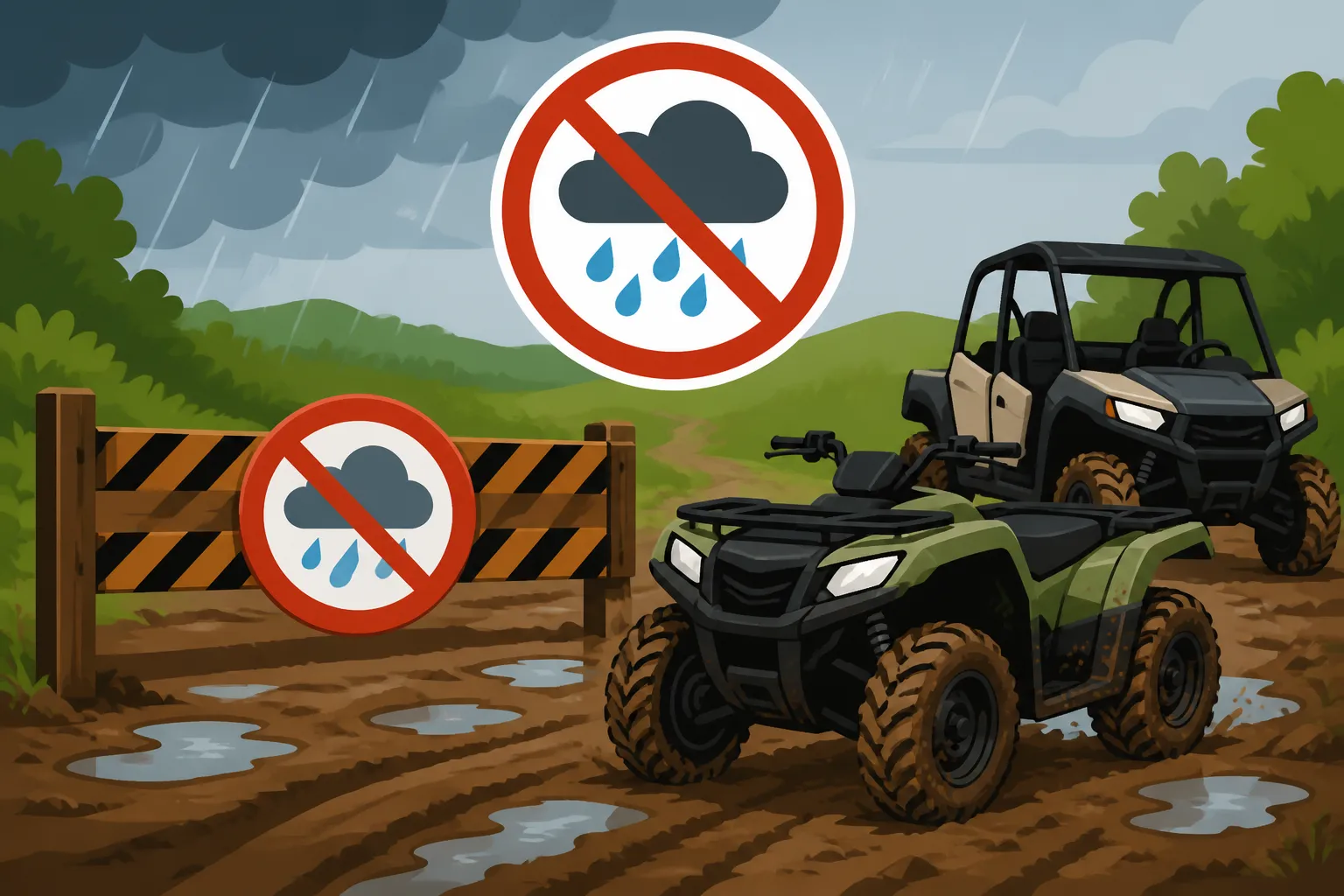
Riding on saturated ground can deepen ruts, push soil off the trail and widen muddy sections as people search for a firmer line. Those marks can channel water during the next storm, making erosion worse. A UTV or ATV may also spin its tires and dig into a spot that would have been passable on foot.
The damage isn’t limited to the trail surface. Riders may unintentionally crush vegetation along the edges, disturb drainage features or create new tracks around a puddle. That’s one reason a manager may close a route before it looks completely impassable.
A closure may be about safety as much as trail protection
Rain can reduce traction on hills, rocks and curves. Water can conceal holes, washouts, loose debris or changes in the trail surface. A shallow-looking crossing may be deeper than it appears, while a muddy slope can become difficult to climb or descend safely.
Conditions can vary widely within one riding area. An exposed stretch may dry quickly while a shaded hollow remains slick. A route near a creek or low spot may collect runoff even when nearby trails seem fine. Managers may close one section, an entire riding area, or access roads leading to it, depending on the situation.
A posted closure is not just a suggestion to pick a different line. Avoid going around a gate, riding past a sign or creating a detour through vegetation. Check the area’s rules and the specific closure notice. For broader planning, [Kansas Trail Closures After Rain] and [Kansas Trail Etiquette Locals Expect] are useful topics to keep in mind when deciding how to ride responsibly.
Soil and terrain make a difference
Kansas riding areas don’t all respond to rain in the same way. A route with rocky sections may shed water differently from a low, muddy trail. Sand, clay, compacted soil and grass-covered ground can each create their own challenges. Even within one park, trail elevation and drainage can make conditions change from one section to the next.
For example, riders considering [Tuttle Creek ORV Area in Kansas] or [School Creek ORV Area in Kansas] should treat each location’s current status as specific to that area, rather than assuming that conditions at one nearby site predict conditions at another. A private park such as [Kansas Rocks Recreation Park] may also set its own closure rules and reopening process.
| Condition | Why it matters | A sensible response |
|---|---|---|
| Standing water or deep mud | May hide holes, soft spots or changing depth | Don’t assume it is safe to cross; check the route status |
| Fresh ruts or tire trenches | Can worsen erosion and create hazards | Turn around rather than trying to widen the trail |
| Slick hills or rocky slopes | Reduce braking and steering control | Avoid the section and follow posted directions |
| Water moving across a trail | May conceal a washout or unstable edge | Do not ride through without clear permission and safe conditions |
| Closed gate or sign | Indicates access is restricted | Stop and use an authorized alternative |
How to check trail status before you tow
Start with the riding area’s own updates
The best condition information usually comes from the people who manage the area. Check the official page, social media account, recorded information line or other communication channel the operator uses. Public riding areas and private parks may post updates in different places, so look for the specific location you plan to visit.
Pay attention to the date and wording of an update. “Open” may refer to the park generally, not every trail or access road. A note that a site has reopened also may not mean all routes are dry or suitable for every type of machine. If the message is unclear, contact the office or operator before loading up.
For public sites, [Kansas Corps of Engineers Riding Areas] can help you identify the kind of area you’re planning to visit, but do not treat a general overview as a real-time trail report. At a private property, check its own rules and contact details. [Kansas Private Off-Road Parks] offers a helpful starting point for understanding how access can differ from one privately operated site to another.
Use maps as planning tools, not permission to ride
A trail map can help you understand the route layout, access points and nearby alternatives. A navigation app such as onX Offroad may be useful for preparing a route and keeping track of your location, particularly when you’re unfamiliar with an area. But a mapped trail is not proof that the route is open today.
Before using onX Offroad or another mapping tool, compare its information with the riding area’s own closure notices. App data may not reflect a fresh closure, a temporary gate or a route condition that changed after rain. If a map shows a route but the operator says it is closed, follow the operator’s instructions.
It also helps to save the area’s official contact details before you leave. Cell reception can be unreliable in some rural areas, and a trail map may not load when you need it. Download or save the information you’ll need ahead of time, then confirm the status again before you begin the drive.
Ask specific questions when conditions are uncertain
A quick, focused call or message can prevent a long, frustrating trip. Instead of asking only, “Are you open?”, ask whether the routes you plan to use are open, whether access roads are affected, and whether any vehicle-width or trail-specific restrictions apply. If you’re taking a side-by-side, make sure the answer applies to your machine, not just to ATVs generally.
You can also ask whether the operator expects conditions to change during the day. A park might be open in the morning but close a section after more rain, or a manager might advise waiting until the ground firms up. Don’t pressure staff to give you a reopening estimate they can’t support; weather and drainage can make that difficult to predict.
This preparation is especially useful when you’re planning a longer trip or coordinating a group. Check [Kansas Trail Conditions Before You Tow] and [Kansas Trail Difficulty Ratings] as part of your planning, then verify the current notice with the area itself.
What to do when rain changes your riding plan
Make the decision before you unload
If you arrive and find a closure sign, a locked gate or an official notice that conflicts with an old map, stop before unloading. Recheck the operator’s latest update and contact the area if the reason or boundaries aren’t clear. Don’t assume that a quiet entrance or an empty trail means riding is allowed.
If a trail is technically open but visibly soft, use judgment. Deep ruts, standing water, slick slopes and fresh washouts are warning signs. The responsible choice may be to turn around even without a formal closure. That can feel disappointing after a long drive, but it’s better than damaging the route, getting stuck or risking a rollover.
Avoid testing a muddy section just to see whether your machine can make it through. If the machine bogs down, repeated throttle can deepen the rut and make recovery harder. If a section is closed, do not use a ditch, field edge or neighboring property as a workaround.
Have a backup that is genuinely available
A backup riding area is useful only if it is open, suitable for your machine and reachable within your schedule. Before your trip, identify one or two alternatives and check their access rules separately. A site with different terrain may handle rain better, but that doesn’t guarantee it will be open or in good condition.
For each alternative, confirm the address or entrance, hours, vehicle requirements, fees or permits, and whether reservations are needed. Do not assume that permission at one riding area carries over to another. [Kansas Riding Areas That Take Reservations] may help you account for access arrangements, while [Kansas Riding Season Month by Month] can help you think through how weather affects the timing of a planned outing.
If every reasonable option is closed or too wet, consider postponing the ride. That’s not always the answer anyone wants, particularly when friends have already traveled, but it is often the least costly choice. A flexible plan might include a later date, a shorter local ride on authorized ground, or a non-riding stop while the group decides what to do next.
Don’t treat reopening as a fixed countdown
A trail does not necessarily reopen a set number of hours after rain. How quickly it dries depends on factors such as rainfall amount, drainage, shade, soil and continued weather. Managers may also need to inspect routes, clear debris or repair damage before reopening them.
Check for a new notice rather than relying on what someone saw the previous day. A trail that was closed yesterday may still be closed, and a reopened area may have restrictions on certain sections. Ask whether the reopening applies to the whole area or only to designated routes.
If the closure lasts longer than expected, resist the temptation to ride around it. Temporary closures protect access for future visitors as well as the land itself. Respecting those decisions helps preserve the riding opportunities Kansas does have, especially in areas where public trail options are limited.
How to ride responsibly after trails reopen
Ease back into the route
When an area reopens, start slowly and pay attention to the surface. Don’t assume every trail has dried evenly. Watch for soft shoulders, standing water, loose gravel, ruts and areas where runoff may have changed the trail. Keep enough space between machines to avoid crowding a rider who needs to stop.
Stay on designated routes. Going around a muddy patch often creates a wider trail and damages vegetation. If a route is still too wet for your comfort, turn around rather than forcing your way through. The same principle applies if a hill or crossing feels beyond your skill or equipment.
A reopening notice is permission to use the routes identified by the manager; it isn’t a promise that every section will feel smooth. [Kansas Trail Riding After Heavy Rain] and [Kansas Trail Volunteer Days] are relevant reminders that trail conditions and trail care are closely connected.
Keep your group informed
Before the ride, make sure everyone understands the closure rules and what to do if conditions worsen. Agree on a turnaround point or a plan for separating temporarily if one rider needs to stop. Groups often get into trouble when the first few machines move ahead and the last riders feel pressured to follow through a questionable section.
If you notice a new washout, unsafe obstacle or closure sign that hasn’t appeared in the area’s updates, report it to the operator. Give a clear location and a plain description. Don’t post an unconfirmed claim that the entire park is closed when you’ve only seen one blocked route; specific information helps other riders make better decisions.
Most of all, treat an open gate as only one part of the decision. Check official updates, follow posted restrictions, assess the ground honestly and be willing to change plans. That approach protects you, your machine and the trails that make a Kansas riding trip worthwhile.
Disclaimer
This article is for general informational purposes only and does not constitute professional advice. Laws, prices and regulations vary by location and change over time. Consult a qualified professional for guidance on your specific situation.