Kansas Titles for a Business Machine
It's no secret that navigating the world of titles and registrations for off-road vehicles in Kansas can feel like you're trying to herd cats – especially when those machines are essential tools for your business. Whether you're running a sprawling cattle operation, managing a busy construction site, or even a small landscaping company, getting your ATVs and UTVs properly titled is a critical, often confusing, step. This guide is here to cut through that confusion, offering a comprehensive look at how to secure a proper Kansas title for your business machine, ensuring you stay compliant and protect your valuable assets.
Understanding Nonhighway Vehicle Titles in Kansas for Businesses
When your ATV or UTV isn't just for weekend fun but is actively earning its keep, the rules around ownership and documentation don't just disappear. In fact, they often become even more crucial because these machines represent a business asset, not just a personal toy.
Why a Business ATV/UTV Needs a Title
Think of the title for your business ATV or UTV as its birth certificate and proof of legal ownership, all rolled into one. For any business, asset management is key, and your off-road machines are no exception. Legally, Kansas law requires a title for all-terrain vehicles and utility vehicles, regardless of whether they're for personal recreation or commercial use. This isn't just red tape; it's a fundamental safeguard.
Without a clear title, proving ownership if the machine is stolen becomes incredibly difficult, leaving your business vulnerable. Imagine showing up to a job site or a sale without a legitimate title – it raises immediate red flags and complicates insurance claims, potential resale, or even just verifying that the machine belongs to your company. It's the official document that says, "This machine belongs to us, and here's the proof." This is also why understanding [Kansas Nonhighway Title Requirements] is so important from the outset.
The "Nonhighway" Designation and What It Means for Your Business
One of the most common points of confusion for business owners is the term "nonhighway vehicle." In Kansas, this classification means your ATV or UTV is designed and intended primarily for off-road use, rather than for travel on public roads. This doesn't mean it can never touch a public road, but it fundamentally shapes the titling process and its implications.
For your business, this "nonhighway" status typically aligns perfectly with how you're using the machine. Farmers are traversing fields, construction crews are moving materials across job sites, and landscapers are maneuvering over private properties. The title reflects this intended use, distinguishing it from road-legal vehicles that require annual registration and license plates. Because these machines are titled as nonhighway, you'll discover [Why a Kansas Nonhighway Title Never Comes With a Tag] – it's simply not what they're designed for by default. While there are exceptions for road use in certain circumstances or with specific city ordinances, the core titling acknowledges its primary off-road function.
Common Business Scenarios and Titling Requirements
The way your business uses its ATV or UTV can slightly influence how you think about its title, even though the fundamental titling process remains consistent across most commercial applications. Different operational needs often highlight different aspects of the titling and ownership requirements.
Titling for Farm and Ranch Operations
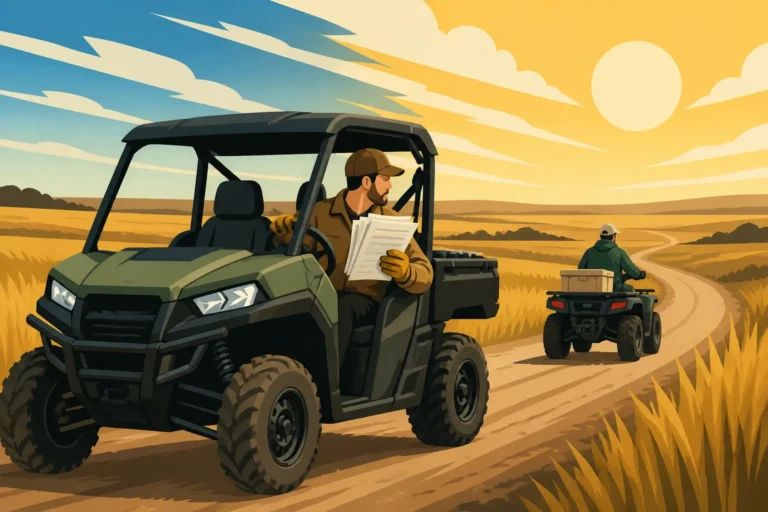
For many Kansas farmers and ranchers, ATVs and UTVs are as indispensable as a tractor. They're used for everything from checking fences and hauling feed to moving tools across vast acreage. The title for these machines is crucial for several reasons specific to agricultural businesses. Firstly, it formalizes the machine as a business asset, which can be important for tax purposes, depreciation, and overall asset valuation. Secondly, in the event of an estate transfer or sale of the farm, having clear titles for all equipment simplifies the process immensely.
Beyond the initial titling, understanding the specific agricultural exceptions for road use (even if minimal) can be helpful, though these exceptions don't change the nonhighway title itself. When you're managing a large property and have multiple machines, keeping track of each title is vital. For more specific details, you might want to look into [Kansas Titles for a Farm Machine] or [Kansas Titles for a Ranch Machine], as they cover the unique aspects of these operational uses.
Titling for Construction or Work-Site Utility Vehicles
Construction companies, landscapers, and various utility services often rely on UTVs for moving personnel, tools, and light materials around a job site. These machines, often referred to as Work-Site Utility Vehicles (WSUVs), have a specific classification in Kansas, primarily dictated by their dimensions and weight. To qualify as a WSUV, a machine typically must be 48 inches or wider and weigh over 800 pounds unladen. Understanding this classification is key, as it can sometimes affect specific local ordinances or how the machine is referenced in official documents.
The titling process for a construction UTV is similar to any other nonhighway vehicle, but the business context adds layers of importance. Proof of ownership is essential for insurance purposes on active job sites, and for tracking equipment across multiple projects. If your business regularly moves machines between sites, having a clear title is paramount for inventory and accountability. You'll find more information on these specific machines in [Kansas Work-Site Utility Vehicles Explained] which delves into their unique characteristics.
Titling for Rental Fleets or Tour Companies
Businesses that operate rental fleets of ATVs or UTVs, or those that offer guided off-road tours, face a unique set of challenges. Their machines are constantly changing hands, even if temporarily, and proving clear ownership for each unit is critical. For these types of businesses, the title serves as the absolute legal proof that the machine belongs to the company, protecting them from disputes or claims of ownership from renters or tour participants.
Moreover, managing a fleet requires meticulous record-keeping. Each machine needs its own title, and tracking these documents, especially as machines are bought, sold, or retired, is a significant administrative task. It's not uncommon for rental companies to establish robust internal systems for managing titles and associated paperwork. This is an area where the specifics covered in [Kansas Title Rules for a Rental Fleet] become highly relevant, detailing the nuances of managing multiple machines under a business entity.
The Step-by-Step Titling Process for Your Business Machine
Titling a business ATV or UTV in Kansas isn't fundamentally different from titling a personal one, but paying close attention to the details related to your business entity is crucial. Rushing through this process can lead to headaches down the road, so let's break it down.
Gathering Necessary Documentation
The first and arguably most critical step is compiling all the required paperwork. For a new machine purchased from a dealer, you'll need the Manufacturer's Certificate of Origin (MCO), which is essentially the machine's birth certificate. This document is vital as it proves the machine has never been titled before and establishes its initial ownership. You'll also need a bill of sale or purchase agreement that clearly lists your business name as the buyer.
If you're buying a used machine for your business, you'll need the existing Kansas title, properly assigned by the seller to your business. If the seller has lost the title, they'll need to obtain a replacement before they can sell it to you, or you might have to explore options like using [Kansas Nonhighway Affidavits] in rare cases where the original title is genuinely unavailable and other proofs of ownership are solid. For both new and used machines, ensure your business's legal name and address are accurately reflected on all documents. It's often helpful to keep these documents organized using a service like LawDepot to generate custom business agreements or keep records in one place. For a more general overview of what's needed, refer to [Kansas Title Paperwork Explained].
Where to Go and What to Expect at the County Treasurer's Office
Once you have your documents in order, the next stop is your local County Treasurer's office. This is where all vehicle titling in Kansas happens – you won't be going to a state-level office for this. It's important to remember [Title an ATV at the County Treasurer, Not the State]. The specific office you visit should be in the county where your business is primarily located or where the machine will be garaged.
When you go, bring all your original documents. A representative of your business will need to present identification, and if you're not the owner or a designated officer, you might need a letter of authorization on company letterhead. Be prepared for a short wait, especially during peak hours. The clerks at the treasurer's office are there to help, but they need everything in order. They'll review your paperwork, ensure all signatures are present, and collect the necessary fees and taxes. Make sure to initiate this process promptly; [Kansas Gives You 60 Days to Apply] for your title after purchase, or you could face late filing penalties.
Handling Sales Tax and Fees for Business Purchases
Even though your ATV or UTV is for business use, sales tax is still a factor in Kansas. The state's sales tax, along with any applicable local sales taxes, will be collected at the County Treasurer's office when you apply for the title. This is clearly outlined in [Kansas Sales Tax Collected at Titling]. The amount you pay will be based on the purchase price of the machine.
Beyond sales tax, there's a flat fee for the nonhighway title itself. It's a nominal charge, often around [Kansas Charges $10 for a Title], which makes it a very affordable part of the overall cost. If you're trading in an old machine as part of the purchase, the sales tax will typically be calculated on the net difference between the new machine's price and the trade-in value, which can be a significant saving for businesses upgrading their equipment. Be prepared to pay these fees using accepted [Kansas Title Payment Methods], which usually include cash, check, or credit/debit card, though card fees may apply.
Special Considerations for Business ATV/UTV Titles
Beyond the standard titling process, businesses often encounter specific situations that require a bit more attention. These can range from how you finance your machine to what happens if you lose your paperwork.
Financing, Liens, and Multiple Owners
Many businesses opt to finance their ATV or UTV purchases, especially for new machines or a fleet of vehicles. When you finance, the lending institution (a bank or credit union) will typically record a lien on the title. This lien serves as their legal claim on the machine until the loan is paid off. The County Treasurer's office will record this lien when they issue the title, and it will be clearly printed on the document itself. Understanding [Kansas Title and Lien Records] is crucial for any business owner who finances equipment. Once the loan is satisfied, the lender will send you a lien release, which you'll need to submit to the Treasurer's office to have the lien removed from your title, giving your business clear ownership.
For businesses with multiple partners or shared ownership, the title can reflect this. Just like a personal vehicle, you can have multiple names on a nonhighway title. This is covered in [Kansas Title With Two Owners]. It's important to decide whether the names will be joined with "and" (meaning both parties must sign for any transfer) or "or" (meaning either party can act independently). For businesses, "and" is often preferred for greater control and protection of assets.
Out-of-State Purchases or Business Relocations
If your Kansas-based business purchases an ATV or UTV from a dealer or private seller in another state, the titling process has an extra step. You'll bring the out-of-state title (properly assigned to your business) or the MCO (for a new machine) to your Kansas County Treasurer's office. You'll then apply for a Kansas nonhighway title, and you'll pay Kansas sales tax on the purchase price (minus any sales tax proof from the other state, to avoid double taxation). This process is fully explained in [Kansas Titles for an Out-of-State Machine].
Similarly, if your business is relocating to Kansas and bringing its existing fleet of ATVs or UTVs, you'll need to obtain Kansas nonhighway titles for them. This means taking your existing out-of-state titles to the Kansas County Treasurer's office. While you likely won't pay sales tax again if you've owned the machines for a while, you will pay the flat Kansas title fee for each machine. For new residents, understanding [Kansas Title for a New Resident] provides a good framework, even for business entities.
Lost Titles and Record Keeping for Your Business
Let's be realistic: paperwork gets misplaced. It happens, especially in the hustle and bustle of running a business. If your business loses a nonhighway title for an ATV or UTV, it's not the end of the world, but it does require prompt action. You'll need to apply for a duplicate title at your County Treasurer's office. This typically involves filling out an application, providing proof of identification for the business representative, and paying a small fee. The process for [Replacing a Lost Kansas Nonhighway Title] is straightforward, but having solid records makes it much easier.
This highlights the immense importance of meticulous record-keeping for your business. Keep copies of all titles, bills of sale, and any lien releases in a secure location, separate from the originals. Digital copies are also a great idea. Services like LawDepot can assist in creating a clear, legally sound bill of sale when you acquire or dispose of a business machine, making the paper trail much cleaner. Having these records readily available simplifies not only lost title applications but also audits, insurance claims, or the eventual sale of your business assets.
Here's a quick summary of essential documents for your business machine title:
| Document Type | New Machine (Dealer) | Used Machine (Private Seller) |
|---|---|---|
| Proof of Ownership | Manufacturer's Certificate of Origin (MCO) | Previous Kansas Title (properly assigned) |
| Bill of Sale/Invoice | Dealer Invoice/Purchase Agreement (showing business) | Bill of Sale (showing business as buyer) |
| Proof of Identity | Business EIN/Tax ID, business representative ID | Business EIN/Tax ID, business representative ID |
| Lien Information (if financed) | Lender's name and address | Lender's name and address (if existing lien) |
| Application Form | Application for Kansas Title | Application for Kansas Title |
Why a Title Matters Beyond Legal Compliance
While securing a title is primarily about fulfilling a legal requirement, its importance for a business extends far beyond simply checking a box. A proper title is a cornerstone of responsible asset management and offers significant practical benefits.
Asset Protection and Insurance Implications
For any business, protecting its assets is paramount. Your ATVs and UTVs, especially if they are part of a fleet, represent a substantial investment. A clear, legal title is the ultimate proof of your business's ownership. If a machine is stolen, the title is what you'll present to law enforcement and your insurance company to prove it's yours. Without it, recovering a stolen machine or successfully filing a claim can become an uphill battle. Imagine the frustration of having a valuable piece of equipment disappear, only to be told you can't prove it ever belonged to your company.
Speaking of insurance, the title also plays a direct role. Most insurance companies will require proof of ownership, usually the title, before they will issue a comprehensive policy for your business's off-road machines. While [Do You Need ATV Insurance in Kansas?] depends on specific city ordinances, it’s always a good idea for businesses to carry coverage, especially when machines are used for commercial purposes. The title helps establish the value and legal standing of the asset being insured, ensuring that your business is adequately protected against theft, damage, or liability claims.
Resale Value and Transferability
Sooner or later, your business might decide to upgrade its equipment or sell off older machines. Having a clean, properly assigned title for each ATV or UTV makes this process incredibly smooth. When a buyer, whether a private individual or another business, considers purchasing a used machine, the first thing they'll typically ask for is the title. It provides them with confidence that they are buying a legitimate machine with clear ownership.
A machine without a title, or one with a confusing ownership history, will almost always sell for less and be much harder to move. Buyers are wary of potential legal issues, and the lack of a title creates immediate suspicion. By ensuring your business's titles are always current and properly transferred when acquiring or disposing of machines, you maximize their resale value and avoid unnecessary delays or complications. This applies whether you're selling directly to a private party (as detailed in [Selling a Titled Machine in Kansas]) or trading it in at a dealership, where [Kansas Dealers and Used Machine Titles] become part of the larger transaction. A well-maintained title record is an investment in the future fluidity and value of your business assets.
Disclaimer
This article is for general informational purposes only and does not constitute professional advice. Laws, prices and regulations vary by location and change over time. Consult a qualified professional for guidance on your specific situation.