Flying a Drone Over a Riding Park
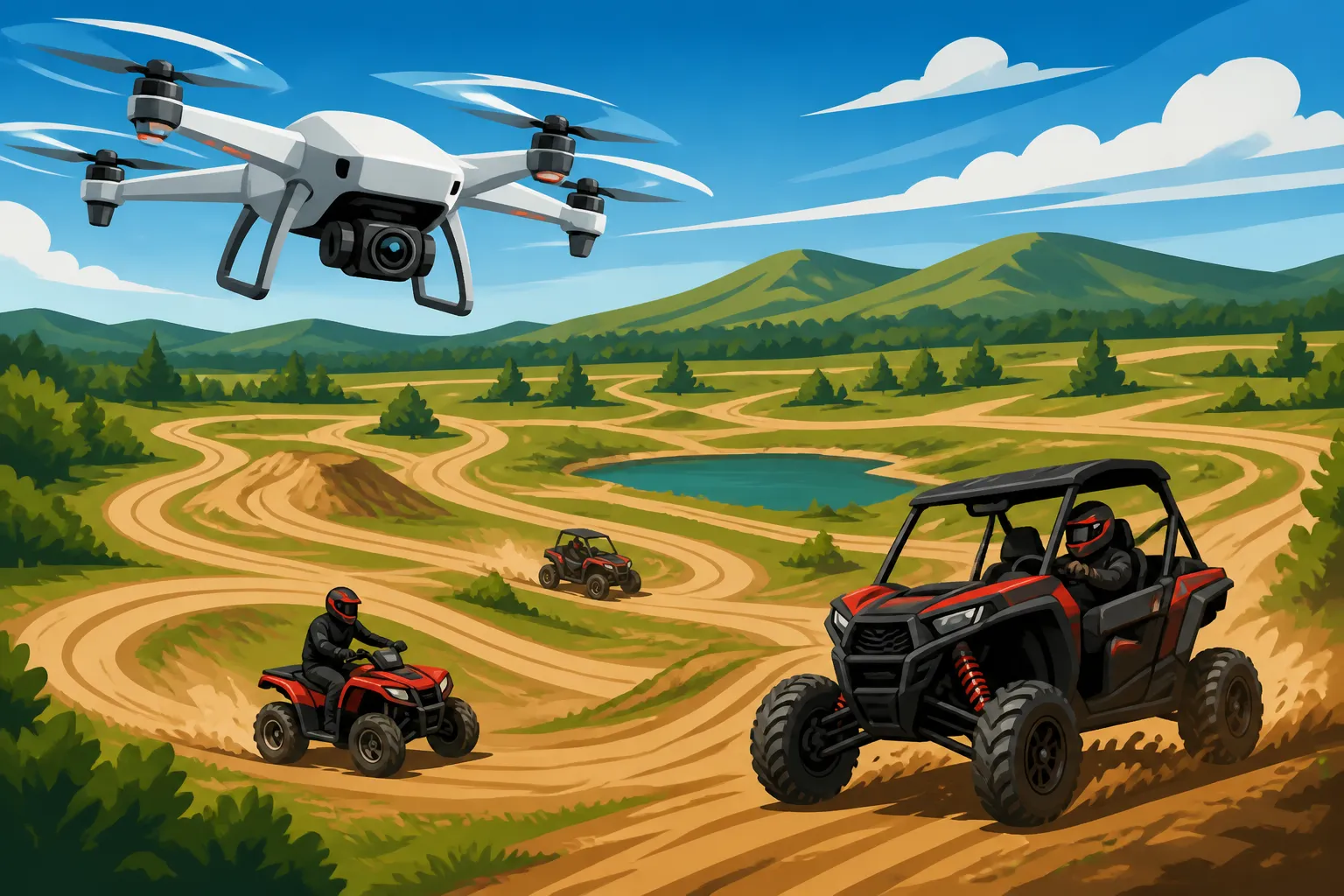
A drone can capture useful footage of a ride, but the answer to “Can I fly it here?” depends on who manages the land. Kansas restricts drone use on state wildlife agency property, while a private riding park may set its own policy. Identify the land manager, ask before you launch, and keep drone permission separate from any permit needed to ride.
First Identify Who Manages the Riding Area
“Riding park” can describe very different places: a privately operated off-road park, a state park, a wildlife area, or a recreation area managed by another public entity. The name on the entrance sign may not tell you who controls the property. Check the park’s official information or call the office and ask who manages the land.
That distinction matters because Kansas has a specific restriction on drones at property managed by the state wildlife agency. According to the Kansas Department of Wildlife and Parks, drone use is prohibited at any Kansas state park, wildlife area, or other property owned or managed by the agency unless specific operating areas are designated.
Do not assume a drone is allowed because the park has open space, because you are not flying over a trail, or because you have a riding permit. The restriction covers the property, not just the marked riding area. A permit to use a vehicle on an allowed road or parking area does not, by itself, give permission to fly a drone.
The riding rules are also distinct from the drone rules. According to the Kansas Department of Wildlife and Parks, Kansas state parks do not feature ATV or UTV trails, and off-road vehicle use is similarly prohibited on state wildlife areas. For more on that distinction, see Kansas State Parks Have No OHV Trails. If you are considering a different public riding location, Kansas Corps of Engineers Riding Areas can help you investigate the land manager before you plan a trip.
| Where you want to fly | What to establish first | Practical takeaway |
|---|---|---|
| Kansas state park | Whether the agency has designated an operating area | Do not launch unless the area is specifically designated for drone use |
| State wildlife area or other state wildlife agency property | Whether the property is managed by the Kansas Department of Wildlife and Parks and whether a designated area exists | Treat drone use as prohibited unless the agency identifies an allowed operating area |
| Private riding park | The park operator’s current drone policy and any launch, flight, or filming conditions | Get permission directly from the operator; do not assume private land means unrestricted use |
| Property managed by another public entity | Which agency or organization controls the property and what its rules say | Ask the land manager; the state wildlife agency’s rule may not answer the question |
The table is a starting point, not a substitute for checking with the manager. A riding venue can sit near other public land, and a trail system or recreation area can have more than one land manager. If you cannot confirm the boundary or the responsible office, do not treat uncertainty as permission.
Ask a Private Park Before You Bring the Drone
A private park’s policy may differ from the state wildlife agency’s restriction, but that does not mean drones are automatically welcome. The park operator may allow flights only in a certain area, restrict filming during busy periods, or prohibit drones altogether. It may also have rules that change with events, trail conditions, or staffing.
Contact the park before you leave home. A quick, specific question is more useful than asking only whether the park “allows drones.” Explain that you want to fly a drone, where you hope to launch, what you plan to film, and whether you intend to share the footage. Ask whether permission needs to be arranged with a particular person, rather than relying on a casual answer from someone who may not set park policy.
Useful questions include:
- Are drones allowed on the property on the day of my visit?
- Is there a designated place to launch and land?
- Are there areas, trails, events, or times when drone use is not allowed?
- Does the park require advance approval for filming or sharing footage?
- Are there instructions for keeping clear of riders, staff, spectators, and parking areas?
- Could weather, trail conditions, or a scheduled event change the answer?
If the park says yes, ask what “yes” covers. Permission to fly does not necessarily mean permission to launch from any location, film every activity, or fly during all operating conditions. Record the name or role of the person who gave you the instructions and keep any written confirmation with your trip information.
A park’s general visitor rules may not mention drones. That is not a reliable reason to assume they are permitted. Ask directly, and read the park’s current rules before unloading. If you are comparing facilities, Kansas Private Park Waivers and Rules explains why private parks can have their own conditions for visitors. You can also review Kansas Rocks Park Rules for Riders or Kansas Syracuse Dunes Park Rules for park-specific riding information, then confirm any drone policy with the operator.
Keep separate questions separate. Permission to ride, permission to film, and permission to fly are not necessarily the same thing. A park employee may be able to answer one but not the others, so ask who has authority over each activity.
Keep Drone Permission Separate From Riding Permits
Kansas does not have a statewide OHV trail permit system or a general public-land trail pass, according to the Kansas Department of Wildlife and Parks. That does not mean every machine can be used everywhere, or that no permits apply to particular places. A vehicle permit and permission to operate a drone address different activities.
For example, the Kansas Department of Wildlife and Parks says a specialized unconventional vehicle permit is required for UTVs operating on allowed improved roads and parking areas within Kansas state parks. The department also says non-residents operating qualifying unconventional vehicles on those roads and parking areas must purchase a state park vehicle permit and an unconventional vehicle permit. These requirements do not authorize ATV or UTV trail riding in a state park, and they do not grant drone permission. See Kansas Unconventional Vehicle Permit for more on the vehicle-permit distinction.
The same separation applies at a private riding park. A day pass or annual pass may cover use of a machine under the park’s rules, but do not assume it includes filming or drone flights. Ask what each pass covers and whether drone approval is a separate decision.
| Permission or document | What it concerns | What it does not establish |
|---|---|---|
| Riding-area admission or park pass | Access under the venue’s visitor and riding rules | Permission to launch or fly a drone |
| State park vehicle permit, where required | Operation of a qualifying vehicle on allowed roads and parking areas | Permission to use ATV or UTV trails, or to fly a drone |
| Drone approval from a land manager | Drone use within the conditions the manager gives | Permission to ride, enter restricted areas, or ignore other applicable flight rules |
| Proof of vehicle ownership | Ownership documentation for a machine when required | Access to a riding area or permission to fly |
For public property, identify the agency responsible before applying rules from another location. The Kansas Department of Wildlife and Parks’ drone restriction applies to state parks, wildlife areas, and other property owned or managed by that agency unless it designates operating areas. A different agency or private operator may have different rules, so do not carry over an answer from one park to another.
For a riding trip, it can help to confirm the vehicle rules separately from the drone plan. Kansas Permit Questions Parks Hear is a useful reference for understanding why an access permit may cover only a particular kind of use. Before making a long drive, Kansas Trail Conditions Before You Tow can also help you build in a check of the riding location’s current status.
Plan a Low-Disruption Flight or Leave the Drone Behind
If the land manager confirms that drone use is allowed, plan the flight around the people using the park. Riding areas can be noisy and active, and a drone can distract a driver or interfere with a staff member’s work. Choose a launch and landing location that the operator approves, and avoid positioning yourself where riders must pass close to you or your equipment.
Before the visit, check the park’s current instructions and any applicable aviation requirements with the relevant authorities. Land-manager approval does not necessarily answer every question about operating a drone. Do not rely on a park employee’s permission as a replacement for checking rules that may apply to the flight itself.
A sensible preflight routine is:
- Confirm the land manager. Establish whether the location is a state park, wildlife area, other state wildlife agency property, private park, or land managed by another public entity.
- Check the exact property. Make sure your intended launch point and filming area are within the location covered by the permission you received.
- Get clear approval. Ask whether drone use is allowed on your visit and whether the operator has conditions for timing, location, or filming.
- Check current conditions. Contact the park again if there is an event, a closure, changed access, or another reason its normal instructions may not apply.
- Keep the activity contained. Follow the approved area and avoid disrupting riders, staff, or other visitors.
- Stop if the situation changes. If the park asks you to land, or conditions make the flight disruptive or unsafe, follow the instruction and end the flight.
If the operator cannot confirm its policy, postpone the flight rather than treating silence as approval. That is especially important when the boundary between a private riding venue and public land is unclear. A drone that is permitted on one part of a recreation area may still be prohibited on neighboring state-managed property.
When drone use is not allowed, you can still plan a useful riding trip without bringing it. Check the park’s approved photography options, ask whether ground-based filming is permitted, or focus on documenting the trip from an area the operator identifies as suitable. If you want aerial footage, look for a location where the responsible manager has clearly designated a place for drone operations.
The main rule is straightforward: establish who controls the land, then ask that manager about the drone itself. On property owned or managed by the Kansas Department of Wildlife and Parks, do not fly unless the agency has designated an operating area. At a private riding park, get the operator’s current permission and follow its conditions. Keep that approval separate from vehicle access permits, and be prepared to leave the drone packed if the answer is unclear.
Sources
- Kansas Department of Wildlife and Parks — Kansas State Park Entrance and Camping Fees (checked November 2, 2026)
Disclaimer
This article is for general informational purposes only and does not constitute professional advice. Laws, prices and regulations vary by location and change over time. Consult a qualified professional for guidance on your specific situation.