Machines Kept to Roads and Parking Areas
Kansas ATV and UTV riders can mistake a state park road permit for permission to ride anywhere on park land. The distinction matters: a permit may cover certain park roads and parking areas, but it does not turn hiking trails, fields or closed routes into riding areas. Here’s how to understand the limits and plan a ride without relying on guesswork.
What a Kansas park permit does and does not allow
Kansas’s Unconventional Vehicle permit is associated with using eligible off-road machines on roads in state parks. Its scope is narrower than a general trail pass: it does not give riders blanket permission to explore every part of a park. The practical rule is to keep the machine on roads and in parking areas where that use is allowed, and to obey posted signs and closures.
The permit question is separate from whether a vehicle can be driven on a public street or highway. A park permit does not make an ATV or UTV street legal, and it does not replace local road permission, vehicle equipment requirements, insurance rules or other requirements that apply outside the park. For those issues, see Kansas UTV Street Legal Rules by City.
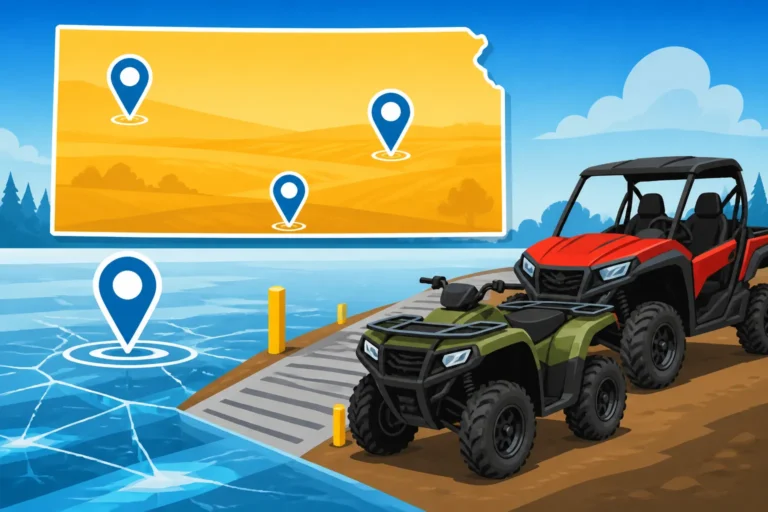
A useful way to think about the permit is as limited access authorization, not a promise of recreational riding space. A park road might let you travel between a campsite, a boat ramp or another destination. It does not follow that you can leave the road to ride a wooded edge, cut across a field or use a pedestrian trail.
| Situation | What to assume | What to check |
|---|---|---|
| Riding a designated, open park road | It may be allowed for an eligible machine with the required permit | Whether the road is open to that vehicle class and what permit is needed |
| Parking a machine in an authorized lot | It may be allowed as part of permitted road use | Posted signs, parking restrictions and access hours |
| Leaving the road to ride a trail or open ground | Do not assume it is allowed | A clear posted exception or specific authorization from park staff |
| Using a machine at a Corps riding area | State park permit rules may not apply | The individual area’s rules, opening status and riding boundaries |
| Visiting a private off-road park | State park rules do not set the park’s conditions | The private operator’s admission, safety and vehicle rules |
| Showing an out-of-state sticker | Do not assume it substitutes for a Kansas requirement | What Kansas and the specific park require |
The phrase “roads and parking areas” is a boundary, not a general description of the whole park. A wide gravel road can still be a restricted route, and an unmarked-looking open area can still be off limits. Follow signs and any instructions provided by park staff. When there is doubt about a particular road, ask before riding it.
For a closer look at the permit’s purpose and limits, see [The $52.50 Unconventional Vehicle Permit] and Kansas Park Permit vs Trail Permit. Check the state’s current requirements before you travel, because permit procedures and park access details can change.
A park permit is not a trail network
Some states operate designated off-highway vehicle trail systems and require a trail pass, registration sticker or other access credential. That is not the same thing as a Kansas state park road-use permit. Kansas does not offer a statewide OHV trail pass that opens a public trail network. A permit for eligible use on park roads should not be treated as permission to ride trails that are not open to machines.
That difference can seem technical until you arrive at a park and see a trailhead. A trail may be intended for hikers, cyclists or equestrians, not motorized vehicles. A nearby parking area does not change the trail’s use rules. If the sign or map identifies a route as nonmotorized, don’t enter it on an ATV or UTV.
This is also why a machine’s title, registration status in another state or city tag does not answer every park-access question. Those documents may relate to ownership or public-road use, while the park controls access to its own routes and facilities. See Kansas Has No State OHV Permit for the distinction between a statewide trail sticker and other permits that may apply in particular places.
How to confirm that a road or parking area is open
Before unloading, identify the exact park and the route you intend to use. Don’t rely on a general map of the park as proof that every road is open to motorized vehicles. Maps may show roads for navigation without explaining whether ATVs, UTVs or other unconventional vehicles may use them.
A careful pre-ride check is straightforward:
- Identify the machine. Note whether it is an ATV, side-by-side, golf cart or another vehicle type. Different classes can have different access rules. If you are unsure how Kansas classifies the machine, start with Four Off-Road Classes Kansas Law Treats Differently.
- Contact the park or check its official information. Ask whether the machine may use the specific roads and parking areas you have in mind, whether a permit is required, and where to obtain it.
- Ask about exceptions. If you need to reach a campsite, launch area or facility, ask whether the route to it is open to your machine. Don’t assume access from one open road extends onto a nearby path.
- Review posted signs on arrival. Signs, gates and temporary closures can restrict access even when a route appeared open during trip planning.
- Follow the permitted route. Stay on the authorized road surface and use designated parking areas. Turn around rather than taking a shortcut across an unapproved area.
When you contact staff, be specific. “Can I ride my UTV in the park?” can be interpreted broadly and may not get you the detail you need. Instead, give the vehicle type and ask: “Can this machine travel on the road between the entrance and this parking area, and does it need a park permit?” If you have a route map, name the road or facility.
The time of your visit can matter. A road may be closed for maintenance, flooding, construction, a special event or another temporary reason. A route that was open on a previous visit is not guaranteed to remain open. Check for current restrictions and obey barriers even if the road beyond them looks passable.
Park access hours and vehicle access are also distinct questions. A park may be open to visitors while a particular road is closed to motorized use, or it may limit vehicle travel to certain times. Review Kansas Park Road Use Sunrise to Sunset for the relevant timing issue, and confirm the specific park’s posted hours and rules.
Stay on the route, including when parking
“Parking area” does not mean that any convenient patch of ground beside a road is available for a machine. Use an authorized lot or marked space, and avoid blocking gates, boat access, emergency routes or other vehicles. If a lot is full, don’t create a new parking spot by driving onto grass or an adjoining path.
The same restraint applies when stopping to check a map, meet another rider or take a break. Pull into an approved area rather than stopping where the machine could obstruct traffic. Keep the vehicle on the road or parking surface unless staff direct you somewhere else.
If signs are unclear or missing, don’t treat the uncertainty as permission. Stop in a safe place and ask park staff. A short check can prevent a mistaken turn from becoming a prohibited off-road excursion.
Kansas permits and out-of-state stickers
Kansas has no general statewide OHV sticker that functions as a universal trail pass. That does not mean every public property is open to riding without a permit. State parks, wildlife department properties, Corps areas and private parks can each have separate access rules. The location—not just the machine—determines which rules to check.
For state parks, ask whether your machine needs the Unconventional Vehicle permit for the road use you plan. The permit is not a substitute for following route limits. For department lands outside state parks, check the rules for that specific property. Machine use may be limited to department roads, parking areas or other designated locations. See Kansas Machines on Department Roads Only for more on that distinction.
Out-of-state permits and registration stickers should not be assumed to transfer. A credential issued elsewhere may satisfy a requirement in its home state, but Kansas may not recognize it as a substitute for a Kansas permit. Conversely, a visitor should not buy a permit simply because another state requires one: first determine whether Kansas requires it for the particular vehicle and location. Kansas Honors No Other State Sticker addresses the recognition question, while Nothing a Visitor Must Buy explains why visiting riders should check the actual Kansas requirement rather than relying on home-state practice.
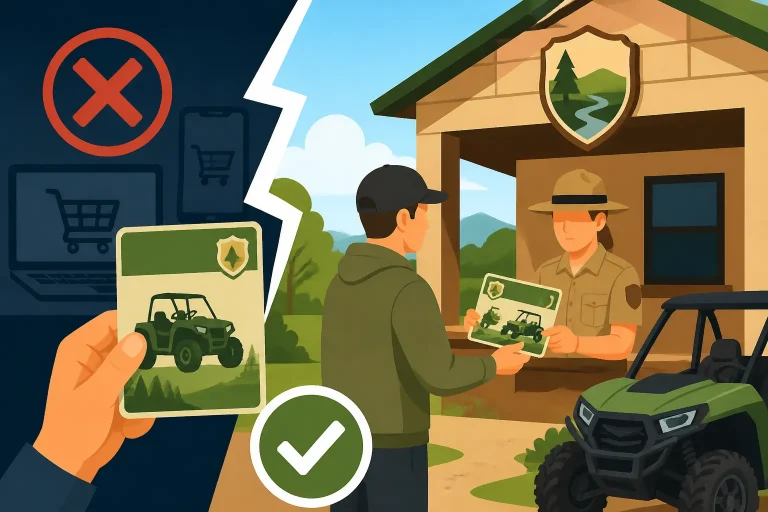
The simplest approach is to bring the paperwork relevant to your machine and confirm what the park expects. Keep any required permit or proof accessible, but remember that having documents on hand does not authorize use of a closed road or prohibited trail.
State parks are not the only riding option
A rider looking for trail riding may need a different destination. Kansas offers a mix of public riding areas, Corps-managed locations and private parks, but their rules are not interchangeable.
Some Corps areas have designated off-road areas and do not use the same state park permit system. That does not make the entire reservoir property open to riding. Follow the boundaries and rules for the specific riding area. See Why Corps Riding Areas Need No Park Permit and check current access conditions before towing a machine there.
Private parks set their own admission and operating rules. They may require a waiver, impose age or helmet rules, restrict machine size or close trails after weather. A state park permit does not replace a private park’s admission requirements, and a private park pass does not authorize riding in a state park.
If the goal is a proper trail day rather than road access within a park, compare designated riding locations using Kansas ATV Trails: Where You Can Actually Ride. Confirm the machine types allowed, hours, fees, closures and site-specific rules before leaving home. A trail being shown on an old map or mentioned in a past trip report is not proof that it is open now.
Plan the trip around permitted access
The most reliable way to avoid a permit or route problem is to decide what kind of ride you want before choosing a destination. If you need to travel on park roads to reach a facility or campsite, ask about the permit and the route. If you want to ride trails for recreation, select a place that specifically allows motorized trail use.
This distinction can save time and prevent a frustrating arrival. A state park can be a good destination for camping, fishing or boating while still offering limited access for off-road machines. A rider expecting a network of ATV trails may discover that the only permitted machine travel is on certain roads and in parking areas.
Use this planning sequence:
- Choose the purpose of the trip. Decide whether the machine is needed for local transportation within the park or whether the main activity is trail riding.
- Choose the destination that fits. For road access, investigate the park’s vehicle rules. For off-road recreation, look for a designated riding area that allows your machine type.
- Confirm the vehicle class. An ATV and a side-by-side may not be treated identically. Width, seating and vehicle design can matter under Kansas classifications. The articles Kansas Park Permit for a UTV and [Kansas Park Permit for a Golf Cart] can help frame the questions to ask.
- Verify the route and permit. Ask about the exact roads, parking areas, permit process and any operating-time limits.
- Check conditions again before departure. Confirm that the area is open and the route has not been closed.
- Carry sensible documentation. Bring whatever permit or proof the park requires, along with identification and ownership papers appropriate to your situation.
- Follow signs at the site. Do not use a route just because it was open on a prior visit or appears on a general-purpose map.
A map can help with planning, but it is not an authorization document. A printed map or offline copy is useful when cell service is weak; a waterproof map case, available from outdoor retailers including Amazon, can keep paper directions readable. Still, rely on the park’s current instructions for access.
Common assumptions that lead riders astray
Several misunderstandings recur because “permit,” “road” and “trail” can sound broader than they are.
- “I have a permit, so I can ride anywhere in the park.” No. A permit does not override route limits, closures or signs.
- “The trail is beside an open road, so it must be open to my ATV.” No. The trail may be restricted to nonmotorized use.
- “My home-state sticker should work in Kansas.” Don’t assume reciprocity. Check Kansas requirements and the destination’s rules.
- “There is no statewide OHV trail permit, so I don’t need to check permits.” That confuses a statewide trail pass with permits for particular properties or uses.
- “If I can drive my UTV on a city street, I can use it on every park road.” Street access and park access are separate questions.
- “A road is visible on the map, so it is open to machines.” A map may show a road without establishing its permitted vehicle use.
These assumptions can lead to unnecessary fees, a wasted trip or a citation. The better habit is to identify the exact property, machine and intended route, then verify all three together.
What to do if the rules are unclear
When park information does not answer a specific question, contact the park office before unloading. Ask for an answer tied to the machine and route, rather than a general description of vehicle access. If there is a gate, sign or temporary closure at the site, treat it as controlling unless park staff clarify otherwise.
Keep a record of the information you receive, including the date, the office contacted and the route discussed. This is not a substitute for current signs or official requirements, but it can help you remember what was confirmed and where. If staff tell you to stay on a particular route, follow that route rather than relying on a different interpretation of the map.
If your planned route is not open to machines, choose an alternative before the trip. You might use the park for activities that do not require riding, or travel to an established riding area with authorized trails. Do not try to negotiate an informal shortcut with another visitor or assume that low traffic means an area is unrestricted.
A quick checklist can make the decision clear:
- Is the destination a Kansas state park, wildlife area, Corps area or private park?
- What exact type of machine are you bringing?
- Is the intended use travel on a road, parking, or recreational trail riding?
- Does the location require a permit for that vehicle and use?
- Is the specific route open, and are there time restrictions?
- Does an out-of-state sticker actually satisfy the local requirement?
- Have you checked for closures and posted restrictions?
If one of those answers is unknown, resolve it before riding. That is especially important when taking a machine across state lines, because a permit or registration routine that works at home may not apply in Kansas.
Ultimately, “machines kept to roads and parking areas” is a practical boundary: authorized road use does not equal open access to park land. Confirm the permit, follow the designated route, and choose a purpose-built riding area when you want trails.
Frequently Asked Questions
Does a Kansas park permit let me ride ATV trails?
No. A permit for eligible use on park roads should not be treated as access to trails. Ride only where motorized use is expressly allowed.
Can I ride from a campsite to a boat ramp?
Possibly, if the route is open to your machine and the required permit is in place. Confirm the specific road and access conditions with the park.
Does an out-of-state OHV sticker replace a Kansas park permit?
Do not assume it does. Check the Kansas requirement and ask the particular park what it accepts.
Is the same permit rule used at Corps areas and private parks?
Not necessarily. Corps locations and private parks have their own rules. Confirm requirements with the specific site before traveling.
Disclaimer
This article is for general informational purposes only and does not constitute professional advice. Laws, prices and regulations vary by location and change over time. Consult a qualified professional for guidance on your specific situation.